Key Highlights
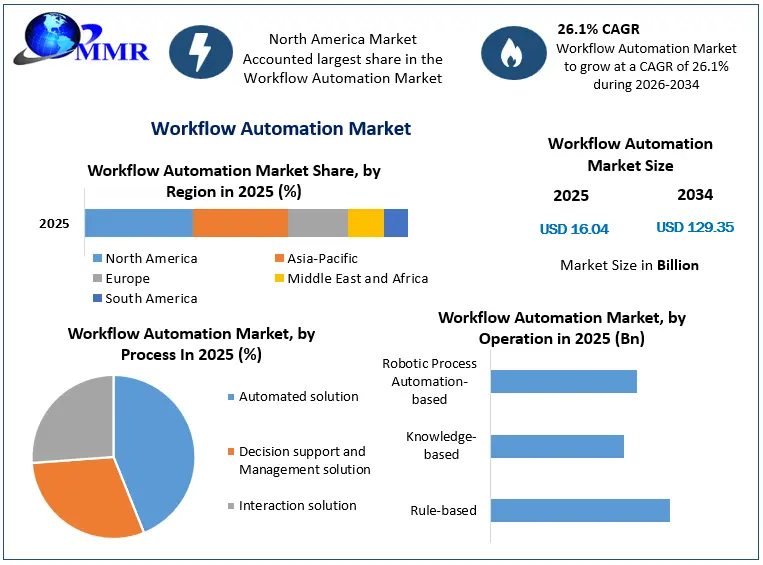
- Enterprise work is moving from manual task management to AI-orchestrated execution, and the companies that automate fastest will reset productivity benchmarks. The Workflow Automation Market was valued at USD 16.04 Bn in 2025 and is expected to reach USD 129.35 Bn by 2034, creating a large enterprise software opportunity for automation platforms, cloud vendors and systems integrators.
- The Workflow automation market is forecast to grow at a 26.1% CAGR from 2026 to 2034, showing that workflow automation has shifted from back-office efficiency to core digital transformation infrastructure.
- Robotic process automation-based operations are expected to grow at a 33.6% CAGR, giving AI-linked software robots the strongest disclosed segment growth signal.
- North America held the dominant position in 2025, supported by established BFSI, telecom and IT, travel, hospitality and transportation industries in the United States and Canada.
- Recent developments show a clear pivot toward agentic workflows, AI-driven modernization, governed automation, case management and automated threat response.
Why This Matters Now
Workflow automation has become the operating system for enterprise productivity. CIOs and CTOs are no longer buying automation only to remove repetitive tasks; they are using it to modernize legacy systems, coordinate complex work and control risk across business functions.
The public MMR page supports AI integration, robotic process automation, cloud deployment, business process automation, data management and cybersecurity-linked workflow response. It does not disclose data center investments, 5G deployment trends, edge computing adoption, telecom infrastructure expansion values or named network modernization investments.
Market Overview
Workflow automation is a series of automated actions in a business process used to improve business performance. Organizations are adopting workflow automation to streamline processes, reduce human intervention and manage business records more efficiently.
The Workflow automation market is segmented by offering into software and services; by process into automated solution, decision support and management solution, and interaction solution; by operation into rule-based, knowledge-based and robotic process automation-based; by deployment into cloud and on-premise; and by vertical into BFSI, telecom and IT, travel, hospitality and transportation, retail and consumer goods, manufacturing and logistics, healthcare and pharmaceuticals, energy and utilities, government and academics.
The public page contains a visible header-panel inconsistency: the top panel lists USD 16.04 Bn as forecast market size, while the overview and scope table state USD 16.04 Bn in 2025 and USD 129.35 Bn by 2034. This article uses the overview and scope-table values because they match the supplied market-size statement.
Key Trends Driving Growth
Digital transformation is the primary driver. MMR states that business sectors have experienced ground-level changes and embraced innovative technologies, pushing organizations to adopt workflow automation to streamline business processes.
Software demand is rising because organizations need structured data formats and record-keeping systems. Workflow automation software uses optical character recognition and optical mark recognition, helping companies eliminate mundane business processes and reduce human intervention.
AI and RPA are changing the automation stack. RPA-based operations are growing because enterprises need business process automation with artificial intelligence and software robots for faster implementation, execution and scaling.
Cloud deployment is part of the market scope, but the public page does not disclose cloud share, cloud CAGR or cloud migration deal values. The supported cloud story is deployment optionality rather than quantified cloud migration activity.
Data insecurity remains the main restraint. As workflow systems move deeper into enterprise processes, security, governance and automated response will determine whether buyers scale automation across regulated operations.
Request an Exclusive Sample for In-Depth Market Analysis
Segment Insights
- Dominant Segment: The public page states that software is expected to contribute a significant share and BFSI held market share, but the exact percentages are shown as “xx%.” No offering or vertical dominance is inferred beyond the disclosed regional leadership of North America.
- Fastest-Growing Segment Robotic Process Automation-Based Operation: RPA-based operations are expected to grow at a 33.6% CAGR, the strongest disclosed segment growth rate on the public page. This signals rising demand for AI-enabled software robots and scalable enterprise automation.
- High-Value Segment Software: Software demand is linked to structured data formats, OCR, OMR, business-process records and reduction of manual work.
- Process Signal Automated Solution: Automated solutions are expected to grow because of flexibility, scalability and large-scale deployment in data management systems, but the exact CAGR is not disclosed.
- Vertical Signal BFSI: BFSI demand is driven by data entry for clearance and registration, system updates, client information production and information gathering across systems.
Regional Growth Story
North America held the dominant position in 2025. The region benefits from established BFSI, telecom and IT, travel, hospitality and transportation industries in developed countries such as the United States and Canada.
The United States is the strongest disclosed country signal because regional demand is tied to mature enterprise sectors and adoption of workflow automation for better business-process management. The page does not disclose U.S. market size, cloud spending, AI deployment values or cybersecurity investment values.
Asia Pacific is expected to grow during the forecast period, supported by rapid expansion of end-user industries and macroeconomic forces in emerging countries. The report covers China, India, Japan, South Korea, Australia and ASEAN, but country-level revenues, telecom modernization metrics and data center investments are not disclosed.
Europe covers the UK, France, Germany, Italy, Spain, Sweden, Austria, Turkey and Russia. The public page does not disclose regional regulatory influences, digital sovereignty programs or country-level enterprise automation spending.
Competitive Landscape
Key players include Software AG, Xerox, Appian, Bizagi, Ipsoft, Newgen Software Technologies, Nintex, IBM, Oracle, Pegasystems, OpenText, TIBCO, UiPath, Sourcecode Technology Holdings, Thoughtonomy, Tiikr and Attila. The market combines automation software firms, enterprise software companies, RPA platforms and business process technology vendors.
Competition is moving toward AI orchestration and platform control. UiPath’s Maestro Case and coding-agent capabilities signal a shift from task automation to agentic case management, governed AI-generated automation and enterprise-scale coordination of unstructured work.
HCLTech and Pegasystems expanding collaboration to integrate HCLTech AI Force with Pega Blueprint signals a modernization battle around legacy transformation. Vendors that automate discovery and transformation can capture enterprise budgets tied to technical debt reduction and operational efficiency.
UiPath’s integration with Microsoft Defender and Sentinel shows cybersecurity is becoming part of workflow automation architecture. Automated threat response inside business workflows raises the bar for vendors that still treat security as an external control layer.
Recent Developments
- 25 May 2026 HCLTech and Pegasystems: The companies expanded collaboration to integrate HCLTech AI Force with Pega Blueprint, accelerating legacy system modernization through automated discovery and transformation.
- 15 May 2026 UiPath: UiPath launched Maestro Case for agentic case management and AI-driven workflows, targeting coordination failures in complex enterprise work.
- 12 May 2026 UiPath: UiPath introduced UiPath for Coding Agents to turn AI-generated code into governed automation, supporting reliable, secure and scalable workflows.
- 28 April 2026 Appian: Appian highlighted Innovation Award winners using “Serious AI” in enterprise workflows, including FAA and Regeneron case studies focused on reduced cycle times and operational risk.
- 18 March 2026 UiPath: UiPath integrated its platform with Microsoft Defender and Sentinel, enabling automated threat responses within business workflows.
- 19 November 2025 UiPath: UiPath 2025.10 introduced enhanced Case Management and process orchestration features to improve visibility, control and productivity.
Strategic Implications
For CIOs and CTOs, workflow automation is now a modernization lever. The strongest business case is not only labor reduction; it is faster execution, cleaner data movement, reduced operational friction and better control of complex processes.
For telecom and IT leaders, automation can improve service delivery, data handling and internal process management. The report lists telecom and IT as a covered vertical, but does not disclose telecom-specific revenue, 5G-linked automation demand or network virtualization metrics.
For investors, the market offers exposure to AI workflows, RPA, business process automation, cloud and on-premise deployment, enterprise software modernization and cybersecurity-linked automation. The key risk is data insecurity, which can slow adoption if vendors cannot prove governance, control and security.
Future Outlook
The Workflow Automation Market is forecast to grow from USD 16.04 Bn in 2025 to USD 129.35 Bn by 2034 at a 26.1% CAGR. Growth will come from AI-integrated RPA, automated solutions, workflow software, structured data management, BFSI process automation, telecom and IT adoption, cloud and on-premise deployment, and enterprise pressure to scale productivity.
The next phase will test whether automation platforms can coordinate people, software robots, AI agents and security controls inside one governed operating layer. Future digital leaders will control the AI workflow fabric behind enterprise execution; laggards will remain trapped in disconnected processes while competitors automate decisions, work and risk response at scale.
Analyst Perspective
“Workflow automation is becoming a strategic enterprise software market as organizations move from task automation to AI-enabled process orchestration,” said Yash Ghosalkar, Analyst at Maximize Market Research. “The strongest providers will combine RPA, governed AI, workflow visibility, security integration, cloud deployment and vertical process expertise.”
About Maximize Market Research
Maximize Market Research Pvt. Ltd. (MMR) is a global market research and consulting company that provides reliable, data-focused, and practical business insights. The firm serves a wide range of industries, including healthcare, pharmaceuticals, technology, automotive, electronics, chemicals, personal care, and consumer goods. Through market forecasts, competitive analysis, strategic consulting, and industry impact assessments, MMR helps organizations understand changing market conditions, identify growth opportunities, and make informed business decisions for long-term success.
Contact Us
2nd Floor, Navale IT Park Phase 3
Pune Banglore Highway, Narhe
Pune, Maharashtra 411041, India
+91 9607365656
sales@maximizemarketresearch.com
