Key Highlights
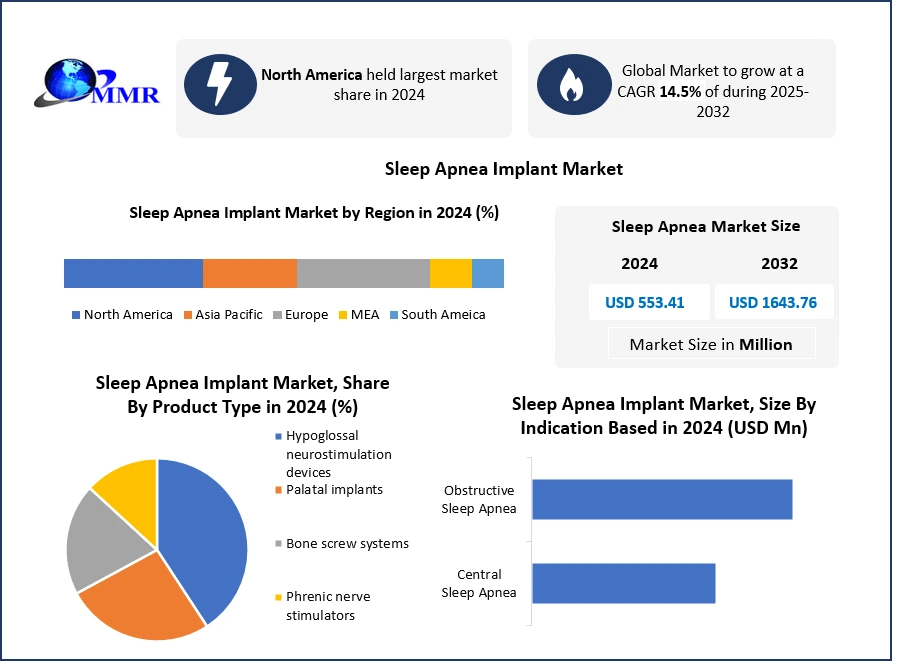
- The global Sleep Apnea Implants Market was valued at USD 556.41 million in 2024.
- Market revenue is projected to reach nearly USD 1,643.76 million by 2032.
- The market is expected to grow at a CAGR of 14.5% from 2025 to 2032.
- The forecast indicates that market revenue is expected to nearly triple over the forecast period.
- The supplied report information does not specify a dominant segment, fastest-growing segment, leading region, named competitors, approvals, launches, acquisitions or reimbursement developments.
- The market is positioned within the broader need for long-term sleep apnea management and implantable treatment options.
Why This Matters Now
Healthcare providers, device manufacturers and payers are facing a faster-growing market for implantable sleep apnea treatment. The Sleep Apnea Implants Market Size is projected to increase from USD 556.41 million in 2024 to nearly USD 1,643.76 million by 2032, making implant-based therapy a larger strategic category in respiratory and sleep-health care.
The expected 14.5% CAGR from 2025 to 2032 matters because it points to demand rising faster than many established medical-device categories. For hospitals and sleep-care providers, this can increase the need for implant evaluation, procedure capacity, patient follow-up and long-term therapy management.
For device companies, the forecast creates a clear commercial signal. A market approaching USD 1.64 billion by 2032 can justify investment in product development, clinical evidence, physician education and patient-support models. For payers, it raises a separate question: how should long-term implant treatment be assessed against other sleep apnea care pathways?
Market Overview
The Sleep Apnea Implants Market covers implantable solutions used in sleep apnea management. These products sit at the intersection of medical devices, sleep medicine, respiratory care and hospital-based treatment.
Sleep apnea can require ongoing management. The market’s projected growth shows that implantable options are gaining commercial importance within the wider treatment landscape. The supplied report data does not provide prevalence figures, disease subtype data, patient population estimates or treatment-adoption rates. Those details are therefore not included here.
The market’s value of USD 556.41 million in 2024 establishes a meaningful starting point for manufacturers and healthcare providers. The projected increase to nearly USD 1,643.76 million by 2032 indicates that demand for implantable solutions is expected to expand materially during the forecast period.
That revenue growth has operational implications. Hospitals and specialist providers may need to consider procedure pathways, clinician training, patient screening and post-procedure monitoring as implant volumes increase. Medical-device companies may need to scale commercial infrastructure while building evidence that supports clinical and economic decision-making.
Key Trends Driving Growth
The main measurable trend is strong market expansion. The Sleep Apnea Implants Market is forecast to grow at 14.5% from 2025 to 2032. This pace suggests that implantable therapies are moving into a more prominent position in the sleep apnea treatment landscape.
Growth in an implant category also changes the role of care providers. Treatment delivery can involve evaluation, implantation, follow-up and ongoing management. As demand expands, hospitals and sleep-care networks may need more coordinated pathways between sleep specialists, surgeons, respiratory clinicians and patient-support teams.
The market outlook also raises the importance of patient selection. Implantable therapies are not simply a product sale; they require a clinical pathway. Providers that can establish consistent assessment, referral and follow-up processes may be better prepared to capture demand while supporting patient outcomes.
Healthcare systems are increasingly focused on durable care models. The report does not provide specific data on digital health, telehealth, artificial intelligence, diagnostics or precision medicine in this market. These themes should not be presented as report findings. However, they remain relevant strategic questions for market participants evaluating how implant care may fit into broader sleep-health services.
The 14.5% CAGR also makes reimbursement and evidence generation commercially important. The supplied report does not specify reimbursement policies or regulatory actions. Still, device companies seeking to participate in a rapidly expanding market will need to demonstrate how their offerings fit provider workflows and payer expectations.
Request a Free Sample Report for Comprehensive Market Insights
Segment Insights
- Dominant Segment: Not specified in the supplied report — The provided report data does not identify a leading segment by product type, procedure, end user, distribution channel or sleep apnea subtype.
- Fastest-Growing Segment: Not specified in the supplied report — The supplied information does not name a segment with the highest forecast growth rate.
- Treatment Scope: Implantable Sleep Apnea Solutions — The market is defined around implantable solutions for sleep apnea management. The supplied report information does not provide further segmentation detail.
- End-User and Care-Setting Data: Not specified in the supplied report — No report-specific data was supplied on hospitals, ambulatory centers, sleep clinics, home-care settings or other treatment channels.
Regional Growth Story
The supplied report information does not identify a leading region, regional market shares or country-level growth rates. It also does not provide specific findings for the United States, Germany, the United Kingdom, China, Japan, India or South Korea.
That absence matters for strategic planning. Sleep apnea implant companies need country-level evidence before assigning commercial priorities, establishing distribution networks or making reimbursement assumptions. Market size growth at the global level does not by itself show where procedure demand, hospital capacity or payment support will be strongest.
The United States is often relevant to medical-device commercialization because of its scale and specialist care infrastructure, but the supplied report information does not provide a U.S. market share, regulatory development, reimbursement policy or treatment-adoption statistic. The same limitation applies to Germany and the United Kingdom, where healthcare delivery and payment systems can differ materially.
China, Japan, India and South Korea may offer future opportunities for sleep-health technology, but the report details provided do not establish market size, healthcare spending, regulatory shifts, hospital infrastructure or adoption patterns for these countries. Companies should not treat a global growth forecast as evidence of equal opportunity across every market.
Regional strategy will therefore depend on evidence beyond the supplied figures. The report confirms a strong global revenue outlook, but it does not provide enough country-level information to rank markets or predict regional treatment adoption.
Competitive Landscape
The supplied report information does not list market participants, product manufacturers, acquisitions, investments, launches, approvals or partnerships. No company-specific competitive claims are included in this article.
The market forecast nevertheless points to an increasingly valuable competitive field. A category expected to grow from USD 556.41 million to nearly USD 1,643.76 million can attract investment from established medical-device companies and emerging technology developers.
Competitive advantage will depend on more than implant technology. Companies will need to support clinician training, patient identification, procedural delivery, long-term follow-up and evidence development. Those capabilities can determine whether a device becomes part of a scalable treatment pathway or remains limited to isolated use.
The market’s growth rate also increases the value of commercial discipline. Companies that build a credible clinical and economic case may be better positioned to work with hospitals and payers. Those that focus only on product availability may face slower adoption if provider workflows and payment questions remain unresolved.
Recent Developments
- The supplied MMR report information does not provide report-specific acquisitions, approvals, product launches, investments or partnerships.
- The market is forecast to grow from USD 556.41 million in 2024 to nearly USD 1,643.76 million by 2032.
- The forecast CAGR of 14.5% from 2025 to 2032 signals expanding commercial interest in implantable sleep apnea management.
- No report-specific regulatory, reimbursement, digital-health or artificial-intelligence development is available in the supplied information.
Strategic Implications
Hospitals should view sleep apnea implants as a care-pathway decision, not only a device procurement decision. The market’s expected expansion may require coordinated work across sleep medicine, surgery, respiratory care and follow-up services.
Medical-device companies should prioritize clinical integration. The most important commercial question is not simply whether an implant can be sold, but whether providers can identify suitable patients, deliver the procedure efficiently and manage care over time.
Payers should evaluate the long-term value of implantable treatment within broader sleep apnea management. The supplied report does not provide reimbursement data, cost comparisons or outcomes evidence. These gaps make evidence generation essential for companies seeking broader coverage and provider adoption.
Investors should focus on execution risk as well as market growth. The 14.5% CAGR indicates substantial opportunity, but the ability to translate that growth into sustainable revenue will depend on clinical adoption, hospital capacity, patient access and payment support.
Future Outlook
The companies that turn sleep apnea implants into accessible, evidence-led and integrated care pathways will lead this market, while those that treat growth as a device-sales opportunity alone will fall behind.
Analyst Perspective
“Sleep apnea implants are emerging as an important area of the broader sleep-health treatment market. The projected growth rate shows that healthcare providers, device companies and payers will need to focus on patient access, clinical integration and long-term treatment value as the category expands,” said Komal Patil, Analyst.
About Maximize Market Research
Maximize Market Research Pvt. Ltd. (MMR) is a global market research and consulting company that provides reliable, data-focused, and practical business insights. The firm serves a wide range of industries, including healthcare, pharmaceuticals, technology, automotive, electronics, chemicals, personal care, and consumer goods. Through market forecasts, competitive analysis, strategic consulting, and industry impact assessments, MMR helps organizations understand changing market conditions, identify growth opportunities, and make informed business decisions for long-term success.
Contact Us
2nd Floor, Navale IT Park Phase 3
Pune Banglore Highway, Narhe
Pune, Maharashtra 411041, India
+91 9607365656
sales@maximizemarketresearch.com
