Key Highlights
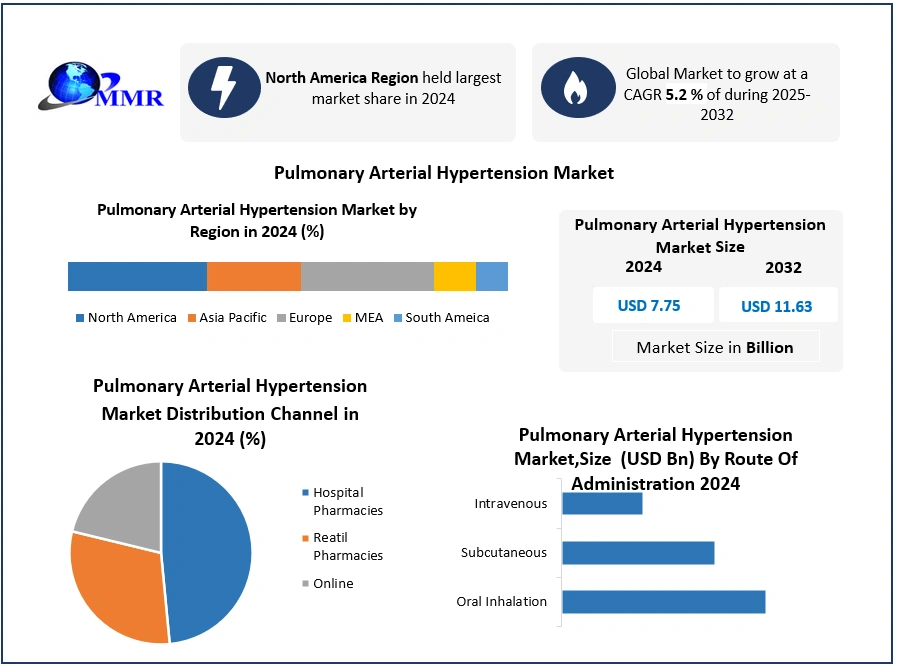
- The Pulmonary Arterial Hypertension Market was valued at USD 7.75 billion in 2024.
- Market revenue is projected to reach nearly USD 11.63 billion by 2032.
- The market is forecast to expand at a CAGR of 5.2% from 2025 to 2032.
- The outlook signals sustained demand for specialty therapies and coordinated pulmonary vascular care.
- The supplied report information does not specify dominant segments, fastest-growing segments, regional market shares, named companies, product approvals, acquisitions, launches or reimbursement developments.
- The market’s growth places greater focus on diagnosis, patient access, treatment continuity and long-term care management.
Why This Matters Now
Pulmonary arterial hypertension care is becoming a larger strategic concern for specialty providers, pharmaceutical companies and payers. The Pulmonary Arterial Hypertension Market Size is projected to grow from USD 7.75 billion in 2024 to nearly USD 11.63 billion by 2032, increasing the commercial and clinical importance of therapies designed for a complex, long-term condition.
The forecast CAGR of 5.2% from 2025 to 2032 signals durable demand rather than a short-lived treatment cycle. For hospitals and specialist networks, that means greater pressure to identify patients earlier, maintain treatment continuity and coordinate care across cardiology, pulmonology, pharmacy and outpatient services.
For pharmaceutical companies, the market expansion points to continued opportunity in specialty treatment. For payers, it raises the need to assess long-term therapy value, patient access and care models that may reduce avoidable deterioration. The supplied report does not provide prevalence, mortality, hospitalization, cost or reimbursement figures, so those details are omitted.
Market Overview
Pulmonary arterial hypertension is a form of pulmonary hypertension that affects the blood vessels in the lungs and can place increasing strain on the heart. The market includes therapies and care services used to manage pulmonary arterial hypertension.
The market was valued at USD 7.75 billion in 2024. It is expected to reach nearly USD 11.63 billion by 2032. This projected increase of almost USD 3.9 billion indicates that pulmonary arterial hypertension will remain a meaningful specialty-care and pharmaceutical category through the forecast period.
The market’s 5.2% CAGR suggests a sustained need for treatment rather than rapid replacement of existing care pathways. That matters because pulmonary arterial hypertension management can require ongoing clinical evaluation, medication access, specialist follow-up and patient support.
The supplied report information does not provide detailed segmentation by drug class, route of administration, disease type, end user, distribution channel or treatment setting. It also does not provide disease-burden data, patient demographics, diagnostic pathways or healthcare expenditure information. These details are not inferred.
Key Trends Driving Growth
The clearest market trend is continued revenue growth. The Pulmonary Arterial Hypertension Market is forecast to expand at a CAGR of 5.2% from 2025 to 2032. This growth indicates that specialty therapies and coordinated care remain commercially important as the patient population requires long-term management.
Pulmonary arterial hypertension treatment is not limited to a one-time intervention. It can involve sustained therapy, monitoring and specialist oversight. As the market grows, healthcare providers may need stronger referral systems and clearer coordination between pulmonary specialists, cardiologists, hospitals, specialty pharmacies and outpatient care teams.
The market outlook also makes patient access a strategic issue. Specialty therapies can require ongoing supply, treatment monitoring and adherence support. Companies that build reliable access and support programs may improve their position as providers and payers seek continuity of care.
Diagnostics are another important commercial consideration. Earlier identification can influence treatment planning and care coordination. The supplied report does not provide information on diagnostic technologies, artificial intelligence, telehealth, remote monitoring or precision medicine. These themes should not be treated as report-specific findings.
The same applies to regulatory and reimbursement developments. The report information supplied does not identify approvals, payment changes or coverage decisions. Yet, in a market projected to reach nearly USD 11.63 billion, evidence supporting treatment value will remain important for companies working with healthcare systems and payers.
Request a Free Sample Report for Comprehensive Market Insights
Segment Insights
- Dominant Segment: Not specified in the supplied report — The supplied report data does not identify the largest segment by therapy type, drug class, route of administration, end user, distribution channel or region.
- Fastest-Growing Segment: Not specified in the supplied report — The supplied information does not identify a segment with the highest forecast growth rate.
- Treatment Scope: Pulmonary Arterial Hypertension Care — The market is defined around therapies and care pathways for pulmonary arterial hypertension. No additional report-specific product segmentation was provided.
- Care Setting: Not specified in the supplied report — The report information does not provide separate data for hospitals, specialty clinics, home-based care, specialty pharmacies or other treatment settings.
Regional Growth Story
The supplied report information does not specify a leading region, regional revenue shares, country-level growth rates or regional treatment-adoption data. It also does not provide detailed market findings for the United States, Germany, the United Kingdom, China, Japan, India or South Korea.
This absence is material for healthcare and commercial planning. A global market forecast does not establish where pulmonary arterial hypertension diagnosis is most advanced, where specialty therapy access is strongest or where reimbursement systems are most supportive.
The United States may be important for specialty pharmaceutical commercialization and advanced cardiopulmonary care, but the supplied report does not provide U.S.-specific data on market share, regulatory developments, reimbursement, healthcare spending or patient access. The same limitation applies to Germany and the United Kingdom, where national health systems and specialty-drug funding can affect treatment pathways.
China, Japan, India and South Korea may offer growth opportunities as specialty care capacity expands, but the supplied information does not provide country-specific evidence on diagnosis rates, hospital infrastructure, therapy adoption or regulatory activity. No country should be ranked based on the global forecast alone.
Companies evaluating regional expansion will need market-specific evidence before setting launch priorities, pricing approaches or distribution models. The report confirms global growth but does not provide enough regional detail to identify market leaders or forecast country-level demand.
Competitive Landscape
The supplied report information does not list market participants, product manufacturers, acquisitions, partnerships, investments, launches, approvals or clinical developments. No company-specific claims are included in this article.
The market forecast still signals a competitive specialty-pharma environment. A market expected to grow from USD 7.75 billion to nearly USD 11.63 billion can attract investment in therapy development, patient-support services, distribution capabilities and clinical evidence.
Competitive advantage will depend on more than product availability. Companies will need to support physician education, patient identification, therapy persistence and coordination with specialty pharmacies. These factors can shape access and commercial performance in a long-term treatment market.
The projected 5.2% CAGR also increases the importance of demonstrating value. Providers and payers will need evidence that therapies fit practical care pathways and support meaningful patient management. The supplied report does not provide outcomes data, comparative effectiveness studies or cost-effectiveness findings, so no such claims are made.
Recent Developments
- The supplied MMR report information does not provide report-specific acquisitions, approvals, product launches, investments, partnerships or clinical-trial updates.
- The Pulmonary Arterial Hypertension Market was valued at USD 7.75 billion in 2024.
- The market is projected to reach nearly USD 11.63 billion by 2032.
- The forecast CAGR of 5.2% from 2025 to 2032 indicates sustained demand for pulmonary arterial hypertension therapies and specialist care.
- No report-specific reimbursement, regulatory, telehealth, artificial-intelligence or precision-medicine developments were included in the supplied information.
Strategic Implications
Hospitals and specialist providers should treat pulmonary arterial hypertension as a coordinated-care challenge. As the market expands, the ability to connect diagnosis, treatment initiation, medication access and follow-up can become a meaningful differentiator.
Pharmaceutical companies should focus on the full treatment journey. In a long-term specialty market, commercial success can depend on patient support, clinician confidence and consistent therapy access as much as on the treatment itself.
Payers should assess how coverage design affects continuity of care. The supplied report does not provide reimbursement data, but the market’s projected growth indicates that treatment access will remain a central issue for patients and providers.
Investors should weigh the market’s steady growth against execution requirements. The opportunity is meaningful, but companies will need robust clinical, regulatory, commercial and patient-support capabilities to convert market expansion into durable revenue.
Future Outlook
The future leaders in the Pulmonary Arterial Hypertension Market will be those that make specialty therapy more accessible, coordinated and evidence-led, while laggards will be constrained by fragmented patient pathways and weak treatment support.
Analyst Perspective
“Pulmonary arterial hypertension remains an important specialty-care market because patients require sustained treatment and coordinated clinical management. The market’s growth outlook shows that healthcare providers, pharmaceutical companies and payers will need to focus on access, continuity of care and long-term treatment value,” said Komal Patil, Analyst.
About Maximize Market Research
Maximize Market Research Pvt. Ltd. (MMR) is a global market research and consulting company that provides reliable, data-focused, and practical business insights. The firm serves a wide range of industries, including healthcare, pharmaceuticals, technology, automotive, electronics, chemicals, personal care, and consumer goods. Through market forecasts, competitive analysis, strategic consulting, and industry impact assessments, MMR helps organizations understand changing market conditions, identify growth opportunities, and make informed business decisions for long-term success.
Contact Us
2nd Floor, Navale IT Park Phase 3
Pune Banglore Highway, Narhe
Pune, Maharashtra 411041, India
+91 9607365656
sales@maximizemarketresearch.com
