Key Highlights
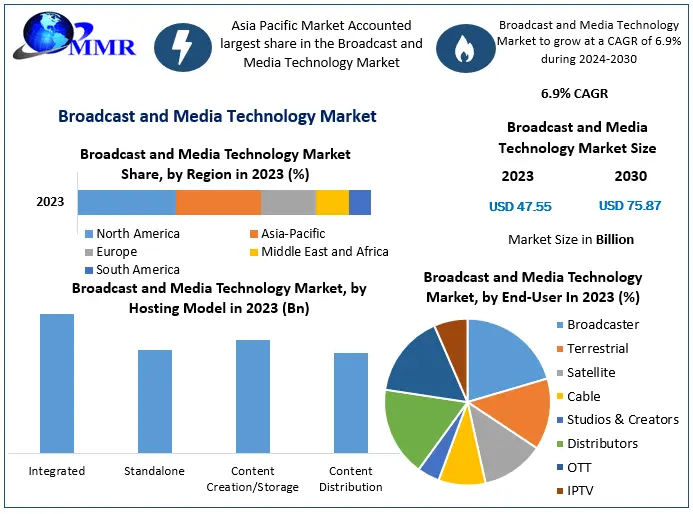
- Media companies are being forced to rebuild broadcast stacks for mobile-first viewing, UHD content and platform-based distribution. The Broadcast and Media Technology Market was valued at US$ 47.55 Bn in 2023 and is expected to reach nearly US$ 75.87 Bn by 2030, creating a measurable opportunity for broadcast software, cloud media systems, storage providers and OTT technology vendors.
- The Broadcast and Media Technology Market is forecast to grow at a 6.9% CAGR from 2024 to 2030, linking demand to multi-platform content delivery, digital video broadcasting and higher-quality video formats.
- Asia Pacific held the highest share in 2023, supported by digital channels, digital broadcasting transition and growing awareness of platforms such as Netflix, Amazon Prime and Hotstar.
- AI is identified as an opportunity for automating routine workflows, audience insights, advertising, content licensing and customer retention.
- The public page does not disclose dominant segment, fastest-growing segment, cybersecurity developments, data center investments, cloud migration values, edge computing adoption or named recent deals.
Why This Matters Now
Broadcast is no longer a linear transmission business. Mobile screens, OTT platforms, IPTV, digital asset workflows and high-resolution video have made media delivery a software and network-performance problem.
For CIOs, CTOs and telecom operators, the investment question is shifting from studio hardware to integrated content creation, storage, distribution, audience data and monetization systems. MMR identifies multi-platform content delivery, digital video broadcasting and UHD, 4K, 8K and 32K video as core drivers of broadcast and media technology demand.
Market Overview
Broadcast and Media Technology Market includes software, on-premise and cloud systems, services, consulting, support and maintenance, managed services, web content management, content storage, editorial and print workflow, media and digital asset management, revenue management, ad and data management, and user management.
The Broadcast and Media Technology Market also covers integrated and standalone hosting models, content creation and storage, content distribution, broadcasters, terrestrial, satellite, cable, studios and creators, distributors, OTT and IPTV. That makes the market a full-stack media infrastructure category rather than a narrow broadcast-equipment segment.
The public page contains a header inconsistency: the top panel lists US$ 47.55 Bn as forecast market size, while the overview and scope table state US$ 47.55 Bn in 2023 and US$ 75.87 Bn by 2030. This article uses the overview and scope-table values because they match the supplied market-size statement.
Key Trends Driving Growth
Multi-platform delivery is the first growth driver. Viewers now move across satellite, cable, on-demand platforms and mobile devices, forcing broadcasters to support content workflows that can serve several formats and endpoints.
High-resolution video is the second driver. MMR identifies UHD, 4K, 8K and 32K resolution as technologies increasing acceptance of advanced broadcast and media systems, which raises demand for better processing, storage and distribution capabilities.
AI is becoming a workflow and monetization lever. The report states that AI can automate routine workflows, improve audience insights, support advertising and content licensing, and turn audience data into customer retention campaigns.
5G is a regional disruption signal. MMR states that recent 5G network infrastructure is expected to disrupt the broadcast and media technology landscape in Asia Pacific, especially as digital platforms gain visibility in China and other regional markets.
Regulation remains a constraint and a market-shaping force. Different countries have different content and broadcasting rules, many markets use permit or licensing systems for video streaming, and prescription-drug advertising rules differ between Europe and the United States.
Start Your Market Research Journey with a Free Sample Report
Segment Insights
- Dominant Segment: The public MMR page does not identify a dominant component, solution, hosting model or end-user segment by share. No segment dominance is inferred.
- Fastest-Growing Segment: The page does not provide usable CAGRs by component, solution, hosting model or end user. No fastest-growing segment is inferred.
- Component Scope Software and Services: Software includes on-premise and cloud, while services include consulting, support and maintenance, and managed services. Segment-level values are not disclosed.
- Solution Scope Content and Monetization Systems: Web content management, content storage, editorial and print workflow, media and digital asset management, revenue management, ad and data management, and user management are included.
- End-User Scope Broadcasters, Studios, OTT and IPTV: Broadcasters, terrestrial, satellite, cable, studios and creators, distributors, OTT and IPTV are covered, but the public page does not rank them by share.
Regional Growth Story
Asia Pacific held the highest share in 2023. The region’s lead is tied to more digital channels, rapid transition toward digital broadcasting and rising awareness of digital platforms such as Netflix, Amazon Prime and Hotstar.
China is a central regional technology signal. MMR states that Baidu, Tencent and Netflix have implemented innovative technologies to enhance user experience, while 5G infrastructure is expected to reshape the regional broadcast and media technology landscape.
The report covers China, South Korea, Japan, India, Australia, Indonesia, Malaysia, Vietnam, Taiwan, Bangladesh and Pakistan in Asia Pacific. It also covers the United States, Canada and Mexico in North America and the UK, France, Germany, Italy, Spain, Sweden and Austria in Europe, but country-level revenues are not disclosed.
The public page does not disclose data center investments, edge computing deployment, cloud migration values, telecom network modernization spending or digital sovereignty initiatives by country. The strongest supported regional themes are digital broadcasting, platform adoption, mobile viewing and 5G-driven disruption in Asia Pacific.
Competitive Landscape
Key players include Dell, Quantum Corporation, IBM, Harmonic, Video Stream Networks, WideOrbit, Grass Valley, AVI Systems, Evertz Technologies, Rohde & Schwarz, Eletec Broadcast Telecom, Clyde Broadcast, Sencore, EVS Broadcast Equipment, ACORDE Technologies and ETL Systems.
The competitive field spans storage, enterprise technology, broadcast equipment, automation, media workflow, transmission and professional AV. This mix shows that broadcast technology competition is moving toward integrated platforms that combine content storage, asset management, distribution and monetization.
Dell, IBM and Quantum signal demand for enterprise-grade infrastructure and storage. Harmonic, Grass Valley, Evertz, Rohde & Schwarz and EVS signal the production, transmission and broadcast-equipment layer where quality, reliability and workflow integration affect pricing power.
WideOrbit’s presence points to ad and revenue workflow relevance. As AI-supported audience insights become more important, vendors that connect content delivery with ad data, user management and retention systems can move closer to platform economics.
Recent Developments
- AI Workflow Opportunity: AI is identified as an opportunity to automate routine workflows and improve audience insight, advertising, content licensing and retention campaigns.
- 5G Infrastructure Signal: Recent 5G network infrastructure is expected to disrupt the broadcast and media technology landscape in Asia Pacific.
- Digital Broadcasting Transition: The industry is moving from analog to digital transmission, and service providers are working to reduce content transmission costs while improving quality and processing.
- No Named Dated Deals Disclosed: The public page does not disclose specific acquisitions, partnerships, platform launches, data center investments, cybersecurity projects or cloud migration deals.
Strategic Implications
For CIOs and CTOs, broadcast modernization requires integrated software, storage and workflow architecture. Fragmented tools will struggle as content must move across live broadcast, OTT, IPTV, mobile and digital platforms.
For telecom operators, 5G can become a media-distribution advantage. The source does not quantify 5G deployments, but it identifies 5G infrastructure as disruptive for broadcast and media technology in Asia Pacific.
For investors, the market offers exposure to AI-enabled media workflows, UHD video, digital broadcasting, OTT, IPTV, media asset management, content storage and ad data systems. The main diligence gaps are missing segment shares, missing fastest-growth data, and limited disclosure on cybersecurity, cloud migration and data center investment.
Future Outlook
The Broadcast and Media Technology Market is forecast to grow from US$ 47.55 Bn in 2023 to nearly US$ 75.87 Bn by 2030 at a 6.9% CAGR. Growth will come from digital broadcasting, multi-platform content delivery, UHD video, 4K, 8K, 32K resolution, mobile viewing, OTT, IPTV, AI workflows and 5G-enabled media delivery.
The next phase will test whether media companies can turn broadcast infrastructure into a software-defined, data-driven delivery platform. Future digital leaders will control AI-assisted content workflows, mobile distribution and audience data loops; laggards will remain tied to legacy transmission models while viewers and advertisers move to platform-native media ecosystems.
Analyst Perspective
“Broadcast and media technology is becoming a strategic digital infrastructure market as content moves across mobile, OTT, IPTV and high-resolution formats,” said Yash Ghosalkar, Analyst at Maximize Market Research. “The strongest providers will combine AI workflow automation, digital asset management, high-quality transmission, ad data systems and 5G-ready distribution capability.”
About Maximize Market Research
Maximize Market Research Pvt. Ltd. (MMR) is a global market research and consulting company that provides reliable, data-focused, and practical business insights. The firm serves a wide range of industries, including healthcare, pharmaceuticals, technology, automotive, electronics, chemicals, personal care, and consumer goods. Through market forecasts, competitive analysis, strategic consulting, and industry impact assessments, MMR helps organizations understand changing market conditions, identify growth opportunities, and make informed business decisions for long-term success.
Contact Us
2nd Floor, Navale IT Park Phase 3
Pune Banglore Highway, Narhe
Pune, Maharashtra 411041, India
+91 9607365656
sales@maximizemarketresearch.com
