Key Highlights
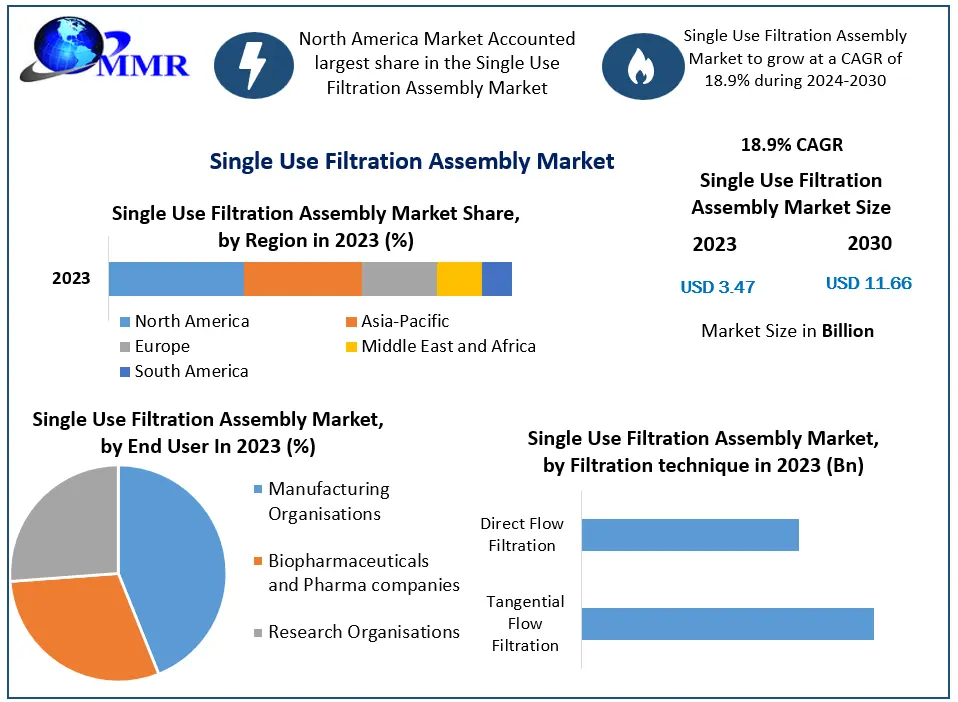
- The global Single Use Filtration Assembly Market was valued at USD 3.47 billion in 2023 and is projected to reach USD 11.66 billion by 2030.
- The market is expected to expand at a CAGR of 18.9% from 2024 to 2030.
- North America held 37.5% of the market, supported by biotechnology investment and established life sciences manufacturing.
- Filters represented the dominant product category, accounting for nearly 40% of market share.
- Filtration was the largest application, while cell culture recorded the highest CAGR.
- Biopharmaceutical and pharmaceutical companies were the largest end users.
- Asia Pacific is forecast to grow at the fastest rate, led by China, Japan, South Korea, India and Singapore.
Why This Matters Now
Biopharmaceutical manufacturers are facing a capacity challenge. They need to increase output, shorten production cycles and reduce contamination risk without committing to large-scale stainless-steel infrastructure.
The Single Use Filtration Assembly Market Size is becoming central to that shift. Valued at USD 3.47 billion in 2023, the market is expected to reach USD 11.66 billion by 2030 at an 18.9% CAGR. That growth signals a structural move toward flexible, ready-to-use filtration systems across biologics production, cell culture and pharmaceutical manufacturing.
For healthcare providers, this matters because faster and more reliable manufacturing can support medicine availability. For pharmaceutical and biotech companies, it changes the economics of capacity expansion. For investors, it points to a supply-chain segment positioned between bioprocess innovation and commercial-scale drug production.
Market Overview
Single-use filtration assemblies are ready-to-use, customer-specific systems built from components such as filters, cartridges, membranes, cassettes and manifolds. They are designed to replace or complement conventional reusable filtration systems in manufacturing environments where sterility, speed and process consistency are critical.
The core commercial advantage is operational efficiency. Single-use systems eliminate the cleaning, validation and sterilization requirements associated with reusable stainless-steel equipment. That can reduce downtime, lower water and energy consumption, and help manufacturers limit cross-contamination risk.
The market’s projected rise from USD 3.47 billion in 2023 to USD 11.66 billion by 2030 indicates that manufacturers are treating disposable filtration as a capacity strategy rather than a niche equipment purchase. The shift benefits companies that can supply reliable, compatible and scalable assemblies while maintaining quality consistency across production batches.
Key Trends Driving Growth
The strongest demand driver is faster manufacturing changeover. Biopharmaceutical companies need production systems that can adapt to different batches, therapies and process volumes without extensive equipment cleaning or revalidation. Single-use filtration assemblies allow manufacturers to integrate filtration components into existing processes with less disruption.
Contamination control is also increasing the value of disposable systems. Single-use assemblies provide a contamination-free alternative to conventional stainless-steel equipment, which is important in pharmaceutical and biotechnology production where process reliability can influence product quality and production schedules.
Sustainability is becoming a commercial consideration. The report identifies reduced water and energy use as a benefit because single-use systems remove cleaning and sterilization steps. Manufacturers must still manage disposal requirements, but lower utility demand can improve the operating case for facilities focused on resource efficiency.
Technology development is widening the addressable market. Advances in materials science, filtration technology and manufacturing processes are expected to improve durability, compatibility and filtration performance. The report also identifies 3D printing as a potential enabler of more customized assembly designs, which could help suppliers serve specialized bioprocessing requirements.
Request a Free Sample Report for Comprehensive Market Insights
Segment Insights
- Dominant Product Segment: Filters — Filters held nearly 40% of the market. Their leading position shows that core filtration performance remains the primary purchasing priority for biopharmaceutical and pharmaceutical manufacturers.
- Fastest-Growing Application Segment: Cell Culture — Cell culture recorded the highest CAGR. This creates a direct opportunity for suppliers that can support scalable, sterile workflows used in biotechnology research and production.
- Largest Application Segment: Filtration — Filtration was the most widely used application. Demand is anchored in the need to remove contaminants and maintain process quality across manufacturing workflows.
- Largest End-User Segment: Biopharmaceutical and Pharmaceutical Companies — These companies held the highest market share because they are the principal buyers of single-use filtration assemblies. Their procurement decisions will shape product standards, supply-chain expectations and innovation priorities.
- Filtration Techniques: TFF and DFF — Tangential Flow Filtration and Direct Flow Filtration address different process requirements. TFF uses flow parallel to a membrane surface, while DFF traps particles within a porous medium.
Regional Growth Story
North America leads the global market, accounting for around 37.5% of total demand. The United States is the largest contributor, supported by major life sciences companies, research investment and established biotechnology manufacturing activity. North America’s position makes it the most important commercial market for suppliers seeking scale, but it also raises the competitive threshold for quality, supply reliability and technical support.
Investment activity is reinforcing this lead. Pall Corporation and Cytiva invested USD 1.5 billion to meet rising demand for biotechnology solutions. The investment signals that filtration capacity is becoming a strategic production asset, not simply an equipment category. It also raises pressure on competitors to expand manufacturing capability and strengthen customer partnerships.
Europe remains a significant market, supported by established pharmaceutical and biotechnology industries, strict regulatory frameworks and a strong focus on product quality and safety. Germany leads regional manufacturing capability, while the UK and France benefit from developed healthcare infrastructure. Switzerland also strengthens demand through its pharmaceutical and life sciences presence.
Asia Pacific is expected to record the highest CAGR among the five regions. China, Japan, South Korea, India and Singapore are identified as key contributors. The region’s growth is linked to population expansion, higher demand, technology development and increasing investment in healthcare and pharmaceutical infrastructure.
China leads the Asia Pacific market and is among the world’s largest pharmaceutical markets. Japan and South Korea offer advanced technology capabilities, while India’s expanding healthcare and pharmaceutical ecosystem supports future demand. For suppliers, Asia Pacific presents the strongest growth runway, but success will depend on local manufacturing access, distribution strength and the ability to manage supply-chain complexity.
Competitive Landscape
The market includes major filtration, life sciences and industrial technology companies. Key players include MilliporeSigma, Sartorius AG, Merck KGaA, Saint-Gobain Performance Plastics, GE Healthcare, Thermo Fisher Scientific, 3M, Pall Corporation, Parker Hannifin Corporation, Meissner Filtration Products, Repligen Corporation, Danaher Corporation and Cytiva.
Competition is increasingly defined by system compatibility, product consistency and customer-specific design. Buyers need assemblies that can perform reliably across different chemicals, process fluids, pressure conditions and temperature requirements. Suppliers that provide technical validation support and dependable delivery will have an advantage as customers reduce supplier risk.
The report also points to acquisitions, collaborations and capacity expansion as current market trends. These moves signal a race to broaden product portfolios, secure manufacturing capacity and capture a larger share of the biotechnology value chain. They may also accelerate standardization, which is important because consistent product quality can build buyer confidence and increase adoption.
Recent Developments
- Thermo Fisher launched its largest single-use technology manufacturing facility in Greater Nashville to accelerate production of single-use technology products.
- Pall Corporation and Cytiva invested USD 1.5 billion to address growing demand for biotechnology solutions.
- Manufacturers are focusing on durability, compatibility and improved filtration capabilities through materials and filtration technology development.
- Industry participants are pursuing acquisitions and collaborations to expand their total addressable market.
- Standardization is gaining importance as suppliers seek to improve product consistency and customer trust.
Strategic Implications
The market’s growth rate creates a clear mandate for biopharmaceutical manufacturers. Companies that continue to rely only on reusable systems may face slower changeovers, higher cleaning requirements and less flexibility when production needs shift.
For suppliers, supply-chain resilience is a major differentiator. The report identifies procurement changes, inventory control, lead times and potential disruptions as key challenges. Manufacturers need close supplier collaboration to ensure a steady flow of disposable assemblies and maintain consistent filtration performance.
Compatibility remains another strategic issue. Single-use assemblies may not suit every chemical, process fluid or harsh operating environment. Suppliers must demonstrate that materials can withstand required pressure, temperature and chemical exposure. Buyers will increasingly evaluate suppliers on validation support as well as product specifications.
Future Outlook
The Single Use Filtration Assembly Market will favor companies that combine scalable capacity, reliable supply chains and customized filtration performance as bioprocessing demand accelerates through 2030.
Analyst Perspective
“Single-use filtration assemblies are moving from an operational convenience to a strategic manufacturing tool for biopharmaceutical and pharmaceutical companies. The market’s growth is being driven by the need for faster changeovers, lower contamination risk and flexible production capacity. Companies that strengthen quality consistency, supplier collaboration and customization capabilities will be better positioned to capture the next phase of demand,” said Komal Patil, Analyst at Maximize Market Research.
About Maximize Market Research
Maximize Market Research Pvt. Ltd. (MMR) is a global market research and consulting company that provides reliable, data-focused, and practical business insights. The firm serves a wide range of industries, including healthcare, pharmaceuticals, technology, automotive, electronics, chemicals, personal care, and consumer goods. Through market forecasts, competitive analysis, strategic consulting, and industry impact assessments, MMR helps organizations understand changing market conditions, identify growth opportunities, and make informed business decisions for long-term success.
Contact Us
2nd Floor, Navale IT Park Phase 3
Pune Banglore Highway, Narhe
Pune, Maharashtra 411041, India
+91 9607365656
sales@maximizemarketresearch.com
