Hydrogen Detection Market: Advanced Safety Technologies Fuel the Next Phase of the Global Hydrogen Economy
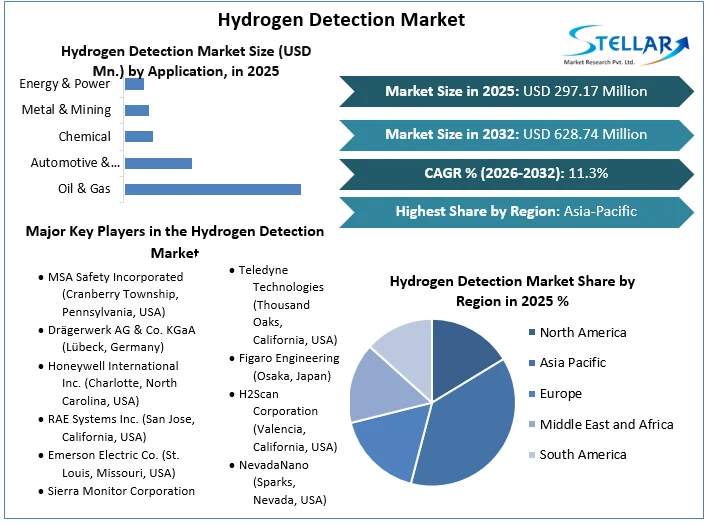
The Hydrogen Detection Market is experiencing robust growth as governments, energy companies, and industrial manufacturers accelerate investments in hydrogen-based technologies to support the global transition toward cleaner energy. As hydrogen production, storage, transportation, and utilization expand across industries, the need for reliable hydrogen detection systems has become increasingly critical for ensuring operational safety and regulatory compliance. According to Stellar Market Research, the global Hydrogen Detection Market was valued at USD 297.17 million in 2025 and is projected to reach USD 628.74 million by 2032, growing at a CAGR of 11.3% during the forecast period.
Rising Hydrogen Adoption Creates Significant Market Opportunities
Hydrogen is emerging as one of the most promising clean energy carriers due to its ability to reduce greenhouse gas emissions across sectors such as transportation, power generation, chemicals, refining, and heavy manufacturing. However, hydrogen is highly flammable, colorless, and odorless, making leak detection an essential safety requirement.
Hydrogen detection systems continuously monitor the presence of hydrogen gas in industrial environments, storage facilities, fuel stations, laboratories, and manufacturing plants. Early leak detection minimizes explosion risks, protects workers, reduces equipment damage, and ensures uninterrupted operations. As investments in hydrogen infrastructure continue to grow worldwide, demand for advanced detection technologies is expected to rise substantially.
Download Free PDF Brochure: https://www.stellarmr.com/report/req_sample/hydrogen-detection-market/2599
Expanding Hydrogen Economy Drives Market Growth
The global push toward carbon neutrality has encouraged governments and private organizations to increase investments in green hydrogen projects. Hydrogen is increasingly being used as a clean alternative to fossil fuels in industries where direct electrification remains challenging.
Large-scale hydrogen production facilities, transportation pipelines, fueling stations, and storage terminals require continuous gas monitoring systems to maintain safe operating conditions. This growing infrastructure development is creating long-term opportunities for hydrogen detection equipment manufacturers.
Furthermore, increasing adoption of fuel cell electric vehicles (FCEVs), hydrogen-powered buses, commercial fleets, and industrial equipment has expanded the application scope of portable and fixed hydrogen detection solutions.
Technological Advancements Enhance Detection Accuracy
Manufacturers are introducing highly sensitive detection technologies capable of identifying even small concentrations of hydrogen before they become hazardous. Modern hydrogen detectors provide faster response times, improved accuracy, lower maintenance requirements, and enhanced durability for demanding industrial environments.
Several sensing technologies are widely used across the industry, including:
Electrochemical sensors
Catalytic sensors
Metal Oxide Semiconductor (MOS) sensors
Thermal conductivity sensors
Solid-state sensor technologies
Smart hydrogen detection systems increasingly integrate wireless connectivity, Internet of Things (IoT) platforms, cloud-based monitoring, and predictive maintenance capabilities. These digital technologies enable real-time monitoring, remote diagnostics, automated alerts, and centralized safety management across multiple facilities.
Industrial Safety Regulations Accelerate Market Adoption
Stringent workplace safety regulations remain one of the strongest growth drivers for the Hydrogen Detection Market. Regulatory agencies worldwide continue strengthening industrial safety standards governing hazardous gas handling and leak detection.
Industries such as oil & gas, chemicals, power generation, mining, aerospace, and automotive manufacturing are required to implement advanced gas monitoring systems to comply with occupational safety regulations and minimize operational risks.
The rapid expansion of hydrogen refueling infrastructure also requires reliable detection equipment capable of maintaining safe operating conditions during hydrogen storage and dispensing operations.
Growing Applications Across Multiple Industries
Hydrogen detection systems have become essential across numerous industrial sectors.
Energy and Power
Power generation companies increasingly integrate hydrogen into renewable energy storage projects, fuel cell systems, and backup power solutions. Continuous monitoring ensures operational reliability while supporting clean energy initiatives.
Oil & Gas
Hydrogen is widely used in petroleum refining and petrochemical processing. Hydrogen detectors help prevent leaks in production facilities, pipelines, compressors, and storage systems.
Automotive
Automotive manufacturers continue expanding hydrogen fuel cell vehicle production. Hydrogen sensors improve safety during vehicle manufacturing, testing, and hydrogen refueling operations.
Chemical Manufacturing
Chemical processing facilities utilize hydrogen in numerous industrial reactions. Reliable detection systems minimize workplace hazards while improving operational efficiency.
Metal and Mining
Hydrogen plays an important role in steel manufacturing and metal processing as industries pursue lower-carbon production technologies.
Regional Market Outlook
North America remains a major market for hydrogen detection technologies due to increasing investments in hydrogen infrastructure, fuel cell research, and industrial automation. Strong government support for clean energy initiatives continues encouraging adoption across energy, transportation, and manufacturing sectors.
Europe represents another important regional market, supported by ambitious climate policies and hydrogen strategies introduced by the European Union. Countries including Germany, France, and the Netherlands are investing heavily in hydrogen production, transportation, and storage projects that require advanced safety monitoring systems.
Asia-Pacific is expected to witness the fastest growth during the forecast period. China, Japan, South Korea, and India are rapidly expanding hydrogen production capacity while investing in fuel cell technologies and clean transportation infrastructure. Government incentives supporting hydrogen adoption continue creating favorable market conditions for detection equipment manufacturers.
The Middle East is also emerging as a promising market due to significant investments in green hydrogen production projects designed to support global energy exports.
Competitive Landscape
- Figaro Engineering (Osaka, Japan)
- H2Scan Corporation (Valencia, California, USA)
- NevadaNano (Sparks, Nevada, USA)
- Membrapor (Aesch, Switzerland)
- Hydrogen Sense Technology Co., Ltd. (Suzhou, China)
- Posifa Technologies (San Jose, California, USA)
- Zhengzhou Winsen Electronics Technology Co., Ltd. (Zhengzhou, China)
- Ambetronics Engineers Pvt. Ltd. (Mumbai, India)
- FES Sensors (Kempen, Germany)
Download Free PDF Brochure: https://www.stellarmr.com/report/req_sample/hydrogen-detection-market/2599
Emerging Trends Shaping the Future
Several industry trends are expected to influence market growth over the coming years:
Expansion of green hydrogen production worldwide
Increasing deployment of hydrogen refueling stations
Growing adoption of Industry 4.0 safety systems
Rising demand for wireless gas detection networks
AI-powered predictive maintenance for industrial safety
Development of miniature, low-power sensor technologies
Greater integration of cloud-based monitoring platforms
Stronger emphasis on ESG compliance and workplace safety
These trends are encouraging manufacturers to develop smarter, faster, and more reliable hydrogen detection solutions that support industrial automation and sustainable energy development.
Future Outlook
The future of the Hydrogen Detection Market appears highly promising as hydrogen becomes an increasingly important component of global decarbonization strategies. Governments, utilities, industrial manufacturers, and transportation companies are expected to continue investing in hydrogen production, storage, and distribution infrastructure over the next decade.
As hydrogen applications expand across energy, mobility, chemicals, and heavy industries, reliable detection technologies will remain indispensable for maintaining operational safety and regulatory compliance. Continuous advancements in sensor technology, artificial intelligence, wireless monitoring, and industrial automation will further improve detection capabilities while reducing operational costs.
Manufacturers that focus on innovation, digital connectivity, sustainability, and high-performance sensing technologies will be well-positioned to capitalize on the growing opportunities presented by the global hydrogen economy. With increasing investments in clean energy and industrial safety, the Hydrogen Detection Market is expected to play a pivotal role in enabling the safe and efficient adoption of hydrogen technologies worldwide.
Media Contact
Stellar Market Research
Website: Stellar Market Research – Global Research Reports & Consulting
Email: sales@stellarmr.com
