Inverter Duty Motor Market: Industrial Automation and Energy Efficiency Drive Next-Generation Motor Demand
The Inverter Duty Motor Market is witnessing strong global growth as industries accelerate investments in automation, energy-efficient manufacturing, and variable frequency drive (VFD) technologies. Designed to operate efficiently under varying speeds and demanding industrial conditions, inverter duty motors have become a critical component across manufacturing, oil & gas, mining, food processing, and renewable energy applications.
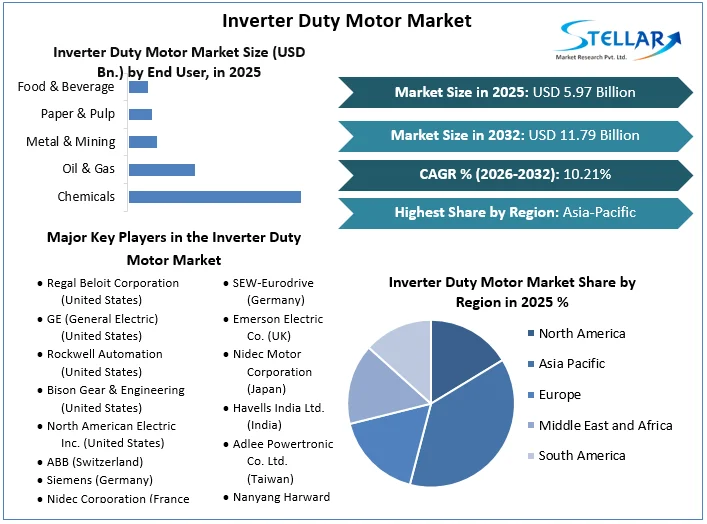
According to Stellar Market Research, the global Inverter Duty Motor Market was valued at USD 5.97 billion in 2025 and is expected to reach nearly USD 11.79 billion by 2032, expanding at a CAGR of 10.21% during the forecast period. The market is being driven by the increasing adoption of Industry 4.0 technologies, stringent energy-efficiency regulations, and growing deployment of smart motor control systems.
Download Free PDF Brochure: https://www.stellarmr.com/report/req_sample/inverter-duty-motor-market/2607
Industrial Automation Accelerates Market Growth
Manufacturing industries worldwide are rapidly modernizing production facilities through automation and digitalization. Variable frequency drives have become indispensable for optimizing motor performance, reducing energy consumption, and extending equipment lifespan. Since conventional motors are not designed to withstand the voltage spikes and varying frequencies generated by VFDs, inverter duty motors have emerged as the preferred solution.
Industries are increasingly replacing conventional motors with inverter duty motors to improve process efficiency, reduce maintenance costs, and support predictive maintenance strategies. The ability of these motors to operate reliably across a wide speed range makes them ideal for high-performance industrial applications.
As smart factories continue expanding globally, demand for inverter duty motors is expected to remain strong throughout the forecast period.
Rising Focus on Energy Efficiency Supports Adoption
Energy consumption remains one of the largest operating expenses for industrial facilities. Governments across major economies continue implementing stringent energy-efficiency regulations aimed at reducing industrial electricity consumption and carbon emissions.
Inverter duty motors help manufacturers optimize energy utilization by precisely controlling motor speed based on operational requirements. This minimizes unnecessary power consumption while improving productivity and reducing equipment wear.
Industries including chemicals, food & beverage, pulp & paper, oil & gas, and mining are increasingly adopting these motors to comply with sustainability goals while lowering operational costs.
Variable Frequency Drives Create Long-Term Opportunities
The growing adoption of VFDs across industrial sectors is creating substantial opportunities for inverter duty motor manufacturers. Modern industrial processes require accurate speed control, enhanced torque performance, and reliable continuous operation under fluctuating load conditions.
Applications such as pumps, fans, compressors, conveyors, mixers, extruders, and HVAC systems increasingly rely on inverter duty motors to deliver superior operational flexibility and energy savings.
The rapid expansion of renewable energy projects and electric vehicle manufacturing facilities is also creating new demand for high-performance motor technologies capable of supporting advanced automation systems.
Digital Technologies Transform Motor Performance
Technological innovation is reshaping the inverter duty motor industry through the integration of Industrial Internet of Things (IIoT), artificial intelligence, and predictive maintenance solutions.
Smart motors equipped with condition-monitoring sensors enable operators to monitor vibration, temperature, electrical load, and overall equipment health in real time. These capabilities help reduce unexpected downtime, improve maintenance planning, and extend motor service life.
Manufacturers are also investing in advanced insulation systems, improved cooling technologies, and lightweight materials that enhance reliability while reducing maintenance requirements.
Digital motor management systems further improve operational efficiency by enabling remote monitoring and centralized asset management across multiple industrial facilities.
Broad Industrial Applications Expand Market Potential
The versatility of inverter duty motors has expanded their adoption across numerous industrial sectors.
Oil & Gas
Energy companies utilize inverter duty motors for compressors, pumps, drilling equipment, and pipeline operations requiring continuous speed variation under demanding environmental conditions.
Chemical Processing
Chemical plants depend on inverter duty motors to achieve precise process control while maintaining operational safety and energy efficiency.
Food & Beverage
Automated production lines use inverter duty motors to maintain accurate speed control across conveyors, mixers, packaging equipment, and refrigeration systems.
Metal & Mining
Mining operations require durable motors capable of handling heavy loads, variable speeds, and harsh operating environments.
Renewable Energy
Wind, solar, and hydrogen infrastructure projects increasingly incorporate inverter duty motors for energy conversion, cooling systems, and automated manufacturing equipment.
Regional Market Outlook
Asia-Pacific currently represents the largest regional market due to rapid industrialization, expanding manufacturing capacity, and significant investments in industrial automation. China, India, Japan, and South Korea continue strengthening advanced manufacturing capabilities while increasing adoption of energy-efficient industrial equipment.
North America remains a significant market supported by modernization of industrial infrastructure, increasing adoption of Industry 4.0 technologies, and strong investment in smart manufacturing.
Europe continues experiencing steady demand driven by strict environmental regulations, energy-efficiency directives, and growing investments in sustainable industrial production.
Emerging economies across Latin America and the Middle East are also increasing investments in manufacturing and industrial automation, creating new opportunities for market expansion.
Competitive Landscape
The Inverter Duty Motor Market remains highly competitive, with global manufacturers focusing on product innovation, digital integration, and expanding geographic presence.
Leading companies continue investing in research and development to improve motor efficiency, thermal performance, insulation systems, and smart monitoring capabilities. Strategic partnerships with industrial automation providers and VFD manufacturers are enabling integrated motor control solutions that improve customer value.
Major participants include:
- Regal Beloit Corporation (United States)
- GE (General Electric) (United States)
- Rockwell Automation (United States)
- ABB (Switzerland)
- Siemens (Germany)
- Nidec Corporation (France)
- VEM Group (Germany)
- Nidec Motor Corporation (Japan)
- Havells India Ltd. (India)
- Adlee Powertronic Co. Ltd. (Taiwan)
Download Free PDF Brochure: https://www.stellarmr.com/report/req_sample/inverter-duty-motor-market/2607
Emerging Industry Trends
Several trends are expected to shape the market over the coming years:
Increasing adoption of smart manufacturing technologies
Growing deployment of Industrial IoT-enabled motors
Expansion of predictive maintenance solutions
Rising investments in renewable energy infrastructure
Greater emphasis on energy-efficient industrial equipment
Development of lightweight, high-performance motor materials
Integration of AI-driven motor diagnostics
Expansion of electric vehicle manufacturing facilities
These innovations are expected to enhance operational efficiency while reducing lifecycle costs for industrial users.
Future Outlook
The future of the Inverter Duty Motor Market remains highly promising as industries continue prioritizing automation, sustainability, and operational efficiency. Growing investments in industrial modernization, renewable energy, electric vehicles, and digital manufacturing are expected to sustain strong demand for advanced inverter duty motors over the coming decade.
Manufacturers that focus on intelligent motor technologies, energy-efficient designs, predictive maintenance capabilities, and digital connectivity will be well positioned to capitalize on emerging market opportunities. As industrial facilities increasingly adopt variable frequency drives and smart automation systems, inverter duty motors will remain essential for improving productivity, reducing energy consumption, and supporting the global transition toward sustainable industrial operations.
Media Contact
Stellar Market Research
Website: Stellar Market Research – Global Research Reports & Consulting
Email: sales@stellarmr.com
