Sustainable Fuel Market: Advancing the Global Energy Transition Through Low-Carbon Fuel Innovation
The Sustainable Fuel Market is rapidly emerging as a cornerstone of the global transition toward cleaner energy systems. As governments, industries, and transportation providers intensify efforts to reduce greenhouse gas emissions and achieve net-zero targets, sustainable fuels are becoming an increasingly viable alternative to conventional fossil fuels. These fuels, produced from renewable feedstocks and low-carbon processes, are helping decarbonize sectors where electrification alone cannot meet energy demands.
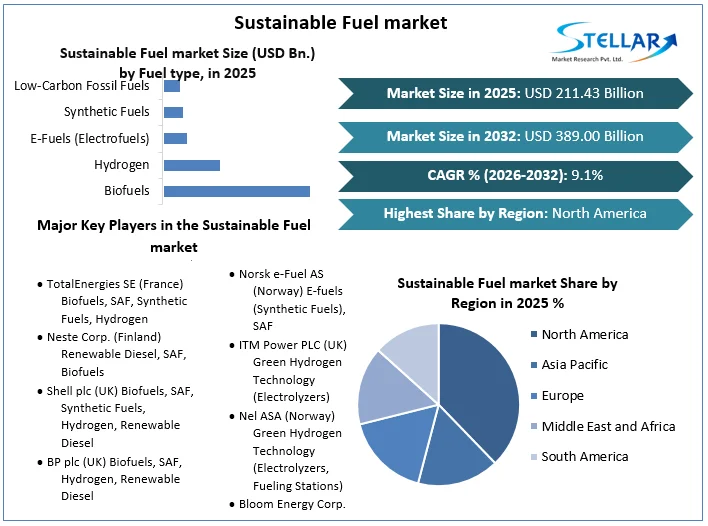
According to Stellar Market Research, the global Sustainable Fuel Market was valued at USD 211.43 billion in 2025 and is projected to grow at a CAGR of 9.1% during the forecast period from 2025 to 2032. Rising investments in renewable energy infrastructure, supportive government policies, and advancements in fuel production technologies are expected to accelerate market expansion over the coming years.
Download Free PDF Brochure: https://www.stellarmr.com/report/req_sample/sustainable-fuel-market/2644
Growing Focus on Carbon Reduction Drives Market Growth
Climate change has become a global priority, prompting governments and businesses to adopt cleaner energy solutions. Sustainable fuels—including biofuels, renewable diesel, sustainable aviation fuel (SAF), green hydrogen, and synthetic e-fuels—offer significant reductions in lifecycle carbon emissions compared to conventional petroleum-based fuels.
International agreements, carbon pricing mechanisms, and stricter environmental regulations are encouraging industries to replace fossil fuels with renewable alternatives. Transportation, aviation, maritime, and heavy industrial sectors are increasingly investing in sustainable fuel technologies to meet emission reduction targets while maintaining operational efficiency.
As global energy demand continues to rise, sustainable fuels are expected to play a critical role in supporting energy security and reducing dependence on traditional fossil fuel resources.
Transportation Sector Leads Demand for Sustainable Fuels
The transportation industry remains one of the largest consumers of sustainable fuels. Road transportation, aviation, shipping, and rail operators are adopting renewable fuel solutions to lower emissions without requiring significant changes to existing infrastructure.
Sustainable aviation fuel has gained particular attention as airlines seek practical solutions to reduce carbon emissions while maintaining compatibility with existing aircraft engines. Similarly, renewable diesel is increasingly replacing conventional diesel across commercial vehicle fleets due to its lower environmental impact and ease of integration.
The maritime sector is also exploring renewable methanol, ammonia, and biofuels as cleaner alternatives to traditional marine fuels, creating additional growth opportunities for fuel producers.
Technological Innovation Improves Fuel Production Efficiency
Continuous technological advancements are transforming sustainable fuel production. Modern biorefineries are utilizing advanced feedstocks such as agricultural residues, municipal solid waste, algae, forestry by-products, and used cooking oil to produce high-quality renewable fuels.
Innovations in catalytic conversion, biomass gasification, hydroprocessing, and carbon capture technologies are improving production efficiency while reducing manufacturing costs.
Artificial intelligence, automation, and digital process optimization are further enhancing production capabilities by enabling real-time monitoring, predictive maintenance, and optimized resource utilization. These improvements are making sustainable fuels increasingly competitive with conventional energy sources.
Government Policies Accelerate Industry Development
Supportive government policies remain one of the strongest growth drivers for the Sustainable Fuel Market. Numerous countries have introduced renewable fuel mandates, tax incentives, blending requirements, and financial support programs to encourage low-carbon fuel production and adoption.
Several governments are investing heavily in green hydrogen infrastructure, sustainable aviation fuel production facilities, and renewable fuel research initiatives. Public-private partnerships are also accelerating commercialization of next-generation fuel technologies.
In addition, environmental regulations requiring reductions in industrial and transportation emissions continue to create long-term demand for sustainable fuel solutions.
Diverse Feedstocks Expand Market Opportunities
One of the strengths of the sustainable fuel industry is its ability to utilize a wide variety of renewable feedstocks. Agricultural waste, forestry residues, animal fats, algae, municipal waste, and industrial by-products are increasingly being converted into valuable energy resources.
The use of waste-based feedstocks supports circular economy principles by reducing landfill waste while creating additional revenue streams for agricultural and industrial sectors.
Research into synthetic fuels produced using renewable electricity and captured carbon dioxide is also opening new opportunities for carbon-neutral energy production.
Regional Market Outlook
North America remains a significant market for sustainable fuels due to strong government support, expanding renewable diesel production, and increasing investments in clean energy technologies. The United States continues to encourage renewable fuel adoption through various incentive programs and emission reduction initiatives.
Europe represents one of the most advanced sustainable fuel markets, supported by ambitious climate goals, stringent carbon reduction regulations, and increasing investments in sustainable aviation fuel and green hydrogen. Countries such as Germany, France, the Netherlands, and the Nordic nations continue expanding renewable fuel infrastructure.
The Asia-Pacific region is expected to witness the fastest growth during the forecast period. Rapid industrialization, increasing energy demand, supportive government policies, and expanding renewable energy investments across China, India, Japan, and South Korea are creating substantial opportunities for sustainable fuel producers.
Latin America and the Middle East are also emerging as promising markets due to abundant renewable resources, biofuel production capabilities, and growing interest in hydrogen-based energy solutions.
Competitive Landscape
The Sustainable Fuel Market is highly competitive, with established energy companies, renewable fuel producers, technology developers, and emerging clean-energy startups investing heavily in production capacity and innovation.
Major participants include:
- TotalEnergies SE (France) Biofuels, SAF, Synthetic Fuels, Hydrogen
- Neste Corp. (Finland) Renewable Diesel, SAF, Biofuels
- Shell plc (UK) Biofuels, SAF, Synthetic Fuels, Hydrogen, Renewable Diesel
- BP plc (UK) Biofuels, SAF, Hydrogen, Renewable Diesel
- Chevron Corporation (USA) Biofuels, SAF, Renewable Diesel
- Cargill Inc. (USA) Biodiesel, Biofuels
- The Archer-Daniels-Midland Company (USA) Ethanol, Biodiesel, Biofuels
- Equinor ASA (Norway) Biofuels, Hydrogen
- Air Products & Chemicals, Inc. (USA) Hydrogen
- Linde plc(UK)/(USA) Hydrogen
Download Free PDF Brochure: https://www.stellarmr.com/report/req_sample/sustainable-fuel-market/2644
Emerging Trends Shaping the Industry
Several transformative trends are expected to define the future of the Sustainable Fuel Market:
Rapid expansion of sustainable aviation fuel production
Growing investments in green hydrogen infrastructure
Increased commercialization of synthetic e-fuels
Integration of carbon capture and utilization technologies
Adoption of digital technologies for fuel production optimization
Greater use of waste-derived feedstocks
Expansion of renewable fuel blending mandates
Rising corporate investments in net-zero initiatives
These developments are strengthening the role of sustainable fuels in global decarbonization strategies while supporting long-term energy resilience.
Future Outlook
The future of the Sustainable Fuel Market appears exceptionally promising as governments and industries continue prioritizing low-carbon energy solutions. Rising environmental awareness, supportive regulatory frameworks, and ongoing technological advancements are expected to drive significant investments across the sustainable fuel value chain.
As production technologies become more efficient and renewable feedstocks become increasingly accessible, sustainable fuels are likely to achieve greater cost competitiveness with conventional fossil fuels. The continued expansion of renewable diesel, sustainable aviation fuel, green hydrogen, and synthetic fuels will further diversify energy portfolios while supporting global climate goals.
Companies that invest in advanced production technologies, strategic partnerships, and sustainable supply chains will be well-positioned to capitalize on the expanding opportunities within the Sustainable Fuel Market. As the global economy accelerates its transition toward cleaner energy systems, sustainable fuels will play a pivotal role in reducing carbon emissions, strengthening energy security, and enabling a more resilient and sustainable future.
Media Contact
Stellar Market Research
Website: Stellar Market Research – Global Research Reports & Consulting
Email: sales@stellarmr.com
