Key Highlights
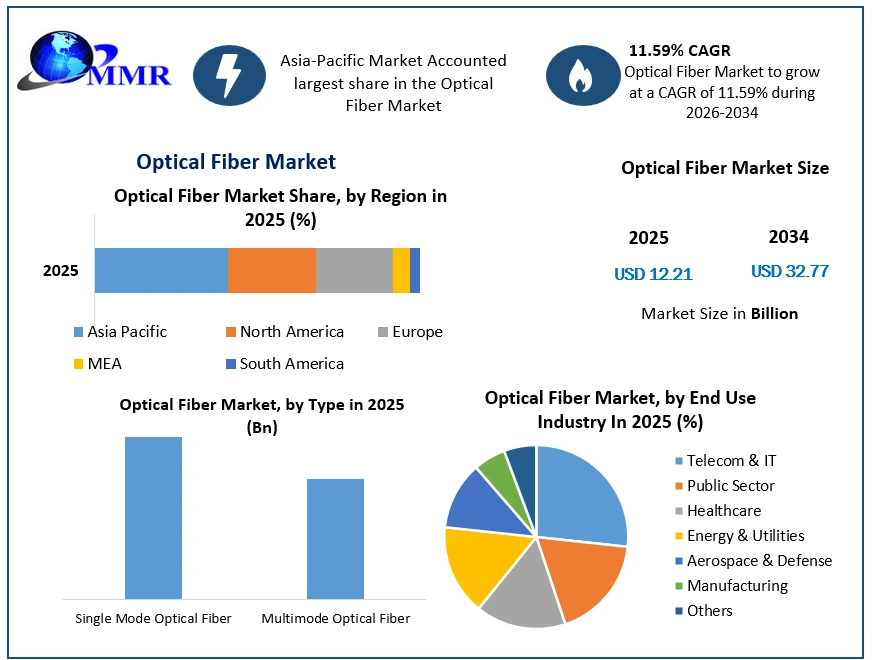
AI data centers, 5G backhaul and fiber broadband are turning optical fiber into core digital infrastructure rather than passive telecom cabling. The Optical Fiber Market was valued at USD 12.21 Bn in 2025 and is expected to reach USD 32.77 Bn by 2034, creating a supply chain opportunity for fiber producers, network operators, hyperscalers and telecom equipment vendors.
The Optical fiber market is forecast to grow at an 11.59 percent CAGR from 2026 to 2034, linking demand to high speed internet, data centers, cloud computing, big data analytics, IoT and 5G networks.
Single mode optical fiber dominated in 2025 and is expected to hold the largest share because it supports long distance, low loss, high bandwidth transmission.
Telecom and IT dominated by end use industry and is expected to retain the largest share, making network operators and data centers the clearest demand base.
Recent deals from Corning, Amazon, NVIDIA, Prysmian, STL and Nokia show the market moving toward AI ready connectivity, domestic manufacturing capacity and national optical transport upgrades.
Why This Matters Now
Network capacity has become a constraint on AI, cloud and 5G expansion. Optical fiber provides the high speed, low latency, long distance connectivity needed to move data between mobile devices, servers, storage systems, cloud platforms and core networks.
For CIOs, telecom executives and cloud providers, fiber investment is now tied to competitiveness. Networks that cannot support high bandwidth traffic from video streaming, online gaming, cloud computing, big data analytics and IoT will face performance limits as digital usage expands.
Market Overview
Optical fiber is a flexible, transparent fiber made of high quality glass or plastic used to transmit light between two ends. It is widely used in telecommunications and computer networking because it enables high speed data transmission over long distances with minimal signal quality loss.
The Optical fiber market is segmented by type into single mode optical fiber and multimode optical fiber. End use industries include Telecom and IT, Public Sector, Healthcare, Energy and Utilities, Aerospace and Defense, Manufacturing and others.
The public page contains a visible header inconsistency: the top panel lists USD 12.21 Bn as forecast market size, while the overview and scope table state USD 12.21 Bn in 2025 and USD 32.77 Bn by 2034. This article uses the overview and scope table figures because they match the supplied market size statement.
Key Trends Driving Growth
High speed internet is the first growth driver. Optical fibers transmit large volumes of data at high speeds over long distances, making them critical for bandwidth intensive applications such as video streaming, online gaming and cloud computing.
5G is the second catalyst. Optical fibers connect 5G base stations to core networks and provide the high capacity backhaul and fronthaul links required for ultra low latency and high bandwidth.
Data center expansion is the third demand engine. Cloud computing, big data analytics and IoT applications are increasing the need for fiber interconnections between servers, storage systems and networking equipment.
Government broadband programs are widening deployment. China’s Broadband China strategy, India’s BharatNet program and Australia’s National Broadband Network are identified as initiatives driving fiber network deployment and demand for cables, components and equipment.
The main restraint is installation cost. Fiber deployment requires materials, labor, equipment, cable laying, splicing and network components, while trenching, boring and coordination with utilities can raise project cost and timelines.
Start Your Market Research Journey with a Free Sample Report
Segment Insights
Dominant Segment: Single mode optical fiber dominated in 2025 and is expected to retain the largest share. Its smaller core, low dispersion and low attenuation make it suitable for long haul telecom, intercity and submarine communication links.
Dominant End Use Industry: Telecom and IT dominated in 2023 and is expected to hold the largest share. Optical fiber acts as backbone infrastructure for telecom networks, data hubs, mobile services, broadband access, cloud connectivity and HPC clusters.
Fastest Growing Segment: The public page does not identify a fastest growing type or end use industry with a usable CAGR. No fastest growing segment is inferred.
Technology Signal: Single mode fibers are used with laser based transmission systems, where semiconductor lasers generate and modulate optical signals for high speed transmission and dense wavelength division multiplexing.
Application Scope: Industrial, Healthcare and Security. Optical fibers are also used for high resolution imaging, remote sensing, precision measurement and secure data transmission in industrial and commercial settings.
Regional Growth Story
Asia Pacific is the main highlighted regional growth story. Governments across the region are investing in broadband infrastructure to expand internet access, reduce the urban rural digital divide and support digital economies.
China, India and Australia are tied to major broadband programs. China’s Broadband China strategy, India’s BharatNet program and Australia’s NBN are driving fiber optic deployment and stimulating demand for optical fiber cables, components and equipment.
Asia Pacific 5G deployment is also accelerating. Fiber provides the backhaul and fronthaul connections needed for 5G networks, while smart cities, autonomous vehicles and IoT applications raise the need for ultra low latency, high bandwidth infrastructure.
The report covers the United States, Canada, Mexico, the UK, France, Germany, Italy, Spain, Sweden, Austria, China, South Korea, Japan, India, Australia, Indonesia, Malaysia, Vietnam and Taiwan. Country level revenues, regulatory metrics, cybersecurity investments and telecom capex values are not disclosed.
Competitive Landscape
Key players include Corning, OFS Fitel, CommScope, AFL, Finisar, Prysmian, Nexans, Draka Communications, Leoni, Emtelle, Nokia Networks, Fujikura, Sumitomo Electric, Sterlite Technologies, YOFC, Tongding Interconnection, LS Cable and System and Furukawa Electric. The field combines U.S., European and Asian fiber manufacturers, cable suppliers and telecom infrastructure companies.
Corning’s agreements with Amazon and NVIDIA signal a shift from conventional telecom demand to AI infrastructure supply chains. Fiber capacity is becoming a prerequisite for hyperscale data centers, accelerated computing clusters and domestic network resilience.
Prysmian’s investment in Relativity Networks signals movement toward hollow core fiber, where lower latency and higher transmission efficiency become competitive differentiators. STL’s BSNL contract and Nokia’s Vodafone Idea upgrade show that national broadband and optical transport networks remain central to emerging market growth.
The public page does not disclose cybersecurity product launches, cloud migration deals, edge computing deployments or regulatory compliance programs by vendor. The visible competitive direction is AI data center connectivity, 5G optical transport, domestic manufacturing capacity, multicore fiber and hollow core commercialization.
Recent Developments
08 June 2026: Corning and Amazon. Corning announced a multibillion dollar agreement to supply optical fiber, cable and connectivity solutions for expanding U.S. data center infrastructure, creating 1,000 advanced manufacturing jobs in North Carolina.
06 May 2026: Corning and NVIDIA. Corning entered a long term commercial and technology partnership with NVIDIA to expand domestic U.S. production of advanced optical connectivity for AI infrastructure, including more than 50 percent optical fiber production capacity expansion and three new advanced manufacturing facilities.
16 March 2026: Corning. Corning launched an integrated multicore fiber solution at OFC 2026, delivering four times the data capacity per fiber within a standard footprint for AI oriented high density networks.
23 July 2025: Prysmian. Prysmian invested in Relativity Networks to support global commercialization of hollow core optical fiber and cable, targeting lower latency and higher transmission efficiency.
11 June 2025: STL and BSNL. Sterlite Technologies signed an infrastructure agreement with BSNL to deploy and maintain an optical transport network in northern India under BharatNet middle mile architecture.
31 March 2025: Nokia and Vodafone Idea. Nokia secured a contract to upgrade and expand Vodafone Idea’s national optical transport network using advanced coherent routing for rising 5G data traffic.
Strategic Implications
For telecom operators, optical fiber is the backhaul foundation for 5G and future mobile broadband. Operators that delay fiber densification risk weaker latency, capacity and service reliability as mobile data and IoT traffic rise.
For cloud providers and AI infrastructure buyers, fiber quality now affects data center performance. Multicore fiber, hollow core fiber and expanded domestic production show that connectivity is becoming part of AI infrastructure strategy, not just facilities procurement.
For governments, fiber investment is digital infrastructure policy. Broadband programs in China, India and Australia show how public sector funding can expand access, support digital transformation and create demand for domestic and regional supply chains.
Future Outlook
The Optical Fiber Market is forecast to grow from USD 12.21 Bn in 2025 to USD 32.77 Bn by 2034 at an 11.59 percent CAGR. Growth will come from single mode fiber, Telecom and IT, 5G backhaul, FTTH, data centers, cloud computing, big data analytics, IoT, AI infrastructure, broadband programs and advanced fiber technologies.
The next phase will test whether fiber suppliers and network operators can scale capacity fast enough for AI workloads, 5G density and cloud traffic. Future digital leaders will control the high capacity optical layer behind AI data centers and national networks; laggards will remain constrained by bandwidth bottlenecks while competitors turn fiber depth into digital speed and service advantage.
Analyst Perspective
“Optical fiber is becoming strategic digital infrastructure as 5G backhaul, fiber broadband, AI data centers and cloud applications demand higher bandwidth and lower latency,” said Yash Ghosalkar, Analyst at Maximize Market Research. “The strongest providers will combine manufacturing scale, advanced fiber technology, regional supply chain resilience and telecom grade deployment capability.”
About Maximize Market Research
Maximize Market Research Pvt. Ltd. (MMR) is a global market research and consulting company that provides reliable, data-focused, and practical business insights. The firm serves a wide range of industries, including healthcare, pharmaceuticals, technology, automotive, electronics, chemicals, personal care, and consumer goods. Through market forecasts, competitive analysis, strategic consulting, and industry impact assessments, MMR helps organizations understand changing market conditions, identify growth opportunities, and make informed business decisions for long-term success.
Contact Us
2nd Floor, Navale IT Park Phase 3
Pune Banglore Highway, Narhe
Pune, Maharashtra 411041, India
+91 9607365656
sales@maximizemarketresearch.com
