Key Highlights
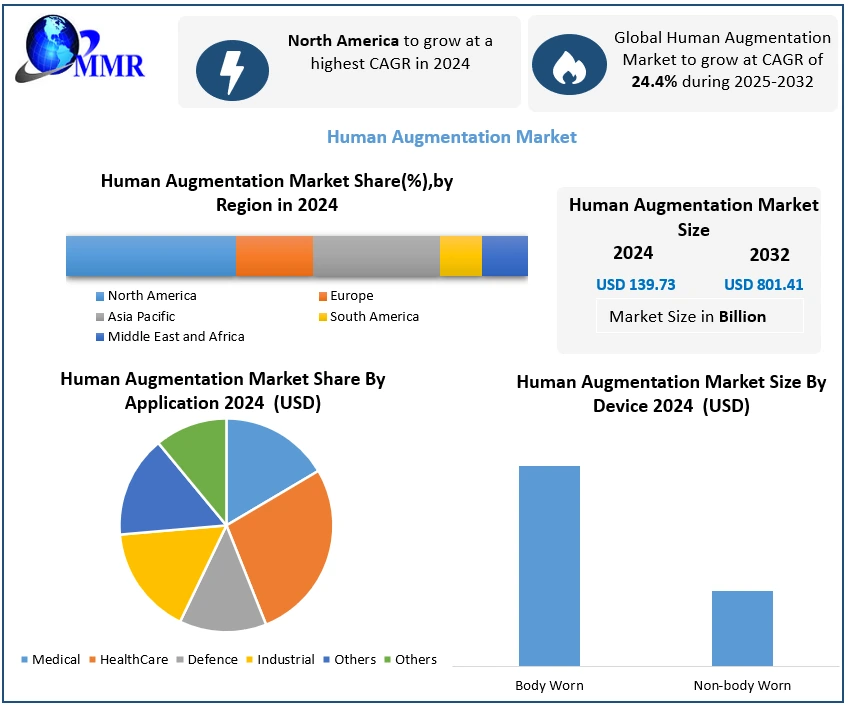
The global human augmentation market size reached USD 112.32 billion in 2023 and is projected to grow to USD 498.04 billion by 2030.
Market growth exhibits a compound annual growth rate (CAGR) of 24.4% over the forecast window from 2024 to 2030.
Advanced artificial intelligence and augmented reality integrations represent the primary technology trends accelerating platform capabilities.
Large multinational technology firms, including Google Inc., Samsung Electronics Co., Apple Inc., and Microsoft Corporation, control significant platform ecosystems.
Strategic alliances with technology developers, healthcare providers, and research institutions function as the primary market entry mechanism.
Navigating complex international regulatory frameworks and emerging ethical standards persists as a primary operational barrier for commercial software vendors.
Why This Matters Now
Traditional enterprise computing interfaces have hit a structural bottleneck regarding real-time labor optimization. Modern workspace operations spread complex information across distributed hybrid cloud repositories and remote edge networks, leaving frontline personnel disconnected from immediate operational analytics.
Technology executives are realizing that standard static screens limit worker throughput and accuracy. Delays in data retrieval and manual operational oversight directly lower system efficiency across manufacturing, logistics, and medical rehabilitation sectors.
The integration of advanced neuroprosthetics, wearable computing systems, and AI-driven exoskeletons has turned human augmentation into a vital operational infrastructure layer. For chief information officers (CIOs) and chief technology officers (CTOs), deployed augmentation architectures now determine how effectively an enterprise achieves digital transformation initiatives and optimizes human capital.
Market Overview
The global Human Augmentation Market achieved an industrial valuation of USD 112.32 billion in 2023. Supported by extensive enterprise software modernization and cloud migration activity, the market is projected to reach USD 498.04 billion by 2030. This expansion reflects a compound annual growth rate (CAGR) of 24.4% across the forecast period.
The underlying technology framework is built to develop innovative, scalable solutions that integrate smoothly into existing enterprise workflows. By combining hardware modifications with deep machine learning adoption, these platforms offer personalized enhancements for industrial performance, medical rehabilitation, and everyday commercial activities.
Key Trends Driving Growth
Corporate operational demands are expanding beyond the limits of manual human execution. Organizations are actively installing specialized exoskeleton and wearable hardware systems to supervise complex material handling, lower the frequency of workplace injuries, and drive industrial precision. This trend directly improves bottom-line operational efficiency by reducing technical support friction and worker downtime.
Widespread cloud computing and the growth of the Software as a Service (SaaS) business model have transformed the integration landscape. Leading developers leverage cloud infrastructure to handle heavy computational loads, shifting advanced processing tasks from local wearable computer deployment up to centralized data centers. This hybrid cloud strategy allows small and medium enterprises to deploy lightweight, cost-effective devices without heavy localized infrastructure costs.
Simultaneously, artificial intelligence and augmented reality (AR) developments are changing interface design. Modern human augmentation solutions utilize custom algorithms to interpret real-time biometric and situational data, delivering instant contextual insights directly to the operator. This transition from passive tools to active digital collaborators maximizes user accuracy output across complex operational environments.
Segment Insights
The market is shifting toward specialized application frameworks and integrated computing delivery models:
Exoskeleton Technologies (Dominant Segment): Physical capability enhancement solutions represent a primary segment focus, with hardware developers optimizing advanced bionic frameworks to improve lifting capacity and reduce fatigue. These platforms are engineered to blend with existing corporate workflows, making them a cornerstone of modern logistics and heavy manufacturing automation trends.
AI and AR Wearables (Fastest-Growing Segment): Smart computer hardware, including untethered holographic headsets and intelligent wearables, stands as the fastest-growing technology segment. The segment’s expansion is propelled by enterprise demand for real-time data overlays and hands-free access to cloud-delivered enterprise software.
Regional Growth Story
The United States maintains a commanding market share position within the human augmentation sector. The region houses the world’s most prominent technology conglomerates, establishing a mature baseline for hardware and software R&D. High capital deployment toward digital infrastructure investments, rapid corporate cloud adoption, and deep artificial intelligence research across commercial sectors keep the North American market at the center of global revenue generation.
Europe exhibits continuous expansion, heavily structured around strict regional safety mandates and digital sovereignty rules. European enterprises are focusing software procurement on secure, legal augmentation systems that enhance worker safety while adhering to local data privacy laws. The region’s industrial manufacturing and healthcare rehabilitation sectors are major drivers of high-end prosthetic and exoskeleton investments.
Asia Pacific is positioned to exhibit rapid long-term growth, driven by the expansion of information technology and telecom infrastructure across China, India, Japan, and South Korea. The region’s expanding industrial base and rising investments in smart manufacturing hubs create an extensive marketplace for wearable computing deployments. Local hardware ecosystems are scaling up production capabilities, allowing for rapid component sourcing and competitive pricing models.
Competitive Landscape
The competitive environment features established platform leaders managing massive global ecosystems alongside highly specialized niche entities. Google Inc., Samsung Electronics Co. Ltd, Ekso Bionics Holdings Inc., Vuzix Corporation, Garmin, Fossil Group Inc., Magic Leap Inc., and Rewalk Robotics Inc. constitute the leading market participants.
Strategic product deployments continue to redefine the landscape. In 2019, Microsoft Corporation launched its HoloLens 2, an ergonomic, untethered, self-contained holographic device running enterprise-ready applications to boost user accuracy output. This design strategy positions Microsoft as a major player by utilizing its existing strengths in software development and its Azure cloud platform to link wearable computer deployment with enterprise software modernization.
Concurrently, other consumer technology firms are leveraging high-profile consumer launches to assert platform readiness. In February 2024, Apple Inc. officially commenced sales of its Vision Pro headset, introducing a spatial computing architecture aimed at redefining professional and everyday applications. This hardware rollout underscores the market’s shifting focus toward ecosystem integration, where wearables link directly with health-associated software and enterprise communications.
Furthermore, Google Inc. maintains a highly structured approach by combining its core competencies in artificial intelligence, machine learning, and cloud computing. The company integrates these digital layers into its wearable solutions to enhance human capabilities and refine the overall customer experience transformation. This AI-first positioning forces competitors to prioritize algorithmic intelligence over simple hardware assembly to sustain their market positions.
Faced with intense technology competition, vendors are increasingly relying on strategic partnerships. Companies collaborate closely with technology developers, healthcare providers, and research institutions to expand their market presence and integrate next-generation neuroprosthetics. However, navigating evolving regulatory standards and emerging ethical guidelines remains the primary structural challenge affecting corporate pricing power and global rollout schedules.
Recent Developments
In February 2024, Apple Inc. launched its Vision Pro headset, introducing a high-performance spatial computing device to the active commercial market.
The deployment of custom generative AI models on edge chipsets has increased, enabling real-time voice and visual translation directly inside wearable corporate hardware.
Advanced exoskeleton manufacturers have expanded their integration with cloud-based analytics platforms to provide managers with immediate visibility into workforce fatigue and biomechanical stress metrics.
Strategic software updates across major smart headset ecosystems have prioritized native compatibility with industrial ERP and CRM software to streamline remote technical operations.
Strategic Implications
For technology executives, investing in modern human augmentation architectures is no longer a futuristic research project; it is an immediate operational efficiency priority. Deployed systems must seamlessly interface with core enterprise software networks, streaming critical data directly into the user’s field of view without introducing cybersecurity vulnerabilities.
Furthermore, cloud providers and telecommunications operators must optimize their network modernization initiatives to support these mobile endpoints. Human augmentation devices require high-speed, low-latency data streams to execute real-time AI and AR workloads, making the deployment of dense 5G infrastructure and localized edge computing architectures a necessary requirement for enterprise-wide adoption.
Future Outlook
The global human augmentation market will continue its transition toward total software-driven connectivity and deep AI adoption. As enterprise data environments grow more complex, the reliance on wearable hardware to bridge the gap between human labor and cloud analytics will remain absolute. Technology strategists who deploy integrated, cloud-native augmentation architectures will convert their frontline operations into an optimized, data-driven competitive advantage, whereas organizations clinging to legacy, manual workflows will face permanent operational drag and diminished workforce productivity.
Analyst Perspective
“The human augmentation market is shifting from isolated physical assists into a unified digital intelligence layer. Forward-looking enterprises are no longer treating wearables as simple accessories; they are deploying them as critical edge computing endpoints that link human capability directly with cloud-delivered AI and automated workflows.”Yash Ghosalkar, Analyst, Maximize Market Research
About Maximize Market Research
Maximize Market Research Pvt. Ltd. (MMR) is a global market research and consulting company that provides reliable, data-focused, and practical business insights. The firm serves a wide range of industries, including healthcare, pharmaceuticals, technology, automotive, electronics, chemicals, personal care, and consumer goods. Through market forecasts, competitive analysis, strategic consulting, and industry impact assessments, MMR helps organizations understand changing market conditions, identify growth opportunities, and make informed business decisions for long-term success.
2nd Floor, Navale IT Park Phase 3
Pune Banglore Highway, Narhe
Pune, Maharashtra 411041, India
+91 9607365656
sales@maximizemarketresearch.com
