Key Highlights
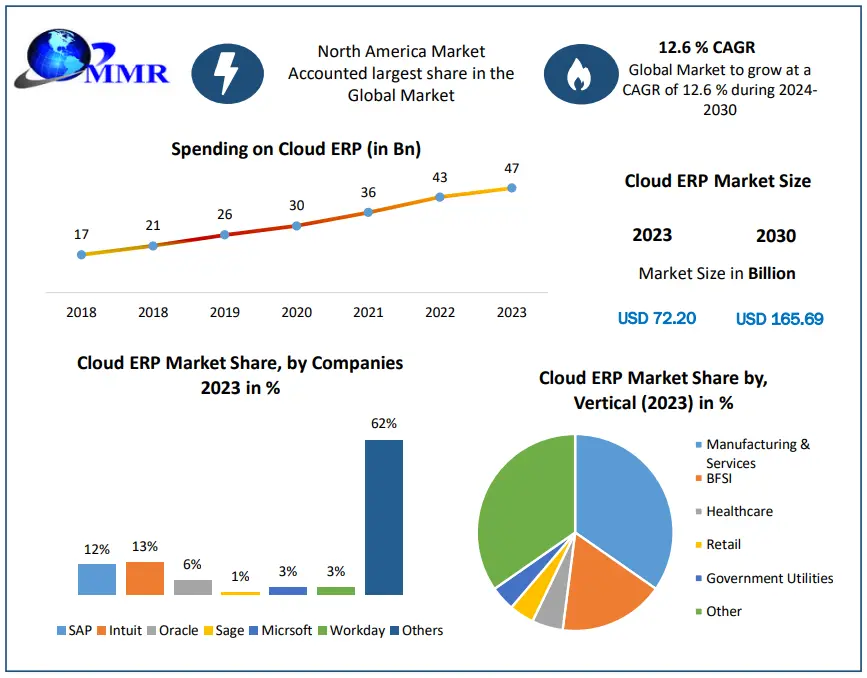
- Cloud ERP has become the operating layer for enterprise modernization as companies move finance, supply chain, HR and customer systems away from fragmented legacy infrastructure. The Cloud ERP Market was valued at USD 72.20 Bn in 2023 and is expected to reach USD 165.69 Bn by 2030, creating a major opportunity for ERP vendors, cloud providers and implementation partners.
- The Cloud ERP market is forecast to grow at a 12.6% CAGR from 2024 to 2030, showing that cloud ERP adoption is moving beyond IT cost savings into business agility, automation and operational visibility.
- Accounting and Finance dominated by function in 2023 and is expected to retain the largest share because finance teams need real-time visibility, automation and compliance-ready records.
- Manufacturing and Services dominated by vertical in 2023 and is expected to hold the largest share because cloud ERP supports production planning, inventory, procurement, asset management and service delivery.
- North America dominated in 2023, supported by digital transformation initiatives, cost advantages, scalability, cloud adoption, advanced analytics and remote-work requirements.
Why This Matters Now
Enterprise software buying has shifted from license ownership to cloud-delivered operating capability. Cloud ERP gives companies access to core business applications through the internet, with third-party providers managing infrastructure, updates, hosting and technical support.
For CIOs and CTOs, the business case is direct. Cloud ERP can reduce total cost of ownership by up to 50% to 60% compared with on-premises ERP over 10 years, freeing capital for modernization, analytics and process automation.
Market Overview
Cloud ERP market is enterprise resource planning software hosted on cloud computing infrastructure and accessed over the internet. Unlike on-premises ERP, it does not require installation and maintenance on local servers, because third-party providers manage the platform in remote data centers.
Cloud ERP market are hosted on infrastructure from vendors such as Amazon Web Services, Microsoft Azure and Google Cloud Platform. The model is typically subscription-based, with recurring fees covering access, maintenance, updates and technical support.
The public page contains a visible header inconsistency: the top panel lists USD 72.2 Bn as forecast market size, while the overview and scope table state USD 72.20 Bn in 2023 and USD 165.69 Bn by 2030. This article uses the overview and scope-table values because they match the supplied market-size statement.
Key Trends Driving Growth
Digital transformation is the first growth driver. Companies are modernizing finance, supply chain management, human resources and customer relationship management, and cloud ERP provides a foundation for integrating and automating those critical business processes.
Scalability is the second driver. Cloud infrastructure allows businesses to scale operations up or down without costly hardware upgrades, helping companies respond to seasonal demand, expansion and changing market conditions.
AI and analytics are becoming the next opportunity layer. MMR identifies artificial intelligence, advanced analytics, predictive analytics, prescriptive analytics, intelligent automation and machine learning-driven insights as opportunities for cloud ERP vendors and enterprise buyers.
Integration is now a strategic requirement. As companies adopt multi-cloud strategies, cloud ERP systems need seamless links with CRM, HRMS, e-commerce and supply chain platforms to improve operational efficiency and unlock more value from cloud investments.
The main restraints are integration complexity, data migration, data security, limited customization, vendor lock-in and compliance with regulations such as GDPR in Europe and HIPAA in the United States. These constraints make governance and implementation planning central to cloud ERP success.
Start Your Market Research Journey with a Free Sample Report
Segment Insights
- Dominant Segment Accounting and Finance: Accounting and Finance dominated in 2023 and is expected to hold the largest share. The segment includes general ledger, accounts payable, accounts receivable, budgeting, forecasting and cash flow management, making it central to financial control and regulatory reporting.
- Dominant Vertical Manufacturing and Services: Manufacturing and Services dominated in 2023 and is expected to retain the largest share. Cloud ERP supports production planning, scheduling, inventory management, quality control, shop floor management, procurement and asset management.
- Fastest-Growing Segment: The public MMR page does not identify a fastest-growing component, function, vertical or organization-size segment with a usable CAGR. No fastest-growing segment is inferred.
- Component Scope Solution and Services: The market is segmented into solution and services, but public component-level shares and CAGRs are not disclosed.
- Organization Scope SMEs and Large Enterprises: Both organization sizes are covered, but the public page does not disclose which segment dominates or grows faster.
Regional Growth Story
North America dominated the Cloud ERP Market in 2023 and is expected to retain the largest share during the forecast period. Regional growth is driven by digital transformation, cost savings, scalability, advanced analytics, remote work adoption and enterprise demand for cloud-based business systems.
The United States is the largest market in North America, supported by its large enterprise base, technological innovation and major technology hubs such as Silicon Valley and Seattle. Startups and multinational corporations are both adopting cloud ERP to modernize operations.
Canada is growing because businesses are increasing digitalization efforts and recognizing cloud ERP’s role in operational efficiency and innovation. Mexico is positioned for growth because of expanding internet penetration, rising digital technology adoption, SME modernization and government initiatives supporting digital transformation.
The report covers the UK, France, Germany, Italy, Spain, Sweden, Austria, China, South Korea, Japan, India, Australia, Indonesia, Malaysia, Vietnam and Taiwan. Country-level revenues, data center investments, telecom infrastructure expansion, 5G deployment metrics, cybersecurity spending and cloud migration values are not disclosed.
Competitive Landscape
Key solution providers include Oracle, SAP, Microsoft, Workday, Infor, Salesforce, Epicor, NetSuite, Plex Systems, Acumatica, Cisco, Sage, Unit4, IFS, Exact Software, Visma, Zoho, Ramco Systems, Deskera and Yonyou. The market combines hyperscale-linked software vendors, ERP incumbents, SaaS specialists and regional cloud ERP providers.
Oracle, SAP, Microsoft and Workday signal enterprise-scale competition around suite depth, integration and global account control. NetSuite, Acumatica, Zoho, Ramco and Deskera signal demand for cloud ERP models that can serve SMEs and region-specific operating needs.
Competition is moving toward industry-specific ERP, AI-enabled analytics and interoperability. Vendors that can integrate ERP with CRM, HRMS, e-commerce and supply chain systems will have stronger platform economics than providers selling isolated ERP modules.
The public page does not disclose named recent acquisitions, platform launches, data center investments, cybersecurity deployments, telecom network expansions or 5G projects by key players. The visible competitive direction is cloud delivery, AI analytics, industry-specific solutions and multi-cloud integration.
Recent Developments
- AI and Advanced Analytics Opportunity: MMR identifies AI, predictive analytics, prescriptive analytics, intelligent automation and machine learning-driven insights as major opportunities for cloud ERP vendors.
- Industry-Specific ERP Demand: Vendors have an opportunity to build sector-specific cloud ERP solutions for manufacturing, healthcare, retail and finance, where compliance and process requirements differ.
- Multi-Cloud Integration Need: Integration with CRM, HRMS, e-commerce and supply chain platforms is becoming more important as companies adopt multi-cloud strategies.
Strategic Implications
For CIOs and CTOs, cloud ERP is now a core enterprise architecture decision. The strongest business case combines lower total cost, faster updates, better process integration, improved data visibility and less dependence on local infrastructure.
For cloud providers and SaaS vendors, ERP is a platform expansion opportunity. Buyers want subscription pricing, remote access, automatic upgrades, integration and analytics, but they also need stronger security, compliance and customization controls.
For investors, the market offers exposure to SaaS ERP, AI analytics, industry-specific enterprise software, multi-cloud integration and digital transformation spending. The main risks are data security concerns, vendor lock-in, integration complexity, compliance burdens and weaker customization than on-premises ERP.
Future Outlook
The Cloud ERP Market is forecast to grow from USD 72.20 Bn in 2023 to USD 165.69 Bn by 2030 at a 12.6% CAGR. Growth will come from accounting and finance automation, manufacturing and services adoption, subscription-based deployment, AI analytics, industry-specific solutions, integration capabilities, remote work and digital transformation.
The next phase will test whether vendors can combine cloud scalability, compliance, interoperability and AI-driven insight without creating new integration debt. Future digital leaders will control the intelligent ERP layer behind enterprise operations; laggards will remain tied to fragmented systems while competitors automate finance, supply chain, people and customer workflows at cloud speed.
Analyst Perspective
“Cloud ERP is becoming strategic enterprise infrastructure as businesses modernize core operations, reduce infrastructure cost and adopt AI-enabled analytics,” said Yash Ghosalkar, Analyst at Maximize Market Research. “The strongest providers will combine cloud scalability, finance automation, industry-specific functionality, integration depth, compliance controls and continuous innovation.”
About Maximize Market Research
Maximize Market Research Pvt. Ltd. (MMR) is a global market research and consulting company that provides reliable, data-focused, and practical business insights. The firm serves a wide range of industries, including healthcare, pharmaceuticals, technology, automotive, electronics, chemicals, personal care, and consumer goods. Through market forecasts, competitive analysis, strategic consulting, and industry impact assessments, MMR helps organizations understand changing market conditions, identify growth opportunities, and make informed business decisions for long-term success.
Contact Us
2nd Floor, Navale IT Park Phase 3
Pune Banglore Highway, Narhe
Pune, Maharashtra 411041, India
+91 9607365656
sales@maximizemarketresearch.com
