Key Highlights
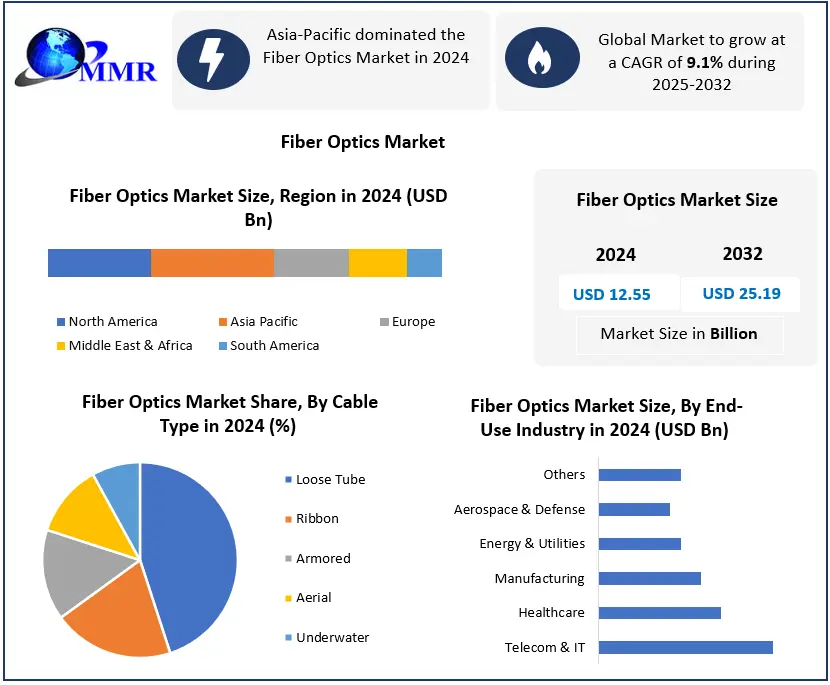
The global fiber optics market size reached USD 12.55 billion in 2024 and is projected to scale to USD 25.19 billion by 2032.
Market revenue registers a compound annual growth rate (CAGR) of 9.1% over the forecast window from 2025 to 2032.
Hardware components generate the maximum revenue share, encompassing physical cables, connectors, transmitters, receivers, and amplifiers.
Single-mode optical fiber stands as the dominant fiber type, driven by strict requirements for long-distance signal transmission and minimal attenuation.
Asia Pacific represents a premier locus for network modernization, backed by intensive infrastructural developments in China and India.
High initial capital installation costs and complex civil deployment protocols remain the primary systemic barriers to widespread market adoption.
Why This Matters Now
Legacy copper-based telecommunications frameworks have officially hit an architectural ceiling regarding data-intensive cloud applications. Modern corporate workloads spread massive resource requirements across distributed edge computing setups, high-density AI storage systems, and remote enterprise applications, making standard bandwidth pipelines entirely insufficient.
Technology strategists are realizing that network latency directly compromises workforce productivity and algorithmic processing speeds. Delays in raw packet transmission and localized data bottlenecks instantly lower system performance across financial trading networks, automated manufacturing hubs, and cloud-delivered software environments.
The expansion of dense 5G infrastructure, virtualized telecom networks, and automated municipal frameworks has converted fiber optic deployment into a mandatory foundation for digital transformation initiatives. For chief information officers (CIOs) and telecom operators, deployed fiber backbones now determine how effectively an enterprise accommodates the increasing data requirements of next-generation connectivity.
Market Overview
The global Fiber Optics Market achieved an industrial valuation of USD 12.55 billion in 2024. Supported by extensive data center investments and global network modernization initiatives, the total market size is projected to reach USD 25.19 billion by 2032. This trajectory represents a sustained CAGR of 9.1% across the eight-year forecast window.
The underlying infrastructure provides the high-bandwidth, low-attenuation transmission channels required for long-distance communication networks. By substituting traditional copper wiring with high-purity glass or plastic waveguides, these deployments allow commercial carriers and private cloud providers to transmit massive data packets at light speed across regional and international network backbones.
Key Trends Driving Growth
The primary catalyst reshaping the global network landscape is the insatiable commercial demand for high-speed internet and real-time data transfer. Bandwidth-intensive applications like multi-stream video broadcasting, interactive digital environments, and remote automation platforms require ultra-low latency pipelines. This trend forces internet service providers (ISPs) to systematically replace legacy coaxial hardware with pure glass backbones to avoid network congestion.
Concurrently, telecommunications operators are executing massive infrastructure expansions to support dense 5G standalone networks. Cellular providers, exemplified by Verizon’s Fios architecture in the United States, are deploying thousands of miles of fiber lines to connect modern macro cells and localized small cells back to centralized data hubs. Without a dense underlying fiber grid, the high capacity and millisecond latency promises of 5G infrastructure cannot be realized.
Furthermore, municipal smart city initiatives are emerging as an essential driver for regional fiber optic deployment. Interconnected municipal systems rely on fiber networks as a foundational backbone to facilitate real-time data exchange across smart traffic management setups, environmental monitoring sensors, and public safety cameras. The structural scalability of fiber optics ensures that local governments can future-proof their physical infrastructure against growing data loads over long-term municipal planning cycles.
Segment Insights
The market is shifting decisively toward high-performance component engineering and long-haul transmission frameworks, as detailed below:
Hardware Sub-segment (Dominant Component Segment): Physical infrastructure components generate the maximum revenue share within the component category. This segment includes glass fiber cables, specialized connectors, high-frequency transmitters, optic receivers, optical amplifiers, and related endpoint equipment vital for establishing and operating high-capacity optical networks.
Single-Mode Optical Fiber (Dominant Fiber Type Segment): Single-mode fiber architectures dominate product deployment due to their narrow core diameter, which allows only a single spatial mode of light to propagate. This design yields exceptionally low signal attenuation and maximum bandwidth capacity over long distances, making single-mode fiber the absolute standard for telecom backbone networks and large-scale data center interconnects.
Regional Growth Story
The Asia Pacific region functions as the fastest-growing and highest-volume locus for fiber optic deployment. This rapid expansion is driven by intensive digital infrastructure investments in major technology markets like China and India, where governments are financing nationwide internet connectivity and broad telecom modernization campaigns. The region’s software ecosystem and tech startup base are expanding by approximately 10% annually, creating immediate commercial demand for ultra-dense fiber routing to manage rising cloud data traffic.
North America maintains a highly mature position in the global market, led by major technological innovators and equipment manufacturers based in the United States. High spending on corporate cybersecurity resilience, advanced data center investments, and early adoption of cloud computing models sustain large-scale fiber procurements. Deployed networks across the United States are increasingly optimized for hybrid cloud strategies, linking on-premise industrial data centers with hyperscale public cloud nodes via private fiber rings.
Europe exhibits steady infrastructure expansion, heavily shaped by regional digital sovereignty regulations and compliance frameworks. European operators are deploying high-count fiber cables to secure localized data routing and satisfy data privacy laws. Rising demand from automated manufacturing centers, healthcare imaging networks, and the banking sector across Germany and the United Kingdom continues to stimulate long-haul cable integration.
Competitive Landscape
The competitive landscape is defined by a concentrated group of advanced engineering conglomerates alongside specialized connectivity developers. Adtell Integration, Adtran, Inc., Broadcom, Inc., Ciena Corporation, Cisco Systems, Inc., CommScope, Corning, Inc., and Finisar Corporation represent the leading entities driving hardware and software platform innovation.
Strategic technological updates continue to redefine platform capabilities and market positioning. For instance, in December 2023, researchers achieved a breakthrough in fiber optics by unveiling the first visible spectrum fiber laser producing femtosecond pulses. Utilizing a lanthanide-doped fluoride fiber and a commercial blue laser diode, this development heralds a new era of compact, efficient, and reliable ultrafast lasers, promising diverse industrial applications across materials processing and biomedicine.
Simultaneously, upstream academic and industrial partnerships are expanding the capabilities of existing infrastructure layers. In November 2023, physicists at Nanjing University successfully extended quantum storage times at telecom wavelengths. This achievement represents a critical milestone for integrating practical quantum networks directly into current fiber optic systems, offering future-proof data security upgrades for enterprise technology buyers and security-conscious cloud providers.
Faced with rising competition from low-cost material suppliers, premium vendors are focusing their capital deployment on high-value architectural innovations and complete end-to-end hardware-software integration. Leading manufacturers are engineering smart fiber cables with integrated optical sensing features, turning raw transmission lines into active data monitors that can detect physical tampering or structural stress points in real time. However, the high upfront capital costs and complex civil engineering processes associated with excavation and submarine laying remain the primary barriers to commercial deployment schedules.
Recent Developments
In December 2023, researchers successfully commercialized a visible spectrum fiber laser using a lanthanide-doped fluoride fiber, introducing compact femtosecond pulse technology to scientific and industrial processing fields.
In November 2023, physicists at Nanjing University extended quantum storage times at telecom wavelengths, paving the way for native quantum encryption integration within standard commercial fiber channels.
Major telecommunications carriers have expanded their deployment of high-count ribbon fiber cables to maximize fiber density inside existing underground conduit systems without requiring new excavation permits.
Enterprise hardware vendors have integrated machine learning diagnostics into optical receivers to automatically predict component degradation and prevent network outages before physical line failure occurs.
Strategic Implications
For technology executives and telecom operators, investing in advanced single-mode fiber architecture is a mandatory prerequisite for long-term operational scaling. Deployed pipelines must feature sufficient dark fiber capacity—unactivated fiber lines reserved for future use—to accommodate the impending influx of generative AI workloads and edge computing data traffic without requiring continuous, costly physical upgrades.
Furthermore, cloud providers and data center operators must align their facilities with high-speed optical routing platforms. As enterprise software demand shifts toward real-time automated processing and microservice API ecosystems, data center interconnects must leverage advanced wave-division multiplexing hardware to maximize data throughput across existing fiber footprints.
Future Outlook
The global fiber optics market will remain the definitive baseline for international data transport and next-generation connectivity. As the requirements of artificial intelligence, machine learning adoption, and virtualized telecommunications networks outgrow standard metallic cabling, the reliance on high-purity glass infrastructure will remain absolute. Technology leaders who prioritize aggressive fiber deployment and quantum-ready optical security will establish an unassailable data-transmission advantage, whereas organizations reliant on legacy, copper-tethered network constraints will suffer from permanent bandwidth limitations and degraded operational capacity.
Analyst Perspective
“The fiber optics market has graduated from simple telecom cabling into a critical piece of global economic infrastructure. Widespread cloud migration and high-density AI processing have made massive bandwidth a baseline operational commodity, forcing network planners to invest heavily in advanced single-mode glass and quantum-compatible optical hardware to prevent systemic data bottlenecks.”Yash Ghosalkar, Analyst, Maximize Market Research
About Maximize Market Research
Maximize Market Research Pvt. Ltd. (MMR) is a global market research and consulting company that provides reliable, data-focused, and practical business insights. The firm serves a wide range of industries, including healthcare, pharmaceuticals, technology, automotive, electronics, chemicals, personal care, and consumer goods. Through market forecasts, competitive analysis, strategic consulting, and industry impact assessments, MMR helps organizations understand changing market conditions, identify growth opportunities, and make informed business decisions for long-term success.
2nd Floor, Navale IT Park Phase 3
Pune Banglore Highway, Narhe
Pune, Maharashtra 411041, India
+91 9607365656
sales@maximizemarketresearch.com
