LEO Terminals Market: Expanding Satellite Connectivity Drives the Future of Global Broadband
The LEO (Low Earth Orbit) Terminals Market is entering a period of sustained growth as satellite broadband networks rapidly expand to meet the increasing demand for high-speed, low-latency connectivity across remote, rural, maritime, aviation, enterprise, and defense applications. The deployment of next-generation LEO satellite constellations is transforming global communications by delivering reliable internet services to areas underserved by traditional terrestrial infrastructure.
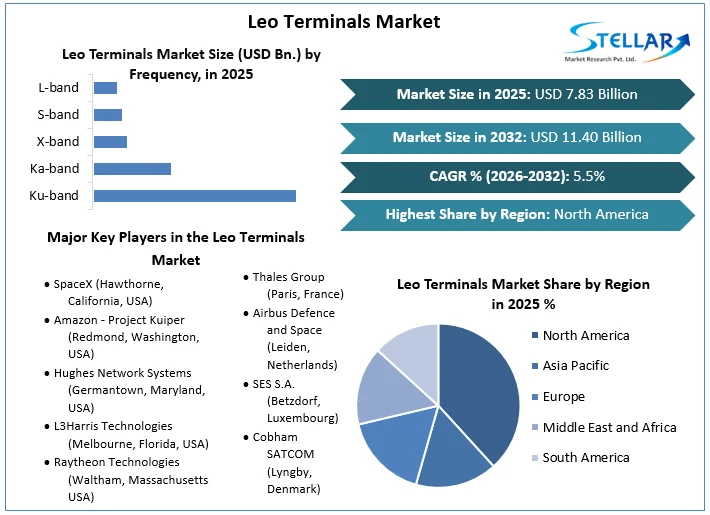
According to Stellar Market Research, the global LEO Terminals Market was valued at USD 7.83 billion in 2025 and is projected to reach USD 11.40 billion by 2032, registering a CAGR of 5.5% during the forecast period. The market’s expansion is being driven by increasing investments in satellite communication infrastructure, rapid digital transformation, and growing demand for resilient broadband connectivity across commercial and government sectors.
Download Free PDF Brochure: https://www.stellarmr.com/report/req_sample/leo-terminals-market/2653
Rising Demand for High-Speed Connectivity Accelerates Market Growth
The rapid expansion of digital services has significantly increased the need for reliable internet access regardless of geographical location. Conventional terrestrial networks often struggle to provide consistent connectivity in remote regions, offshore operations, disaster-affected areas, and moving platforms such as ships and aircraft. LEO satellite terminals address these challenges by offering low-latency, high-bandwidth communication through satellite constellations positioned much closer to Earth than traditional geostationary satellites.
Governments, telecommunications providers, logistics companies, and enterprise customers are increasingly adopting LEO terminal solutions to improve communication reliability while supporting digital transformation initiatives. As satellite networks continue expanding globally, demand for advanced user terminals capable of seamless connectivity is expected to remain strong.
Smart Infrastructure and Digital Payments Create New Opportunities
Beyond broadband connectivity, modern LEO terminals are supporting an expanding range of digital applications including contactless payment systems, industrial IoT communication, warehouse automation, fleet management, and smart city infrastructure. Businesses increasingly require secure, real-time communication systems capable of supporting mission-critical operations across distributed locations.
The growth of e-commerce, logistics automation, and digital financial services has further accelerated demand for intelligent terminal solutions that combine advanced communication capabilities with durable, energy-efficient designs. The integration of artificial intelligence, cloud computing, and 5G technologies is enabling smarter terminals with enhanced processing capabilities and improved operational efficiency.
Technological Innovation Enhances Terminal Performance
Manufacturers continue investing in research and development to improve antenna performance, reduce terminal size, lower power consumption, and simplify deployment. Flat-panel electronically steered antennas, software-defined networking, and advanced semiconductor technologies are enabling faster installation while improving network reliability.
Modern LEO terminals increasingly feature:
High-speed broadband connectivity
AI-powered network optimization
Multi-orbit compatibility
Lightweight and portable designs
Energy-efficient architectures
Secure encrypted communications
Remote software updates and diagnostics
These innovations are improving user experiences while reducing operational costs for enterprise customers and satellite service providers.
Commercial and Government Applications Expand Rapidly
The commercial sector continues to represent one of the fastest-growing markets for LEO terminal deployment. Retail businesses, logistics providers, transportation companies, energy operators, and financial institutions are increasingly utilizing satellite-based communication to improve operational continuity.
Government agencies and defense organizations are also investing heavily in resilient satellite communication networks capable of supporting emergency response, border surveillance, disaster recovery, and military operations. Reliable broadband connectivity has become a strategic requirement for national infrastructure modernization initiatives.
Regional Market Outlook
North America currently leads the global LEO Terminals Market, supported by advanced satellite communication infrastructure, strong investments in Low Earth Orbit satellite constellations, and the presence of major industry participants. Increasing demand for broadband services in rural communities, maritime operations, and aviation continues to strengthen regional growth.
Europe remains the second-largest regional market, driven by government initiatives aimed at improving digital connectivity and satellite broadband deployment. Collaborative aerospace projects and investments in next-generation communication infrastructure continue supporting market expansion.
The Asia-Pacific region is emerging as one of the fastest-growing markets due to rapid digitalization, expanding telecommunications infrastructure, increasing internet penetration, and growing demand for high-speed connectivity across developing economies. Countries including China, India, Japan, South Korea, and Australia are investing heavily in satellite communication technologies to bridge digital connectivity gaps.
Competitive Landscape
The LEO Terminals Market remains highly competitive, with global companies focusing on innovation, satellite network expansion, and strategic partnerships. Major industry participants are investing in research and development to deliver compact, high-performance terminals capable of supporting diverse commercial, enterprise, and government applications.
Leading companies include SpaceX (Starlink), OneWeb, Telesat, Amazon (Project Kuiper), and SES, among others. These organizations continue expanding satellite constellations, improving terminal technologies, and strengthening partnerships with telecommunications providers and government agencies to increase global market presence.
Download Free PDF Brochure: https://www.stellarmr.com/report/req_sample/leo-terminals-market/2653
Emerging Trends Shaping the Market
Several trends are expected to influence future market development:
Expansion of Low Earth Orbit satellite constellations
Growing demand for broadband connectivity in remote locations
Increased adoption of flat-panel satellite antennas
Integration of AI-driven network optimization
Development of multi-orbit communication terminals
Expansion of enterprise satellite connectivity services
Growth in maritime and aviation broadband applications
Rising investments in smart infrastructure and IoT ecosystems
Manufacturers are also focusing on improving terminal affordability, portability, and ease of deployment to expand adoption across both developed and emerging markets.
Future Outlook
The future of the LEO Terminals Market appears highly promising as governments, enterprises, and communication providers continue investing in advanced satellite connectivity solutions. The increasing reliance on digital communication, remote operations, cloud services, and intelligent infrastructure will continue driving demand for high-performance LEO terminals.
Advancements in satellite technology, artificial intelligence, 5G integration, and software-defined networking are expected to further improve communication reliability while reducing deployment costs. As global satellite constellations continue expanding, LEO terminals will become increasingly important for delivering seamless broadband connectivity across commercial, industrial, government, and consumer applications.
Companies that prioritize technological innovation, strategic partnerships, scalable manufacturing, and customer-focused product development will be well-positioned to capitalize on the growing opportunities within the global LEO Terminals Market. With digital connectivity becoming essential for economic development and operational resilience, LEO terminals are expected to play a transformative role in shaping the future of global communications.
Media Contact
Stellar Market Research
Website: Stellar Market Research – Global Research Reports & Consulting
Email: sales@stellarmr.com
