Key Highlights
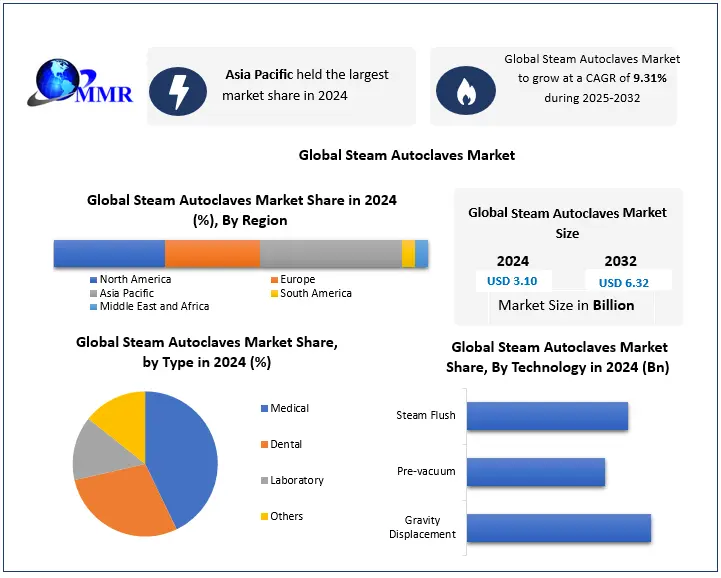
Global market valuation is ascending from USD 3.10 billion in 2024 to USD 6.32 billion by 2032, advancing at a 9.31% compound annual growth rate (CAGR).
Vertical and tabletop product types command the dominant share of market revenue, driven by intense deployment across research laboratories and pharmaceutical units.
The medical application segment rules global volume consumption because of immediate sterilization mandates across expanding hospital networks.
The rising prevalence of hospital-acquired infections (HAIs) forces healthcare administrators to increase capital spending on heavy decontamination machinery.
The growing commercial use of disposable or single-use medical consumables presents a continuing baseline restraint to long-term autoclave utilization.
Why This Matters Now
Hospital executives, medical device manufacturers, and pharmaceutical operations directors face severe regulatory and financial risks as healthcare-associated pathogens adapt to basic hygiene protocols. The steam autoclaves market has transitioned from a routine basement utility into a core component of clinical risk management. Institutions that fail to expand their high-pressure thermal sterilization infrastructure face immediate containment failures, leading to rising patient readmission rates and significant financial penalties from insurance providers.
The commercial realities of modern healthcare require a complete overhaul of traditional decontamination workflows. Rising patient volumes, coupled with a surge in complex surgical interventions, create an intense supply bottleneck within central sterile supply departments (CSSDs). Securing advanced, high-throughput thermal sterilization channels determines which healthcare systems can safely maximize procedural capacity without exposing patients to cross-contamination risks.
Market Overview
The global steam autoclaves market Size achieved a clear valuation of USD 3.10 billion in 2024 and is on a definitive path to hit USD 6.32 billion by 2032, expanding at a 9.31% CAGR. These specialized containment systems use superheated steam under extreme physical pressure to neutralize resilient pathogens, micro-organisms, and spongy spores. The complete process is required to decontaminate biological wastes and sterilize critical clinical labware, surgical instruments, media, and chemical reagents.
Currently, institutional demand centers around automated decontamination equipment that combines fast processing cycles with strict safety verifications. The systemic threat of hospital-acquired infections acts as the primary economic force expanding the market, forcing hospital systems to prioritize automated sterilization hardware over manual chemical alternatives. To offset the high capital expenditure required for these industrial installations, healthcare procurement divisions are establishing long-term service and validation contracts with dominant original equipment manufacturers (OEMs).
Key Trends Driving Growth
The rapid enforcement of stricter clinical infection control protocols acts as the primary driver expanding the active target market across international borders. Global health authorities are implementing zero-tolerance policies regarding preventable patient cross-contamination during inpatient stays. Because manual disinfection methods are vulnerable to human error, hospital networks are accelerating the installation of large-capacity thermal autoclaves to protect patient safety metrics.
Furthermore, technical advancements in automated pressure tracking and heat regulation architectures represent a second primary force pushing market revenue forward. Device manufacturers are integrating real-time digital monitoring sensors that log cycle metrics to ensure complete sterilization validation. This technological integration simplifies compliance audits for healthcare networks, allowing operational managers to maintain verifiable regulatory records while maximizing daily decontamination throughput.
𝐃𝐨𝐰𝐧𝐥𝐨𝐚𝐝 𝐏𝐃𝐅 𝐁𝐫𝐨𝐜𝐡𝐮𝐫𝐞 @
Segment Insights
Vertical and Tabletop Types (Dominant Segment): These product configurations dominate the global industry footprint. Widespread adoption is sustained by high operational versatility across research laboratories, pharmaceutical manufacturing units, breweries, and specialized fertilizer plants.
Medical Segment (Dominant Application Segment): This application sector holds the largest revenue share due to the non-discretionary requirement for sterile instruments across acute care facilities, surgical suites, and long-term diagnostic clinics.
Horizontal and Floor-Standing Types: These heavy industrial systems generate a stable revenue stream, serving as the core infrastructure for high-volume biopharmaceutical decontamination and bulk waste treatment.
High-Pressure Systems: This category is capturing specialized interest because of its rapid cycle times, which allow clinical teams to minimize instrument downtime between complex surgical procedures.
Regional Growth Story
North America maintains a dominant position in global steam autoclave deployment, backed by high institutional spending and an advanced medical infrastructure. The region’s competitive positioning is maintained by rigorous compliance mandates from regional safety boards, which force healthcare networks to continuously update their sterilization equipment. Frequent collaborations among major market players, coupled with automated laboratory projects that reduce manual operational errors, keep the region at the forefront of the market.
The Asia Pacific region is recording the highest CAGR during the forecast period due to rapid healthcare infrastructure modernization and expanding public investments. Increasing urbanization, coupled with the construction of multi-specialty hospital chains across developing hubs, is accelerating thermal sterilization adoption. Furthermore, expanding domestic pharmaceutical production across major sub-markets requires consistent installations of validation-ready decontamination machinery.
Competitive Landscape
The global competitive environment is characterized by intense product optimization as leading engineering firms look to secure long-term hospital procurement contracts. Market leaders utilize integrated hardware-and-maintenance service models to establish highly sticky revenue streams that deliver predictable, long-term commercial returns.
Key global enterprises positioning themselves across the market include:
BMM Weston
Belimed Deutschland
LTE Scientific
Getinge Infection Control
Medisafe International
Matachana
Priorclave
Eryigit Medical Devices
Recent Developments
Engineering teams at major autoclave manufacturing firms have increased their R&D spending to design energy-efficient water recirculation systems that minimize utility costs for high-volume hospitals.
Strategic partnerships between sterilization OEMs and digital health tracking providers have expanded, enabling direct integration of autoclave cycle logs into centralized hospital information networks.
Regional regulatory bodies have updated their validation frameworks, requiring more frequent biological indicator testing within active thermal containment chambers.
Leading equipment providers have expanded their technical support networks across emerging markets to address the growing demand for rapid on-site calibration services.
Strategic Implications
The formalization of institutional sterilization frameworks indicates a major shift in how modern hospital networks manage their clinical assets. Relying on fragmented, manual disinfection methods is no longer economically viable due to rising labor costs and the threat of severe medical malpractice claims linked to cross-contamination. By prioritizing automated, high-pressure steam autoclaves, clinical directors can protect their workflows from staff shortages while ensuring uniform sterilization baselines.
However, the increasing market penetration of single-use disposable medical consumables presents a continuing challenge that device manufacturers must monitor. While disposables reduce the immediate volume of instruments requiring thermal processing, they increase long-term hospital waste disposal costs and environmental tracking challenges. Manufacturers that position steam autoclaves as a more sustainable, cost-effective alternative for reusable surgical kits can secure a long-term competitive position within value-based health systems.
Future Outlook
As the global market advances toward its 2030 valuation milestone and heads toward its USD 6.32 billion projection by 2032, long-term commercial success will depend on managing utility consumption metrics and reducing equipment footprint sizes. The coming years will reward engineering innovators that deliver high-capacity, automated systems capable of fast processing cycles without consuming excessive water or electrical power. Ultimate market leadership belongs exclusively to those enterprises that deploy smart, highly efficient thermal validation platforms today, while legacy producers relying on slow, unoptimized energy-intensive machinery will find themselves marginalized.
Analyst Perspective
“The expansion of the global steam autoclaves market highlights an administrative shift toward completely automated infection containment strategies. As hospital-acquired infection tracking intensifies globally, long-term asset value will center on the digital integration of sterilization data into the core operational networks of modern healthcare facilities.” — Komal Patil, Research Analyst, Maximize Market Research
About Maximize Market Research
Maximize Market Research Pvt. Ltd. (MMR) is a global market research and consulting company that provides reliable, data-focused, and practical business insights. The firm serves a wide range of industries, including healthcare, pharmaceuticals, technology, automotive, electronics, chemicals, personal care, and consumer goods. Through market forecasts, competitive analysis, strategic consulting, and industry impact assessments, MMR helps organizations understand changing market conditions, identify growth opportunities, and make informed business decisions for long-term success.
2nd Floor, Navale IT Park Phase 3
Pune Banglore Highway, Narhe
Pune, Maharashtra 411041, India
+91 9607365656
sales@maximizemarketresearch.com
