Key Highlights
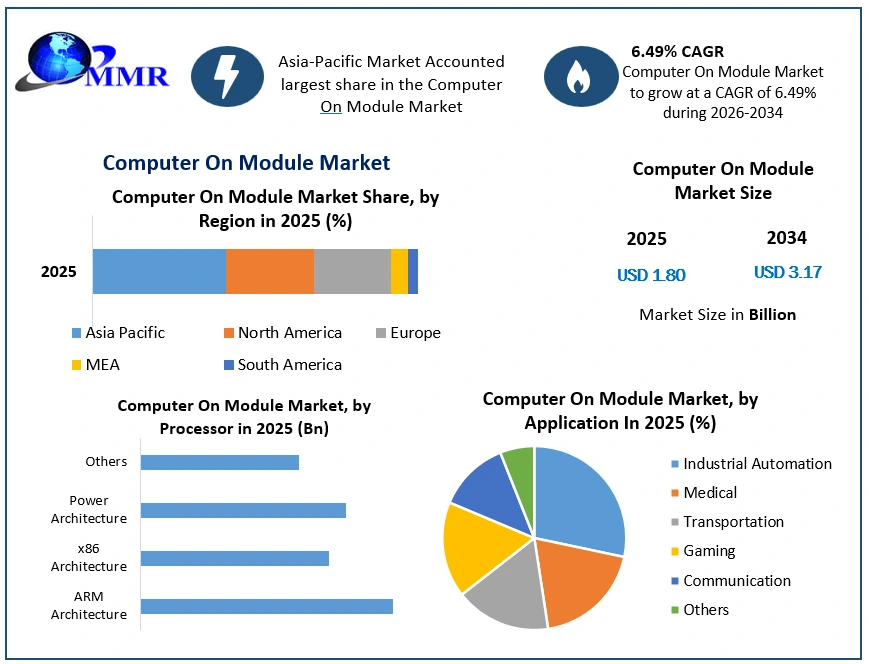
- Edge AI and industrial automation are turning computer-on-module platforms into strategic embedded infrastructure for robotics, machine vision and smart factories. The Computer On Module Market was valued at US$ 1.80 Bn in 2025 and is expected to reach US$ 3.17 Bn by 2034, creating a growth opportunity for embedded hardware vendors, industrial OEMs and edge computing suppliers.
- The computer on module market is forecast to grow at a 6.49% CAGR from 2026 to 2034, showing steady demand for compact modular computing in industrial and connected-device environments.
- Industrial Automation dominated the global market in 2025, with the application segment holding nearly 32.89% share, making factories, logistics systems and production equipment the clearest demand base.
- Asia Pacific accounted for the largest market share in 2025 and is expected to register a 7.12% CAGR from 2026 to 2034, strengthening the region’s role in embedded computing and automation supply chains.
- Recent launches from congatec, DATA MODUL, Advantech, Portwell and SECO show the market moving toward edge AI, integrated neural processing, machine vision and secure embedded operating systems.
Why This Matters Now
Industrial systems are becoming smaller, smarter and more software-defined. Computer-on-module platforms help OEMs add computing, connectivity and embedded intelligence without designing full custom boards for every product.
The shift matters for CIOs, CTOs, automation leaders and device manufacturers because COM platforms shorten development time and reduce hardware design complexity. MMR identifies Ethernet connections, Bluetooth radios, flash memory drives and inbuilt Wi-Fi modules as basic parts of these systems, linking the market to connected industrial devices and IoT gateways.
Market Overview
A computer on module is an embedded technology that combines computing components into a single hardware module or chipset. The chipset is then combined with software to complete a system or computer, making COMs suitable for compact and portable computing systems.
The computer on module market is segmented by processor into ARM Architecture, x86 Architecture, Power Architecture and others. It is segmented by form factor into COM Express, SMARC, Qseven, ETX and others, and by application into Industrial Automation, Medical, Transportation, Gaming, Communication and others.
The public page contains a visible header inconsistency: the top panel lists US$ 1.80 Bn as forecast market size, while the overview and scope table state US$ 1.80 Bn in 2025 and US$ 3.17 Bn by 2034. This article uses the overview and scope-table figures because they match the supplied market-size statement.
Key Trends Driving Growth
Industrial automation is the first growth driver. Robotics, SCADA, PLCs and new automation technologies are increasing demand for compact computing modules that can improve productivity and reduce industrial operating costs.
Industry 4.0 is the second catalyst. Customers want smart industrial applications that improve operational performance, and module-based architecture gives equipment manufacturers a faster path to deploy connected automation systems.
Edge AI is now a visible technology shift. In 2026, congatec introduced a COM Express Compact module with up to 41 TOPS of total AI performance without a discrete accelerator, while SECO launched a COM Express Type 6 module offering up to 180 platform TOPS for high-demand edge applications.
Machine vision is becoming a high-value use case. Advantech’s AOM modules using NXP i.MX 95 processors target scalable, high-efficiency compute deployments for edge-level machine vision, showing demand from industrial inspection and intelligent device markets.
IoT security remains the main challenge. MMR states that COMs and other single-board computers are critical to IoT, but manufacturers must invest in secure access, gateway design and module-level protection to prevent theft of confidential data.
Start Your Market Research Journey with a Free Sample Report
Segment Insights
- Dominant Segment Industrial Automation: Industrial Automation dominated the Computer On Module Market in 2025. The application segment held nearly 32.89% share, supported by the use of integrated modules in manufacturing, product assembly, supply chain management and logistics.
- Fastest-Growing Segment: The public MMR page does not identify a fastest-growing processor, form factor or application segment with a usable CAGR. No segment-level fastest-growth claim is inferred.
- Processor Scope ARM, x86 and Power Architecture: The report covers ARM Architecture, x86 Architecture, Power Architecture and others, but public processor-level market shares and growth rates are not disclosed.
- Form Factor Scope COM Express, SMARC, Qseven and ETX: The market covers several standard module formats, but the public page does not rank form factors by share or growth rate.
- Application Scope Medical, Transportation, Gaming and Communication: These use cases are included, but the public page does not disclose application-level revenues beyond the industrial automation share.
Regional Growth Story
Asia Pacific accounted for the largest market share in 2025 and is expected to register a 7.12% CAGR during 2026 to 2034. The region benefits from demand for advanced computing solutions and the development of industrial automation capabilities.
India and Taiwan are highlighted for developing manufacturing and industrial automation capabilities across sectors. China is identified as a high-share and high-growth market within the region because of established commercial facilities, continuous startup formation and reliance on automation techniques.
The report covers the United States, Canada, Mexico, the UK, France, Germany, Italy, Spain, Sweden, Austria, China, South Korea, Japan, India, Australia, Indonesia, Malaysia, Vietnam, Taiwan, Bangladesh and Pakistan. Country-level revenues, 5G deployment values, telecom infrastructure spending, cloud migration activity and data center investment are not disclosed.
Competitive Landscape
Key players include Kontron, congatec, MSC Technologies, Advantech, ADLink, Portwell, Eurotech, SECO, Technexion, Phytec, Axiomtek, Aaeon, Toradex, EMAC, Avalue Technology, CompuLab, Variscite, Digi International, Olimex, Shiratech, Critical Link and iWave Systems Technologies. The market combines module specialists, embedded systems vendors and industrial computing suppliers.
Competition is moving toward edge-ready performance and hardware-software integration. Congatec, DATA MODUL, Portwell and SECO are using Intel Core Series 3 and Intel Core Ultra Series 3 processors to position COM platforms for edge AI, industrial automation and medical technology.
Kontron’s embedded systems partnership with congatec signals a shift toward secure module ecosystems. Integrating hardened operating systems into standard-based Computer-on-Modules shows that cybersecurity is becoming a product differentiator, not an after-sale feature.
The public page does not disclose data center investments, telecom network expansions, 5G deployments, cloud migration contracts or generative AI software launches. The visible competitive direction is edge AI compute, neural processing, compact industrial design, machine vision and secure embedded platforms.
Recent Developments
- 16 April 2026 congatec GmbH: congatec introduced the conga-TC300 Computer-on-Module in COM Express Compact form factor based on Intel Core Series 3 processors, delivering up to 41 TOPS of total AI performance without a discrete accelerator.
- 04 March 2026 DATA MODUL AG: DATA MODUL expanded its embedded solution family with high-performance Computer-on-Modules using Intel Core Ultra Series 3 processors on congatec platforms for industrial automation and medical technology.
- 04 February 2026 Advantech Co., Ltd.: Advantech launched two compact AOM-series Computer-on-Modules using NXP i.MX 95 processors for edge-level machine vision applications.
- 27 January 2026 American Portwell Technology: Portwell unveiled a COM Express module and Mini-ITX board powered by Intel Core Ultra Series 3 processors for edge-ready industrial applications.
- 06 January 2026 SECO S.p.A.: SECO launched the SOM-COMe-BT6-PTL COM Express Type 6 module with Intel Core Ultra Series 3 processors and up to 180 platform TOPS for high-demand edge applications.
- 25 November 2025 Kontron AG: Kontron formed a strategic embedded systems partnership with congatec to integrate hardened KontronOS into standard-based Computer-on-Modules.
Strategic Implications
For industrial OEMs, COMs reduce hardware design complexity and shorten product development cycles. This matters in automation, robotics and machine vision, where product refresh speed increasingly determines competitiveness.
For CIOs and CTOs, the market signals a broader shift toward distributed computing at the edge. AI-capable modules allow more processing to occur inside machines, gateways, medical devices and automated retail systems rather than relying only on centralized infrastructure.
For investors, the market offers exposure to industrial automation, embedded systems, robotics, medical devices, edge AI and IoT security. The key risks are module-level security requirements, development and testing costs, and the absence of publicly disclosed segment-level growth rates.
Future Outlook
The Computer On Module Market is forecast to grow from US$ 1.80 Bn in 2025 to US$ 3.17 Bn by 2034 at a 6.49% CAGR. Growth will come from industrial automation, robotics, Industry 4.0, edge AI, compact computing systems, medical technology, transportation, communication, machine vision and secure IoT gateway applications.
The next phase will test whether module vendors can combine AI acceleration, compact design, security and industrial reliability in standard platforms. Future digital leaders will control the edge computing layer inside machines and connected systems; laggards will remain tied to slower custom hardware cycles while competitors turn modular compute into faster automation and smarter device platforms.
Analyst Perspective
“Computer-on-module platforms are becoming strategic embedded infrastructure as industrial automation, robotics, IoT gateways and edge AI applications demand compact, secure and scalable computing,” said Yash Ghosalkar, Analyst at Maximize Market Research. “The strongest providers will combine standard form factors, integrated AI acceleration, cybersecurity readiness, industrial reliability and faster OEM development paths.”
About Maximize Market Research
Maximize Market Research Pvt. Ltd. (MMR) is a global market research and consulting company that provides reliable, data-focused, and practical business insights. The firm serves a wide range of industries, including healthcare, pharmaceuticals, technology, automotive, electronics, chemicals, personal care, and consumer goods. Through market forecasts, competitive analysis, strategic consulting, and industry impact assessments, MMR helps organizations understand changing market conditions, identify growth opportunities, and make informed business decisions for long-term success.
Contact Us
2nd Floor, Navale IT Park Phase 3
Pune Banglore Highway, Narhe
Pune, Maharashtra 411041, India
+91 9607365656
sales@maximizemarketresearch.com
