Key Highlights
The global cognitive assessment and training market is expanding rapidly, with major growth driven by the integration of AI, machine learning, and neuro-technologies.
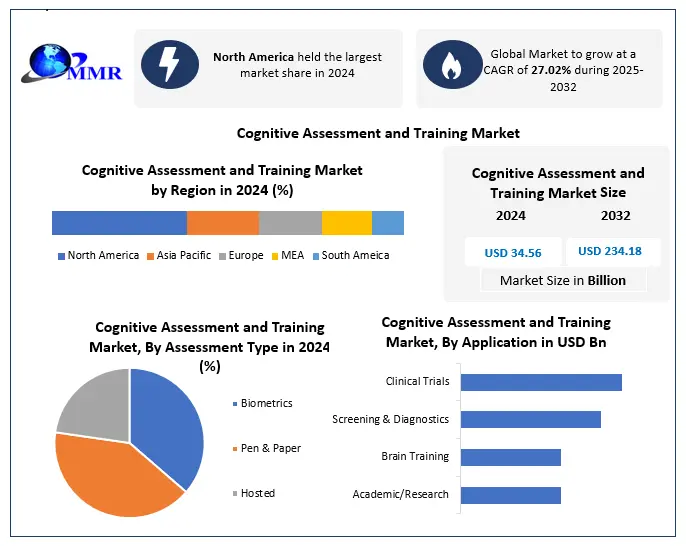
Traditional pen-and-paper-based assessments maintain a dominant revenue share due to their established reliability, regulatory acceptance, and lack of technical barriers in clinical and educational settings.
North America currently holds the largest market share, fueled by high healthcare expenditures, significant R&D investments, and a growing geriatric population facing age-related cognitive decline.
Enterprise and corporate sectors are increasingly adopting cognitive training to optimize workforce performance, leadership development, and cognitive flexibility.
The clinical trials segment remains a primary growth engine, as biopharmaceutical companies leverage digital assessment tools to improve diagnostic precision and data quality for CNS-related drug development.
Systemic challenges such as the lack of standardized validation methods and the need for data privacy protection remain key hurdles for global scalability.
Why This Matters Now
The world is facing a “cognitive imperative.” With an aging global population and rising mental health awareness, the demand for precise, early-stage cognitive detection has transitioned from a specialized medical niche to a mainstream enterprise and healthcare priority. Organizations are no longer just measuring performance; they are measuring brain health as a core component of human capital and clinical efficacy.
Technology leaders and healthcare executives now realize that cognitive decline and mental fatigue represent hidden operational costs—whether through reduced workforce productivity or delayed clinical trial timelines. By shifting to digital-first assessment platforms, they are turning qualitative mental health indicators into quantitative, actionable data. For stakeholders, the transition to cognitive-aware systems is not just about wellness; it is about building the infrastructure for a sharper, more resilient future.
Market Overview
The global Cognitive Assessment and Training Market is undergoing a fundamental structural shift, moving from static diagnostic tests to dynamic, AI-powered ecosystems. This evolution is facilitated by the rapid convergence of cloud computing, mobile device proliferation, and neuro-scientific breakthroughs.
As institutions across healthcare, education, and corporate sectors seek to quantify “mental state” and “cognitive potential,” they are adopting centralized platforms that offer real-time data analysis. These tools support diverse use cases, ranging from the early detection of dementia in seniors to the cognitive enhancement of high-performing corporate teams. The market’s growth is inherently tied to this digitization trend, which replaces fragmented manual assessments with scalable, high-fidelity software solutions.
Key Trends Driving Growth
Artificial Intelligence (AI) and Machine Learning (ML) are the primary catalysts transforming the cognitive landscape. Modern platforms now use these technologies to personalize training programs, allowing them to adapt in real-time to an individual’s progress. By analyzing vast datasets of cognitive performance, AI models can detect subtle patterns of decline or improvement that human observers would miss.
Simultaneously, the expansion of telehealth and remote monitoring has enabled cognitive assessments to transcend traditional hospital settings. This digital transformation allows for continuous, longitudinal data tracking, which is essential for diagnosing chronic neurological conditions and monitoring cognitive wellness. For enterprises and research institutions, this means shorter trial cycles, more accurate patient recruitment, and deeper insights into learning efficacy.
Furthermore, there is an intensifying focus on “Cognitive Wellness” as a pillar of employee performance. Corporations are integrating brain-training modules into their talent management software, aiming to boost memory, attention, and complex problem-solving abilities. This reflects a broader shift: cognitive health is now being treated as a quantifiable asset, similar to physical health and financial solvency.
Segment Insights
The market is defined by a dichotomy between established methodologies and emerging digital solutions:
Pen and Paper-based Assessment (Dominant Segment): Traditional methods hold the largest market share. Their dominance is rooted in established regulatory reliability, lack of technical infrastructure requirements, and ease of use in clinical and classroom environments globally.
Hosted/Digital Assessment (Fastest-Growing Segment): AI-enhanced, cloud-based assessment tools are witnessing the most rapid growth. These solutions offer superior data management, automated scoring, and real-time reporting, positioning them as the inevitable successors to manual workflows.
Regional Growth Story
North America remains the undisputed leader in market revenue, supported by a mature healthcare infrastructure and a high concentration of neuro-tech innovators. Major clinical investments in the U.S. and Canada, coupled with supportive government policies regarding mental health and aging, ensure that the region remains at the forefront of early-detection technologies.
Asia Pacific is emerging as the fastest-growing frontier. Driven by a rapidly aging demographic and increased government funding for digital health in countries like China and India, the region is witnessing a surge in cognitive-tech adoption. The integration of mobile-first health apps into these fast-growing digital economies is creating a uniquely high growth potential for user-friendly, low-cost cognitive assessments.
Competitive Landscape
The competitive environment is shifting from individual product offerings to integrated ecosystem development. Key players such as Cogstate Ltd., Cambridge Cognition, Pearson, and others are moving beyond assessment tools to offer comprehensive platforms that include data management, research analytics, and training modules.
This consolidation signals a maturing market where platform scale and data security are the new currency. Strategic partnerships between neuro-tech firms and large-scale cloud providers are becoming common, as these tools require massive data processing capabilities to manage longitudinal patient information. We are also seeing “platformification,” where companies build API-driven ecosystems that allow clinical trials and educational institutions to plug in cognitive metrics directly into their own existing enterprise software environments.
The competition is no longer just about who has the best test; it is about who has the most reliable data platform. Companies that can provide seamless integration with existing hospital information systems or enterprise HR software are gaining distinct pricing power and market share.
Recent Developments
In 2025, major industry players accelerated R&D into AI-integrated diagnostic tools, shifting the focus from simple performance measurement to adaptive training systems.
Clinical research organizations have expanded the use of digital biomarker tools, allowing for more precise data collection in CNS (Central Nervous System) trials.
New partnerships between mental health startups and enterprise software vendors have integrated cognitive wellness tracking directly into employee performance dashboards.
Regulatory bodies have increased their scrutiny of digital assessment tools, leading to a new wave of industry-wide focus on standardized data validation and clinical proof of efficacy.
Strategic Implications
For enterprise technology buyers and healthcare providers, the imperative is clear: move away from siloed tools. The future of cognitive management lies in integrated data ecosystems where cognitive performance data informs broader decisions—be it clinical diagnosis or employee development. CIOs and CTOs must evaluate vendors based on the interoperability of their APIs and the transparency of their AI algorithms.
As digital sovereignty and data privacy regulations tighten, investing in platforms that offer robust, compliant data management is a prerequisite. Organizations that fail to standardize their approach to cognitive data will find themselves with fragmented information that is impossible to leverage for longitudinal insights.
Future Outlook
The cognitive assessment and training market is transitioning into a new era where brain health is treated as a foundational data point for the digital economy. The winners will not be those with the most tests, but those with the most actionable insights—leveraging AI to convert raw neural metrics into predictive behavioral models. Digital leaders who weave neuro-health into their core infrastructure will secure a massive performance advantage, while laggards remaining on stagnant, manual evaluation cycles will struggle to address the mounting complexity of a cognitively demanding future.
Analyst Perspective
“Cognitive assessment is moving from the back-office of clinical research to the front-lines of daily performance. By embedding AI-driven diagnostics into clinical and enterprise workflows, we are seeing the emergence of a multi-billion dollar sector that fundamentally changes how we monitor, treat, and enhance human cognitive potential. “Yash Ghosalkar, Analyst, Maximize Market Research
About Maximize Market Research
Maximize Market Research Pvt. Ltd. (MMR) is a global market research and consulting company that provides reliable, data-focused, and practical business insights. The firm serves a wide range of industries, including healthcare, pharmaceuticals, technology, automotive, electronics, chemicals, personal care, and consumer goods. Through market forecasts, competitive analysis, strategic consulting, and industry impact assessments, MMR helps organizations understand changing market conditions, identify growth opportunities, and make informed business decisions for long-term success.
2nd Floor, Navale IT Park Phase 3
Pune Banglore Highway, Narhe
Pune, Maharashtra 411041, India
+91 9607365656
sales@maximizemarketresearch.com
