Key Highlights
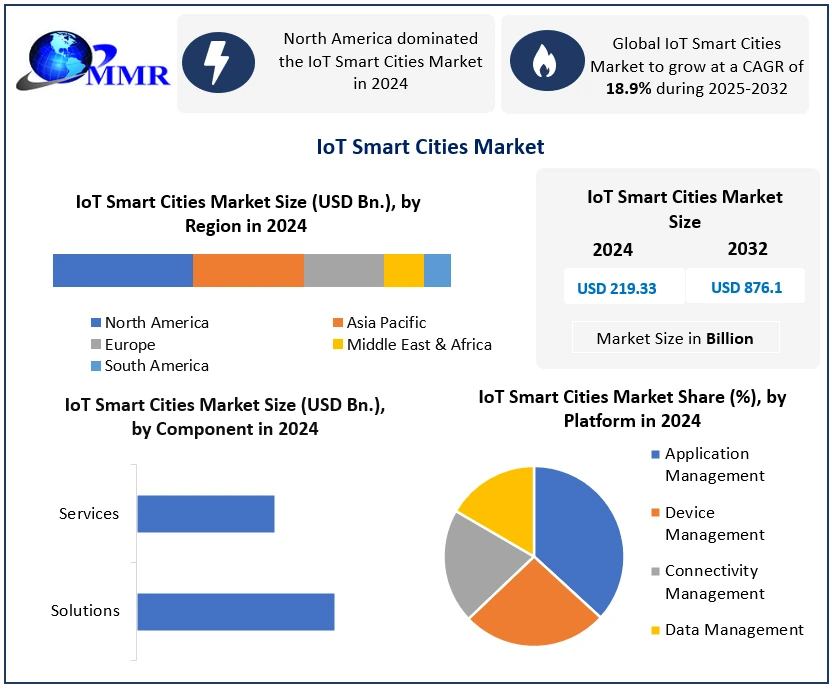
Rapid Market Expansion: Expected growth from USD 219.33 billion in 2024 to USD 876.1 billion by 2032, reflecting a massive capital shift toward integrated urban technology.
Integrated Solutions Dominance: Solutions-based components lead the market, prioritizing centralized, data-driven systems for utilities and traffic management.
Cloud-Native Orchestration: Application Management platforms emerge as the critical layer for ensuring seamless interaction between municipal infrastructure and citizen services.
Infrastructure Modernization: Transition from traditional, siloed city services to unified, interoperable digital frameworks powered by IoT.
Why This Matters Now
The traditional, siloed model of city management is effectively obsolete. As urbanization intensifies, city officials face the immediate pressure to manage infrastructure assets—power, water, traffic, and public services—with unprecedented precision. The shift toward IoT-enabled smart cities represents the most significant opportunity for telecom operators and technology providers to deploy enterprise-grade automation at a massive, municipal scale. Leaders who capture these urban contracts now will control the foundational infrastructure of 21st-century civilization.
Market Overview
The global IoT smart Cities Market is the primary venue for deploying enterprise-grade digital transformation. At its core, the market enables city officials to interact directly with infrastructure through real-time telemetry and predictive analytics. This is no longer an experimental phase; it is an industrial-scale rollout. As municipalities move away from legacy software, they are increasingly favoring cloud-native solutions that offer high scalability, security, and integration capabilities for diverse urban services.
Key Trends Driving Growth
Automation of Urban Services: Centralized data-driven systems are replacing manual management of utilities, waste, and traffic. This automation provides the real-time visibility required to reduce operational costs and improve resource efficiency.
AI and Internet of Things Convergence: The integration of AI allows cities to transform raw sensor data into actionable insights, enabling proactive maintenance of critical infrastructure rather than reactive repairs.
Connectivity Expansion: Increased telecom penetration, including 5G deployment, provides the low-latency backbone required for complex applications like smart traffic control and autonomous public systems.
Collaborative Service Models: Governments are shifting toward integrated delivery models, forcing vendors to provide solutions that can bridge the gap between formerly isolated departments like energy, public safety, and transportation.
Get a free sample
Segment Insights
Dominant Component Segment: Solutions. Driven by the demand for integrated platforms that manage traffic, energy, and waste, these solutions provide the real-time analytics and centralized automation that define modern urban infrastructure.
Fastest-Growing Platform Segment: Application Management. As the complexity of IoT deployments increases, this segment becomes essential for orchestrating diverse services and ensuring seamless interoperability between various connected devices and end-users.
Regional Growth Story
North America maintains its lead in the global market, backed by substantial government investment and a high density of early-adopter urban centers. The region serves as the primary testing ground for large-scale, enterprise-ready smart city frameworks. Simultaneously, the Asia-Pacific region is emerging as a high-growth theater. Driven by massive infrastructure development and the rapid adoption of digital technologies, countries across Asia are building smart city frameworks from the ground up, bypassing the legacy upgrade cycles seen in older Western cities.
Competitive Landscape
The competitive landscape for smart cities has shifted from hardware-centric vendors to software-led platform providers. Companies like Intel, Microsoft, Cisco, and Siemens are no longer just selling components; they are acting as the architectural brains behind urban ecosystems. This signals a market consolidation where platform stickiness is the ultimate prize. Vendors that can prove high-level integration, security, and long-term scalability are securing lucrative, multi-year contracts, effectively locking out smaller, specialized competitors. This market structure rewards those who offer end-to-end, “as-a-service” models, where they remain embedded in the city’s operational lifecycle.
Recent Developments
Platform-Based Ecosystems: Major technology providers are launching centralized command-center platforms that allow cities to monitor energy consumption, surveillance, and traffic flow from a single pane of glass.
Strategic Public-Private Partnerships: Increased collaboration between municipal governments and private tech giants has accelerated the rollout of pilot programs for smart lighting and waste management.
Focus on Energy Optimization: New IoT deployments are increasingly prioritizing “green” technology, using granular data to optimize power consumption across municipal grids.
Strategic Implications
For technology leaders and telecom operators, the smart city is an enterprise-sized network opportunity. It requires robust cloud migration strategies and a shift toward hybrid-cloud deployments that ensure data sovereignty while maintaining real-time processing capabilities. CIOs and urban planners must prioritize interoperability—avoiding proprietary “walled gardens”—to ensure their infrastructure remains adaptable as new AI technologies and connectivity standards emerge over the next decade.
Future Outlook
The next phase of the smart city market will be defined by autonomous infrastructure and AI-managed urban environments. As municipal grids become fully instrumented, the software layer will evolve from a monitoring tool to an autonomous operator, capable of re-routing traffic and adjusting energy distribution in microseconds without human intervention. Future digital leaders will be the vendors that treat the city as a living, learning software stack, while laggards will be relegated to the role of legacy hardware suppliers, managing disconnected, non-responsive components.
Analyst Perspective “The transition to an IoT-integrated urban model is an imperative of scale, where the ability to synthesize data from disparate municipal systems into a singular, automated response framework separates functional efficiency from stagnation,” says Yash Ghosalkar, Analyst at Maximize Market Research.
About Maximize Market Research
Maximize Market Research Pvt. Ltd. (MMR) is a global market research and consulting company that provides reliable, data-focused, and practical business insights. The firm serves a wide range of industries, including healthcare, pharmaceuticals, technology, automotive, electronics, chemicals, personal care, and consumer goods. Through market forecasts, competitive analysis, strategic consulting, and industry impact assessments, MMR helps organizations understand changing market conditions, identify growth opportunities, and make informed business decisions for long-term success.
2nd Floor, Navale IT Park Phase 3
Pune Banglore Highway, Narhe
Pune, Maharashtra 411041, India
+91 9607365656
sales@maximizemarketresearch.com
