Key Highlights
Data-Driven Precision: Shift from simple binary signaling to bidirectional, real-time diagnostic data exchange.
Predictive Maintenance: Moving from reactive repairs to AI-enabled, proactive monitoring of industrial assets.
Industry 4.0 Integration: Serving as the foundational communication layer for modern smart manufacturing and IoT-integrated production lines.
Operational Agility: Enabling rapid device replacement and remote parameterization, significantly reducing engineering overhead and production downtime.
Why This Matters Now
The manufacturing floor is no longer a collection of isolated hardware; it is a live, data-generating ecosystem. For CTOs and plant operators, the ability to extract granular health data from sensors and actuators directly via IO-Link is the difference between planned efficiency and catastrophic, unpredicted failure. With global supply chains tightening, the urgency to modernize communication protocols has never been higher. IO-Link is the essential bridge that transforms raw industrial telemetry into actionable, enterprise-wide intelligence.
Market Overview
The IO-Link Market is the standardized, point-to-point communication interface that enables digital, bidirectional data exchange between industrial sensors, actuators, and master controllers. As the industrial sector undergoes a broader digital transformation, IO-Link has emerged as the universal language for field-level components. It provides the visibility required to feed cloud-based AI engines, allowing manufacturers to move away from legacy fieldbus silos toward interoperable, flexible, and automated production architectures.
Key Trends Driving Growth
Predictive Maintenance: The integration of IO-Link allows for the continuous monitoring of device status, temperature, and vibration. This granular data enables AI models to predict component failures long before they disrupt production.
Industry 4.0 Adoption: The push for “Smart Factories” requires high-level interoperability. IO-Link acts as the conduit, allowing field devices to communicate with Ethernet-based networks, facilitating seamless data flow from the sensor to the cloud.
Reduced Engineering Overhead: IO-Link enables automatic parameterization. When a sensor is replaced, the new unit receives its settings automatically from the master, slashing machine downtime and maintenance costs.
Hybrid Industrial Integration: Hybrid industries—sectors merging traditional manufacturing with advanced robotics and IoT—are the fastest adopters, leveraging IO-Link to achieve the necessary flexibility and real-time connectivity.
Get a free sample
Segment Insights
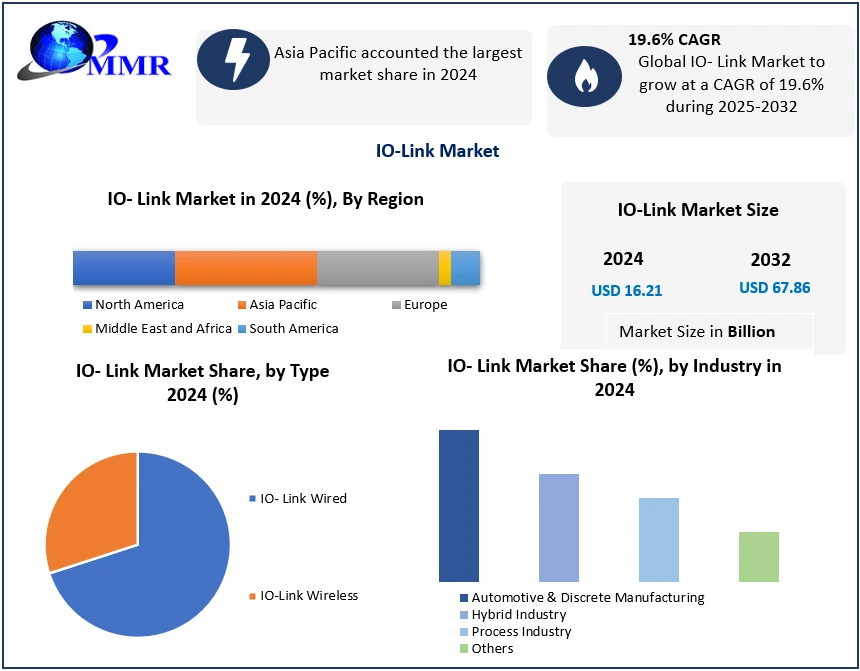
Dominant Segment: IO-Link Devices. This segment commands the largest market share, driven by the massive deployment of smart sensors, switches, and actuators across assembly lines, packaging, and material handling systems.
Fastest-Growing Segment: IO-Link Wireless. While wired infrastructure remains the standard, the wireless segment is expanding rapidly as manufacturers seek greater mobility, flexible factory layouts, and the ability to connect sensors in rotating or unreachable machinery.
Regional Growth Story
Asia-Pacific currently leads the global market in both volume and growth velocity. The rapid industrialization of China, India, and South Korea, coupled with massive government-backed initiatives for smart manufacturing and Industry 4.0, has made the region the global epicenter for automation. Europe remains a critical innovation hub, where stringent manufacturing quality requirements and high labor costs drive the adoption of automated, high-precision IO-Link systems to maintain global competitiveness.
Competitive Landscape
The competitive field has evolved into a war for ecosystem dominance. Major players like Siemens, Rockwell Automation, SICK AG, and Balluff are no longer just component suppliers; they are building platform-agnostic communication ecosystems. Market consolidation is a reality, as firms acquire specialized sensor technology to bolster their “smart” product portfolios. This signals a strategic shift where pricing power is moving toward vendors who offer superior data-integration tools. The winners are those who make it easiest for the client to push field-level data into high-level enterprise software, effectively positioning themselves as the “nervous system” of the client’s smart factory.
Recent Developments
Safety Specification Rollouts: The introduction of safety-certified IO-Link protocols allows for the transmission of safety-critical data, expanding the technology’s utility into high-risk production environments.
Cloud Gateway Partnerships: Increased collaboration between IO-Link master vendors and cloud service providers has streamlined the path from field sensors to AI-driven predictive analytics platforms.
Miniaturization: Innovations in component size allow for IO-Link deployment in space-constrained machinery, broadening its application in compact medical and electronics manufacturing.
Strategic Implications
For industrial leaders, the adoption of IO-Link is a prerequisite for long-term digital resilience. It forces a departure from proprietary, hardware-locked communication and toward an open, standardized framework. CIOs should prioritize investments in systems that are IO-Link compatible to ensure future-proofing of their capital assets. Failing to implement this at the field level today creates a “data island,” preventing the organization from fully leveraging advanced AI or cloud computing in tomorrow’s automated production environment.
Future Outlook
The next phase of the IO-Link market will be defined by the transition from simple connectivity to autonomous orchestration. As 5G-enabled networks and edge computing become standard, IO-Link will function as the terminal point for an AI-driven, self-healing factory. Future industrial leaders will be those who harness this field-level data to create a closed-loop automated system, while laggards will be left struggling with the maintenance costs and latency of disconnected, non-responsive legacy assets.
Analyst Perspective “The IO-Link protocol has moved beyond a mere cabling standard; it is now the primary interface through which the physical factory floor speaks to the intelligent enterprise, and mastering this data flow is the defining characteristic of the modern digital manufacturer,” says Yash Ghosalkar, Analyst at Maximize Market Research.
About Maximize Market Research
Maximize Market Research Pvt. Ltd. (MMR) is a global market research and consulting company that provides reliable, data-focused, and practical business insights. The firm serves a wide range of industries, including healthcare, pharmaceuticals, technology, automotive, electronics, chemicals, personal care, and consumer goods. Through market forecasts, competitive analysis, strategic consulting, and industry impact assessments, MMR helps organizations understand changing market conditions, identify growth opportunities, and make informed business decisions for long-term success.
2nd Floor, Navale IT Park Phase 3
Pune Banglore Highway, Narhe
Pune, Maharashtra 411041, India
+91 9607365656
sales@maximizemarketresearch.com
