Foam Cups Market: Balancing Convenience, Cost Efficiency, and Sustainability in Food Packaging
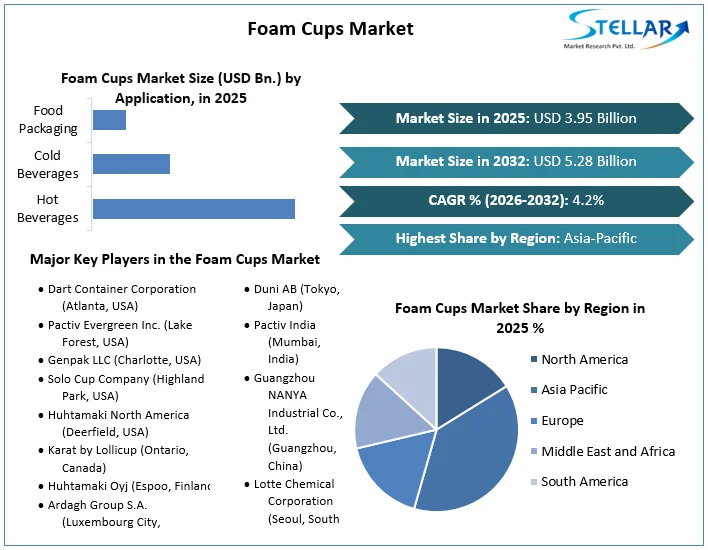
The global Foam Cups Market continues to play a significant role in the foodservice and beverage packaging industry, driven by rising demand for convenient, lightweight, and cost-effective disposable drinkware. Foam cups, primarily manufactured from expanded polystyrene (EPS), are widely used for serving hot and cold beverages due to their excellent thermal insulation, durability, and affordability. According to Stellar Market Research, the Foam Cups Market was valued at USD 3.95 billion in 2025 and is expected to reach USD 5.28 billion by 2032, growing at a CAGR of 4.2% during the forecast period.
Although environmental concerns surrounding single-use plastics continue to challenge the industry, foam cups remain an attractive solution for restaurants, cafés, convenience stores, institutional cafeterias, and beverage vendors. Manufacturers are increasingly focusing on sustainable production methods, recyclable materials, and improved waste management systems to meet evolving regulatory requirements and changing consumer preferences.
Download Free PDF Brochure: https://www.stellarmr.com/report/req_sample/foam-cups-market/2684
Rising Demand from Foodservice and Beverage Industries
The expansion of quick-service restaurants (QSRs), coffee chains, food delivery services, and takeaway businesses has significantly contributed to the growing demand for foam cups. Consumers increasingly prefer beverages that remain hot or cold for extended periods, making foam cups an ideal packaging solution due to their superior insulation capabilities.
Their lightweight design also reduces transportation costs and minimizes the risk of spills during delivery. As urban lifestyles become busier and on-the-go consumption increases, disposable beverage packaging continues to gain importance across both developed and emerging economies.
The hospitality sector, educational institutions, healthcare facilities, and corporate offices also contribute substantially to market demand by requiring economical disposable cups for large-scale beverage service.
Advantages Driving Market Growth
Foam cups offer several practical advantages that continue to support their widespread adoption. Their excellent insulation properties help maintain beverage temperatures without requiring additional sleeves, improving customer convenience while reducing material usage.
Compared with many alternative disposable cup materials, foam cups are lightweight, inexpensive to manufacture, and resistant to leakage. These characteristics make them particularly suitable for coffee shops, vending services, catering companies, and event organizers seeking reliable and cost-efficient beverage packaging solutions.
Manufacturers have also improved product quality through enhanced molding technologies, enabling stronger cup structures while reducing material consumption during production.
Sustainability Challenges Encourage Innovation
Environmental regulations remain one of the most significant challenges for the Foam Cups Market. Growing public concern regarding plastic waste, marine pollution, and landfill accumulation has led several countries and municipalities to introduce restrictions on single-use foam products.
In response, manufacturers are investing in recycling initiatives, material recovery programs, and research aimed at improving the recyclability of expanded polystyrene. Companies are also exploring bio-based alternatives, recycled content integration, and advanced processing technologies that reduce environmental impact without compromising product performance.
The industry’s transition toward circular economy principles is encouraging collaboration between packaging manufacturers, recycling companies, and regulatory agencies to improve waste collection and material reuse.
Technological Advancements Improve Manufacturing Efficiency
Technology continues to reshape foam cup manufacturing through greater automation, precision molding, and energy-efficient production systems. Modern manufacturing facilities utilize advanced molding equipment that minimizes raw material waste while maintaining consistent product quality.
Digital quality monitoring systems help manufacturers detect production defects in real time, improving operational efficiency and reducing manufacturing costs. Artificial intelligence and predictive maintenance technologies are increasingly being adopted to optimize production schedules, equipment performance, and inventory management.
At the same time, research into lightweight foam formulations enables manufacturers to reduce raw material consumption while maintaining structural strength and insulation performance.
Regional Market Outlook
Asia-Pacific currently represents the largest market for foam cups, supported by rapid urbanization, expanding foodservice industries, and rising disposable incomes. Countries such as China, India, Indonesia, and Vietnam continue to experience strong growth in takeaway food consumption, café culture, and organized retail.
North America remains a significant market due to its extensive quick-service restaurant network, large coffee consumption, and established convenience store industry. However, stricter environmental regulations in certain U.S. states and Canadian provinces are encouraging manufacturers to adopt more sustainable packaging solutions.
Europe is witnessing moderate market growth as regulatory pressure on single-use plastics accelerates innovation in recyclable and environmentally responsible packaging materials. Meanwhile, Latin America and the Middle East are gradually expanding their consumption of disposable beverage packaging as foodservice infrastructure develops.
Competitive Landscape
- Dart Container Corporation (Atlanta, USA)
- Pactiv Evergreen Inc. (Lake Forest, USA)
- Genpak LLC (Charlotte, USA)
- Solo Cup Company (Highland Park, USA)
- Huhtamaki Oyj (Espoo, Finland)
- Ardagh Group S.A. (Luxembourg City, Luxembourg)
- Benders Paper Cups (Leeds, UK)
- Duni AB (Tokyo, Japan)
- Pactiv India (Mumbai, India)
Download Free PDF Brochure: https://www.stellarmr.com/report/req_sample/foam-cups-market/2684
Emerging Trends Shaping the Industry
Several important trends are expected to influence the future development of the Foam Cups Market:
Growing investment in recyclable expanded polystyrene technologies.
Increased adoption of lightweight manufacturing techniques.
Expansion of food delivery and takeaway services worldwide.
Development of bio-based and hybrid foam materials.
Greater automation in packaging production facilities.
Improved collection and recycling infrastructure for foam products.
Rising consumer demand for sustainable disposable packaging.
Enhanced compliance with evolving environmental regulations.
These trends indicate that innovation will remain essential for balancing product performance, affordability, and environmental responsibility.
Future Outlook
The Foam Cups Market is expected to maintain steady growth over the coming years as demand for convenient beverage packaging continues to rise across foodservice, hospitality, healthcare, and institutional sectors. While regulatory challenges surrounding single-use plastics will continue to reshape the competitive landscape, manufacturers are responding with investments in sustainable materials, advanced recycling technologies, and more efficient production processes.
Companies capable of combining affordability with environmental responsibility will be well positioned to capitalize on emerging opportunities. Continued urbanization, expanding café culture, increasing online food delivery, and technological advancements in packaging manufacturing are expected to support long-term market expansion.
As governments, businesses, and consumers work toward more sustainable packaging solutions, the Foam Cups Market is likely to evolve through innovation rather than decline. Manufacturers that embrace circular economy practices, improve product recyclability, and invest in environmentally responsible production will strengthen their competitive advantage while meeting the changing expectations of global customers.
If you’d like, I can also create an SEO package for this blog, including a meta title, meta description, URL slug, focus keyword, FAQs, and schema-ready headings.
Media Contact
Stellar Market Research
Website: http://stellarmr.com/
Email: sales@stellarmr.com
