Key Highlights
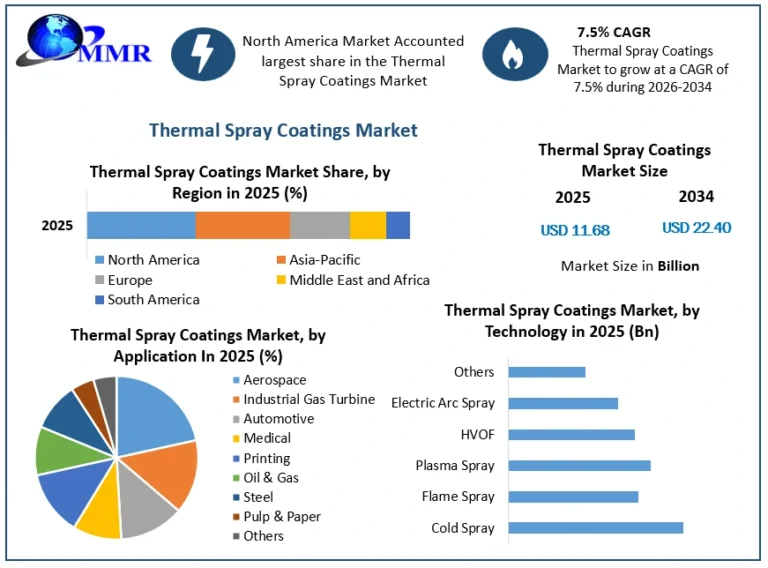
Strong Valuation Trajectory: The global thermal spray coatings industry achieved a baseline valuation of USD 10.87 Billion in 2024 and is projected to expand to USD 19.39 Billion by 2032, presenting an absolute dollar opportunity of nearly nine billion dollars.
Rapid Volume Consumption: Global volume procurement and coating service execution are advancing at a definitive CAGR of 7.5% from 2025 to 2032, indicating a steady, long-term escalation across heavy downstream processing sectors.
Material Category Dominance: Ceramic-based coatings hold the largest market share, dictated by a growing commercial requirement for low-cost, readily available, and high-temperature resistant barriers in aerospace and healthcare systems.
Aviation Fleet Scaling: Thermal barrier coatings (TBCs) stand as one of the critical application segments, driven by specialized insulation requirements in high-temperature aircraft propulsion architectures.
Geographical Hegemony: The North American region commands the highest market share, supported by large-scale aerospace infrastructure setups and massive defense spending across the United States.
Why This Matters Now
Volatile operational environments, escalating turbine firing temperatures, and shifting mechanical safety protocols are forcing industrial asset management teams to re-evaluate their long-term surface treatment strategy. Plant operators can no longer rely on legacy metal plating techniques due to tightening environmental mandates against hazardous chemicals like hexavalent chromium and strict component lifecycle rules. This commercial shift is altering supplier dynamics, forcing aviation component blenders and heavy industrial machinery builders to lock down advanced surface engineering contracts.
Industrial enterprises that delay their transition to specialized thermal barrier structures face severe component degradation risks and unexpected downtime as processing stresses rise. Escalating performance requirements in high-temperature aerospace engines and heavy maritime locomotion leave no room for sub-standard surface friction performance. Consequently, immediate corporate investment in high-durability coating formulations has transitioned from an operational preference to a fundamental commercial necessity.
Market Overview
The thermal spray coatings market functions as an essential, high-performance sector sitting at the intersection of specialized metallization metallurgy, advanced materials engineering, and heavy industrial manufacturing. Because supplying these advanced surface barriers requires strict control over particle melting velocities, precise thermal gun gas ratios, and specialized substrate preparation loops, this market serves as a core infrastructure pipeline for aviation assembly lines, heavy-duty utility plants, and medical device engineers.
The market’s steady climb toward USD 19.39 Billion by 2032 highlights a broad industrial transition toward robust mechanical components capable of enduring extreme thermal stress and chemical corrosion. The shifting market valuation directly influences corporate capital allocation, with leading surface engineering vendors redirecting resources to scale up automated robotic spray cells. Concurrently, downstream manufacturers are expanding their baseline maintenance schedules to mitigate sudden component wear in high-stress operational networks.
Key Trends Driving Growth
The most prominent trend accelerating market expansion is the continuous, widespread technological innovation across industrial power generation systems. Modern gas turbine plants require specialized thermal spray barriers to optimize mechanical output while reducing unexpected machinery downtime. This engineering push directly increases the consumption of high-grade ceramic and carbide formulations capable of protecting multi-million dollar rotating assets.
Another primary driver is the urgent need within the aerospace sector for advanced coatings to support modern, high-efficiency engine architectures. Heavy aviation operations are simultaneously boosting their baseline requirements for abradable seals and thermal barriers to maximize fuel efficiency and extend the intervals between overhaul cycles. This simultaneous demand surge from commercial jet assembly lines and defense machining facilities ensures a highly reliable revenue baseline for global coating providers.
Additionally, regional environmental safety regulations are driving chemical and surface engineering firms to increase their targeted R&D spending to introduce eco-friendly alternatives to hard chrome plating. Surface treatment centers are actively forming localized service agreements to ensure consistent coating availability for high-volume automotive and medical clients, buffering downstream processing from sudden regulatory adjustments.
Segment Insights
Ceramics (Dominant Product Type): This specialized material category functions as a cornerstone product type because of its exceptional insulation characteristics, low cost, and thermal resistance profile. Heavy industries utilize these coatings extensively as high-performance thermal barriers and structural protectors, ensuring operational safety in high-temperature engine zones.
Metals & Alloys (High-Volume Material Segment): Retains a secure hold on high-volume restoration lines, preferred by repair engineers due to its high density, excellent bond strength, and cost-efficient application during mechanical shaft and rotor dimensions rebuilds.
Aerospace & Power Generation (Fastest-Growing Application): Driven heavily by the continuous implementation of high-velocity oxygen fuel (HVOF) and plasma spray procedures to protect critical combustion liners, blades, and vanes.
Regional Growth Story
The North American region held the highest market share in 2024, driven by a sprawling aerospace manufacturing base and massive investments in commercial and military aviation. Rapidly growing component production networks across the United States are transforming the region into an influential hub for premium surface engineering and volume chemical consumption. This concentration of manufacturing capacity forces global coating suppliers to position their localized service bays close to these high-volume aerospace assembly centers.
In tandem, the Asia-Pacific region is positioned to record rapid growth through 2032. This momentum is driven by massive infrastructure spending and industrial expansion across China and India. Rapidly growing energy networks are increasing local demand for advanced gas turbines, while simultaneous investments in domestic automotive and medical manufacturing lines are forcing international suppliers to move their primary logistics and application centers closer to these high-volume Asian hubs.
Market Restraints & Challenges
High Initial Capital Outlay: Setting up advanced, fully automated robotic plasma and HVOF spray systems requires substantial upfront capital, presenting a financial hurdle for small-scale regional job shops.
Evolving Substitute Process Competition: In basic, low-complexity wear scenarios, the availability of alternative deposition technologies like physical vapor deposition (PVD) or laser cladding can sometimes challenge thermal spray placement.
Competitive Landscape
The global marketplace is highly consolidated, with major chemical conglomerates and surface engineering groups exercising significant influence over product availability and regional pricing structures. Key market participants are optimizing their production footprints and utilizing targeted capacity adjustments to defend their market share against rising regional suppliers.
To protect their commercial positions, industry leaders focus on developing proprietary, high-purity powder formulations and forming secure long-term service contracts with major aerospace OEMs. Companies compete intensely on the bond strength metrics of their coatings, porosity limitation documentation, and the scale of their automated regional workshop networks, allowing them to capture premium market segments.
Key Market Players
Oerlikon Metco (Switzerland/USA)
Praxair Surface Technologies (Linde plc) (United States)
Bodycote plc (United Kingdom)
Flame Spray Technologies Inc. (United States/Netherlands)
Curtiss-Wright Corporation (United States)
Plasma-Tec, Inc. (United States)
American Roller Company, LLC (United States)
ASB Industries, Inc. (United States)
H.C. Starck Inc. (United States/Germany)
Strategic Implications
For procurement executives and industrial engineering directors worldwide, relying entirely on basic, legacy surface protection configurations without an active migration strategy represents an inefficient and high-risk approach. As international emissions and efficiency mandates tighten across flight and energy sectors, traditional unprotected components will face rapid thermal fatigue and early structural collapse. Transitioning toward secure partnerships with specialized thermal spray services is an essential step to protect continuous plant operations and satisfy shifting structural criteria.
For thermal spray materials manufacturers and product managers, treating powder chemistry as an isolated material layer limits long-term market acceptance. As modern turbine and flight networks rapidly adapt to extreme compression ratios, buyers favor platforms that offer integrated, multi-layered ceramic solutions backed by complete validation data. Strategic foresight in asset management and active reallocation of R&D assets toward high-purity nanostructured powders are critical to winning high-volume corporate accounts.
Future Outlook
The trajectory of the global thermal spray coatings market will be shaped by the growth of advanced multi-functional suspension plasma spray systems, the expanding adoption of specialized carbide matrices in renewable energy hardware, and the implementation of automated real-time diagnostic registries during deposition loops. As manufacturing plants manage extreme mechanical loads and strict corporate sustainability criteria, long-term market leadership will belong to suppliers that master deposition efficiency. Future market leaders will be the engineering innovators that seamlessly combine high-purity powder synthesis with resilient regional service networks.
Analyst Perspective
“The rapid evolution of modern aviation propulsion and energy generation architectures is fundamentally rewriting the performance expectations for specialized surface barriers,” states a mechanical materials specialist at Maximize Market Research. “Suppliers that proactively adapt their production structures to deliver high-purity ceramic thermal barrier coatings will capture significant market share as global industrial safety mandates tighten.”
About Maximize Market Research
Maximize Market Research Pvt. Ltd. (MMR) is a global market research and consulting company that provides reliable, data-focused, and practical business insights. The firm serves a wide range of industries, including healthcare, pharmaceuticals, technology, automotive, electronics, chemicals, personal care, and consumer goods. Through market forecasts, competitive analysis, strategic consulting, and industry impact assessments, MMR helps organizations understand changing market conditions, identify growth opportunities, and make informed business decisions for long-term success.
Office Address:
2nd Floor, Navale IT Park Phase 3,
Pune-Bangalore Highway, Narhe,
Pune, Maharashtra 411041, India.
Contact: +91 9607365656
