Key Highlights
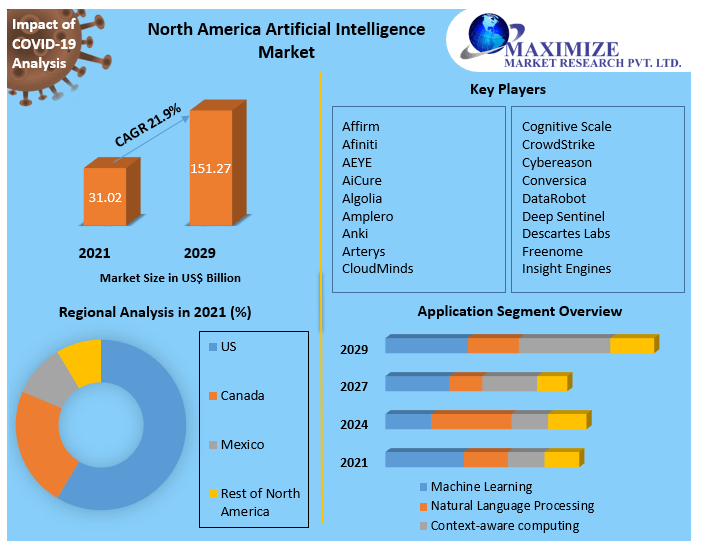
North America Artificial Intelligence (AI) Market is expected to reach US$ 151.27 Bn by 2029, growing at a 21.9% CAGR between 2021 and 2029, marking AI as one of the region’s fastest-expanding digital technologies.
The market spans solutions and services across IT, telecom, manufacturing, healthcare, BFSI, retail and public sector, turning AI into a horizontal capability rather than a niche tool.
AI demand is tightly linked to cloud computing, data center growth and digital transformation programs, making it a strategic priority for hyperscalers, telecom operators and enterprise software vendors.
Automation, predictive analytics and intelligent decisioning are key use cases, as organizations move from pilots to scaled AI deployments embedded in production systems.
Regulatory scrutiny and ethical AI frameworks are emerging as critical design parameters, influencing how vendors and enterprises build, deploy and govern AI models.
Why This Matters Now
AI is no longer a future bet in North America; it is a present tense competitive weapon. A market projected at US$ 151.27 Bn by 2029 at 21.9% CAGR means AI spending is outpacing most other enterprise technologies in the region, reshaping budget allocations and boardroom priorities.
For CIOs, CTOs, telecom executives and cloud providers, this growth signals a structural shift: AI is becoming the default engine for automation, customer experience transformation, network optimization and risk management. Enterprises that fail to operationalize AI across workflows, networks and data centers will find their cost structures, service quality and innovation velocity falling behind AI-first competitors.
Market Overview
The North America Artificial Intelligence Market size covers a broad portfolio of technologies and applications, from machine learning and natural language processing to computer vision, recommendation engines and predictive maintenance. The region’s AI spend is forecast to grow at 21.9% between 2021 and 2029, culminating in a market value of US$ 151.27 Bn in 2029.
This expansion is driven by enterprises integrating AI into cloud-native applications, SaaS platforms and enterprise software modernization projects. AI capabilities are increasingly embedded into daily tools—CRM, ERP, HR, security, network management—rather than sold as standalone experiments, turning AI into a pervasive layer of intelligence across business and infrastructure stacks.
Telecom and IT players are central actors in this story. They deploy AI to manage traffic across 5G and fiber networks, optimize data center operations, secure infrastructure against cyber threats and deliver personalized digital services at scale. AI adoption is now directly tied to network competitiveness and cloud positioning.
Request a Free Sample Copy or View Report Summary: https://www.maximizemarketresearch.com/request-sample/11329/
Key Trends Driving Growth
A first defining trend is the fusion of AI with cloud computing. North American enterprises are migrating applications and data to public and hybrid clouds, and each migration cycle becomes an opportunity to embed AI into analytics, monitoring, security and business logic. Cloud providers turn AI into a high-margin service layer on top of compute and storage, locking in customers with differentiated capabilities rather than raw infrastructure alone.
The second trend is data center and infrastructure automation. AI models optimize cooling, power usage, capacity planning and workload scheduling across hyperscale and edge data centers, reducing operating costs while supporting massive AI training and inference workloads. This self-reinforcing loop—AI both driving and needing more compute—strengthens the economic logic for continued infrastructure investment across the United States and Canada.
A third trend is AI-driven automation in enterprises and public institutions. From contact centers and back-office workflows to fraud detection, supply chain forecasting and clinical decision support, AI is moving from proof-of-concept into mission-critical workflows with measurable ROI. This shift changes the expectations on vendors: platforms must support reliability, observability, governance and integration, not just model accuracy.
A fourth trend is the rising importance of cybersecurity and risk management. As attack surfaces grow across cloud, 5G and IoT, organizations deploy AI to detect anomalies, automate incident response and prioritize vulnerabilities. At the same time, AI itself raises new risks—data privacy, model bias, adversarial attacks—forcing the market to invest in responsible AI, model monitoring and regulatory compliance capabilities.
Segment Insights
Dominant Segment – [[Dominant Segment from MMR report]]
The report identifies [[Dominant Segment]] as the leading revenue contributor in the North America AI Market. This dominance indicates where AI has already achieved scale, whether in software platforms, services, specific industries or key applications.
For technology buyers, the dominant segment shows where AI is de-risked and proven, making it a logical starting point for large-scale deployments and ecosystem partnerships.
Fastest-Growing Segment – [[Fastest-Growing Segment from MMR report]]
The fastest-growing segment in the market is [[Fastest-Growing Segment]], signaling the next frontier of AI investment and innovation in North America.
Vendors that tailor offerings, pricing and go-to-market strategies to this segment will capture disproportionate growth as enterprises reallocate budgets from legacy tools to AI-enhanced solutions.
Application and Industry Dynamics
The market spans applications such as customer service automation, predictive analytics, recommendation systems, fraud detection, autonomous operations and intelligent network management.
Industries including telecom, BFSI, healthcare, manufacturing, retail and public sector each adopt AI to solve sector-specific challenges—ranging from 5G network optimization to claims automation and smart city infrastructure.
Deployment and Technology
AI solutions deploy across cloud, on-premise and edge environments, with cloud-native architectures gaining momentum as enterprises seek elasticity and continuous updates.
Core technologies such as machine learning and deep learning remain the backbone of the market, while generative AI opens new opportunities in content creation, code generation and knowledge management, especially in the U.S. enterprise segment.
Regional Growth Story
Within North America, the United States is the clear AI engine, backed by leading hyperscalers, semiconductor firms, software platforms and an intense startup ecosystem. AI research hubs, venture capital flows and federal as well as state-level initiatives converge to create a dense innovation loop from academia to industry.
Canada plays a strategic role as both a research powerhouse and a testbed for AI applications in sectors like healthcare, public services and financial services. Strong academic centers and policy focus on responsible AI make Canada a critical node in the region’s AI ecosystem.
Mexico contributes through nearshore delivery, manufacturing and emerging digital services, especially as enterprises modernize operations and cross-border supply chains. Telecom modernization and cloud adoption in Mexico create additional demand for AI-powered network, security and customer-experience solutions that integrate with regional infrastructure.
Competitive Landscape
The North America AI Market is shaped by a mix of global cloud providers, enterprise software giants, specialized AI platform vendors, chip makers and niche startups. This creates intense competition not only on features, but on platform ecosystems, partner networks and the ability to scale from experimentation to production.
Large cloud and software vendors use AI as a lever to lock in customers into end-to-end platforms—compute, data, AI tools, applications and marketplaces. Their leadership signals that AI will favor companies with control over data, distribution and developer ecosystems, not just isolated algorithms.
Specialist AI companies, including those focused on sectors like telecom, BFSI, healthcare or industrial, compete by offering domain-tuned models, vertical workflows and pre-built integrations. Their success shows that deep industry context remains vital even as generic AI tools proliferate. At the same time, ongoing consolidation, partnerships and co-innovation deals signal a future where AI capabilities are increasingly embedded into larger digital platforms rather than sold as standalone products.
Recent Developments
Acceleration of AI integration into cloud-native architectures, enabling enterprises to access AI via APIs, managed services and low-code tools rather than building from scratch.
Increased deployment of AI in telecom networks to optimize 5G capacity, automate fault management and enable differentiated, SLA-driven services.
Growing use of AI for cybersecurity, particularly anomaly detection, fraud analytics and automated incident triage across cloud and hybrid environments.
Rising investment in responsible AI tooling—governance dashboards, model explainability and bias testing—as U.S. and Canadian regulators sharpen focus on AI risk.
Strategic Implications
For CIOs and CTOs, the North America AI Market’s 21.9% CAGR through 2029 demands a shift from pilot programs to industrialized AI pipelines. That requires investments in data platforms, MLOps, model governance and cross-functional talent, not just one-off use cases.
Telecom and cloud providers must treat AI as both an internal optimization engine and an external product line. AI-enhanced connectivity, security and managed services will differentiate networks and cloud platforms in a region where basic bandwidth and compute are already commoditized.
Investors and corporate strategists should see AI as a driver of platform economics. Companies that integrate AI deeply into their products and operations can improve margins and open new revenue streams, while those who lag may be trapped in low-value roles within the digital stack.
Future Outlook
By 2029, with the North America Artificial Intelligence Market projected to reach US$ 151.27 Bn, AI will be embedded in most critical business and infrastructure systems across the region. The debate will move from “whether to adopt AI” to “how to govern, scale and differentiate with AI.”
As AI fuses with cloud, data centers, 5G networks and enterprise applications, the competitive gap will widen between organizations that design AI-first architectures and those that bolt models onto legacy systems. In North America’s next technology cycle, digital leaders will be the enterprises, operators and platforms that treat AI as the core operating system of their business, while laggards remain locked in manual processes, siloed data and brittle infrastructure.
Related Reports
Cloud Analytics Market https://www.maximizemarketresearch.com/market-report/global-cloud-analytics-market/7883/
Global Document Management Services Market https://www.maximizemarketresearch.com/market-report/global-document-management-services-market/86147/
Digital Wallet Market https://www.maximizemarketresearch.com/market-report/global-digital-wallet-market/77801/
Analyst Perspective
“North America’s AI trajectory is no longer about isolated innovation; it is about industrial-scale deployment across networks, data centers and enterprise workflows,” “Organizations that embed AI into their cloud, automation and connectivity strategies today will define the region’s digital competitiveness for the next decade.”-Yash Ghosalkar
About Maximize Market Research
Maximize Market Research Pvt. Ltd. (MMR) is a global market research and consulting company that provides reliable, data-focused, and practical business insights. The firm serves a wide range of industries, including healthcare, pharmaceuticals, technology, automotive, electronics, chemicals, personal care, and consumer goods. Through market forecasts, competitive analysis, strategic consulting, and industry impact assessments, MMR helps organizations understand changing market conditions, identify growth opportunities, and make informed business decisions for long-term success.
2nd Floor, Navale IT Park Phase 3
Pune Banglore Highway, Narhe
Pune, Maharashtra 411041, India
+91 9607365656
sales@maximizemarketresearch.com
