Veterinary Excipients Market: Advancing Animal Healthcare Through Next-Generation Drug Formulation Innovation
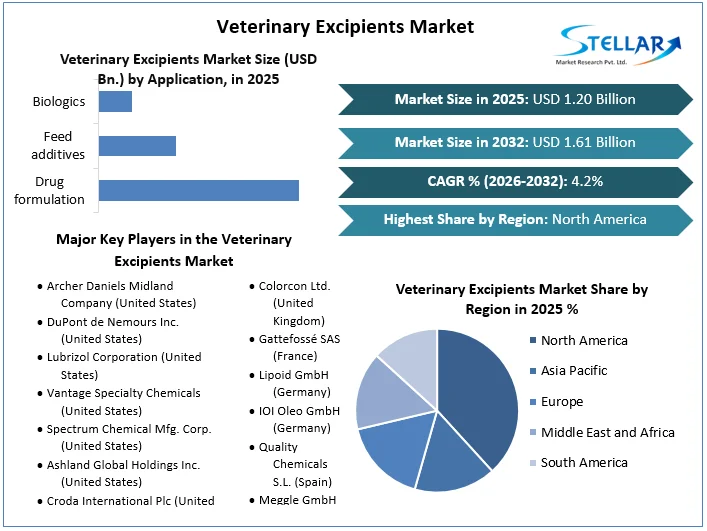
The Veterinary Excipients Market size was valued at approximately USD 1.20 billion in 2025 and is projected to reach nearly USD 1.61 billion by 2032, expanding at a CAGR of around 4.2% during the forecast period of 2026–2032. The market growth is supported by increasing demand for veterinary medicines, advancements in animal drug delivery systems, and rising emphasis on animal welfare.
The global Veterinary Excipients Market is witnessing steady transformation as the animal healthcare industry increasingly focuses on improving drug stability, bioavailability, safety, and administration efficiency. Veterinary excipients, which are inactive ingredients used alongside active pharmaceutical ingredients (APIs), play a crucial role in developing effective veterinary medicines, including tablets, injections, vaccines, and feed-based therapies. Growing investments in animal health, rising pet ownership, expansion of livestock production, and increasing demand for advanced veterinary formulations are creating new opportunities for market growth.
Download Free PDF Brochure: https://www.stellarmr.com/report/req_sample/veterinary-excipients-market/2716
Veterinary Excipients Market Growth Overview
Unlike traditional pharmaceutical ingredients, modern veterinary excipients are becoming strategic components that influence formulation performance. Pharmaceutical companies are investing in multifunctional excipients capable of improving solubility, enhancing stability, and enabling advanced delivery mechanisms. This trend is particularly important for biologics, vaccines, and long-acting injectable formulations.
Rising Focus on Animal Health Driving Market Expansion
One of the primary factors supporting the growth of the veterinary excipients industry is the increasing global focus on animal healthcare. Growing companion animal adoption and rising expenditure on pet medical care have increased demand for high-quality veterinary drugs. At the same time, livestock producers are investing in preventive healthcare solutions to reduce disease outbreaks and improve productivity.
The expansion of poultry, dairy, and livestock industries has created demand for veterinary medicines that require reliable excipient systems. Excipients help improve the effectiveness of medicines by ensuring accurate dosage, enhancing absorption, and maintaining formulation stability.
Additionally, growing awareness regarding antimicrobial resistance and zoonotic diseases has encouraged governments and healthcare organizations to promote better veterinary practices. These initiatives are driving pharmaceutical innovation and increasing demand for advanced excipient technologies.
Increasing Demand for Advanced Drug Delivery Systems
A major trend shaping the Veterinary Excipients Market is the development of advanced drug delivery systems, particularly long-acting injectable (LAI) formulations. These formulations require specialized excipients that enable controlled release, improved drug stability, and extended therapeutic effects.
Long-acting veterinary medicines are gaining popularity because they reduce the frequency of administration and improve treatment compliance. This is particularly valuable in livestock management, where large animal populations require efficient healthcare solutions.
Innovative excipients such as biodegradable polymers, lipid-based carriers, and specialized stabilizers are being explored to support next-generation veterinary formulations. These developments are encouraging pharmaceutical companies to collaborate with excipient manufacturers to create customized solutions.
Segment Analysis of Veterinary Excipients Market
According to product type, the market is segmented into binders, disintegrants, viscosity agents, flavoring agents, lubricants and glidants, emulsifiers, preservatives, and other excipients.
Among these, binders represent a dominant segment due to their essential role in maintaining tablet strength, stability, and accurate drug dosage. Binders are widely used in solid veterinary dosage forms such as tablets and capsules because they improve formulation integrity during manufacturing, transportation, and storage.
Based on formulation, oral formulations hold a leading position because of their convenience, affordability, and ease of administration. Oral veterinary medicines can be delivered through tablets, powders, or feed mixtures, making them suitable for both companion animals and livestock applications.
The animal type segment includes livestock animals and companion animals. Increasing pet healthcare spending and expanding livestock production are expected to support demand across both categories.
Technological Innovation Transforming Veterinary Formulations
Technology advancements are significantly influencing the development of veterinary excipients. Manufacturers are focusing on multifunctional excipients that provide multiple benefits, including improved solubility, enhanced bioavailability, and better drug protection.
Biotechnology-driven formulations, vaccine development, and biologics are increasing the need for specialized excipient solutions. High-purity excipients are becoming increasingly important in advanced veterinary medicines, especially for sensitive biological products.
Digitalization and improved pharmaceutical manufacturing processes are also helping companies optimize formulation development and quality control. These innovations are expected to improve efficiency throughout the veterinary pharmaceutical supply chain.
Regional Insights: North America Leads Market Growth
North America dominates the global Veterinary Excipients Market due to its advanced veterinary healthcare infrastructure, strong pharmaceutical industry presence, and strict regulatory standards. The United States and Canada have significant investments in animal health research, veterinary pharmaceuticals, and innovative drug formulation technologies.
The region benefits from strong demand for companion animal healthcare products, increasing pet ownership, and growing investment in animal disease prevention.
Asia Pacific is emerging as a high-growth region due to increasing livestock production, rising animal healthcare awareness, and expanding pharmaceutical manufacturing capabilities. Countries such as China, India, Japan, and South Korea are expected to contribute significantly to future market expansion.
Market Challenges and Restraints
Despite positive growth prospects, the Veterinary Excipients Market faces several challenges. One major restraint is the limited availability of species-specific excipient approvals. Since different animal species have unique metabolic characteristics, regulatory approval processes can be complex and time-consuming.
Supply chain disruptions and fluctuations in raw material prices also impact manufacturers. Dependence on international suppliers for specialized ingredients can increase production costs and create availability challenges.
Regulatory complexity remains another important factor influencing market development, as companies must meet strict quality and safety requirements before introducing veterinary formulations.
Competitive Landscape and Industry Developments
The Veterinary Excipients Market includes major companies focusing on product innovation, sustainability, and strategic partnerships. Key players include BASF SE and Croda International Plc, which are expanding their excipient portfolios and investing in advanced formulation technologies.
Recent industry developments include:
Clariant (2023): Introduced the VitiPure™ high-purity excipient portfolio designed to improve stability and solubility for advanced veterinary formulations, including biologics and vaccines.
Croda International Plc (2023): Partnered with Amyris through a licensing agreement for biotechnology-derived pharmaceutical-grade squalene used in vaccine applications.
Domes Pharma Group (2023): Acquired SentrX Animal Care Inc. to strengthen its veterinary healthcare portfolio and expand market presence in North America.
Future developments are expected to focus on sustainable excipients, advanced drug delivery systems, and customized veterinary formulations.
Download Free PDF Brochure: https://www.stellarmr.com/report/req_sample/veterinary-excipients-market/2716
Future Outlook of Veterinary Excipients Market
The future of the Veterinary Excipients Market will be shaped by increasing demand for safer animal medicines, advanced formulation technologies, and sustainable pharmaceutical solutions. As veterinary healthcare moves toward precision medicine and improved therapeutic performance, excipients will become increasingly important in drug development.
Growing investments in animal health research, expansion of veterinary biologics, and increasing demand for long-acting therapies will create significant opportunities for manufacturers. Companies that develop innovative, regulatory-compliant, and environmentally responsible excipient solutions are expected to gain a competitive advantage.
By 2032, the veterinary excipient industry is expected to become a critical component of the broader animal healthcare ecosystem, supporting improved treatment outcomes for both companion animals and livestock worldwide.
Media Contact
Stellar Market Research
Website: http://stellarmr.com/
Email: sales@stellarmr.com
