Key Highlights
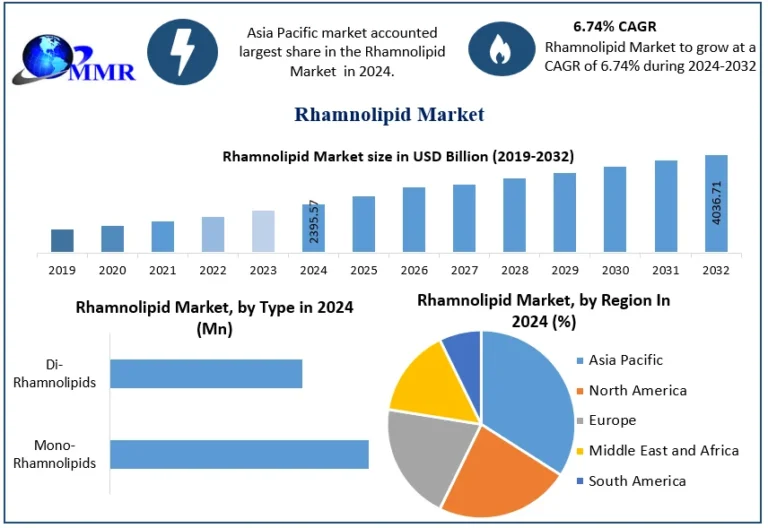
Resilient Expansion Path: The global rhamnolipid market achieved a baseline valuation of USD 2.39 Billion in 2024 and is projected to expand to USD 4.03 Billion by 2032, driven by commercial scale-up activities.
Controlled Market Momentum: Total global revenues are advancing at a steady CAGR of 6.74% over the forecast period, reflecting a consistent, non-volatile increase in volume procurement.
Product Form Dominance: Mono-rhamnolipids command the largest structural share of the global landscape, holding over 60% of the market due to their excellent surface-active tendencies and water solubility.
Application Framework Shifts: The surfactants and personal care categories represent the fastest-growing blocks, supported by retail brand initiatives to eliminate synthetic chemical configurations.
Geographical Hegemony: The Asia-Pacific region holds the highest global market share, anchored by expanding agricultural chemical needs and cosmetic manufacturing hubs in China and India.
Why This Matters Now
Modern consumer product formulators and industrial process engineers are facing an urgent need to replace legacy petrochemical surfactants within their active product pipelines. Relying entirely on traditional synthetic wetting agents introduces severe operational bottlenecks due to tightening international environmental mandates, strict ecotoxicity audits, and emerging regional chemical bans. This tracking vulnerability is particularly stressful for premium personal care brands and agricultural compounders managing high-volume consumer distribution lines where clean-label documentation is non-negotiable.
Deploying high-efficiency rhamnolipid biosurfactants addresses these baseline formulation limitations directly. As a highly functional, fermentation-derived glycolipid matrix engineered for low critical micelle concentration and complete biodegradability, rhamnolipids function as a drop-in replacement for harsh synthetic detergents. Implementing these advanced, non-toxic biological chains enables manufacturing plants to run continuous production lines with reduced regulatory scrutiny, ensuring downstream formulations satisfy strict international environmental emissions criteria.
Market Overview
The rhamnolipid market functions as an essential, high-technology sector sitting at the intersection of advanced microbial fermentation, specialized surface chemistry, and global consumer goods packaging. Because supplying these high-purity biological matrices requires strict control over strain optimization, precise aldol lipid linkages, and specialized downstream filtration loops, this market forms a mandatory procurement pipeline for cosmetic chemists, industrial cleaners, and enhanced oil recovery teams.
The market’s steady climb toward USD 4.03 Billion by 2032 highlights a broad industrial transition toward sustainable, renewable, and circular intermediate options. The commercial framework monitors continuous shifts across critical product types (mono-rhamnolipids, di-rhamnolipids), primary delivery configurations (liquid, powder), target grades (technical, high-purity), and localized regional distribution pipelines.
Key Trends Driving Growth
The most prominent trend accelerating market expansion is the continuous, widespread technological innovation across commercial household and industrial cleaning formulations. Modern consumer goods corporations require specialized bio-based foaming agents to satisfy growing public preferences for green chemistry products. This purchasing push directly increases the consumption of high-grade rhamnolipid surfactants capable of delivering high cleansing efficiency without leaving persistent chemical residues in municipal waterways.
Another primary driver is the urgent need within the global agricultural and crop protection sectors for advanced bio-pesticides and organic soil wetting systems. Commercial farming networks are shifting toward rhamnolipid-derived solutions to eradicate plant pathogens, improve root nutrient absorption, and replace persistent synthetic herbicides. This agricultural transition ensures a highly reliable, recurring revenue baseline for specialized bio-chemical synthesis plants.
Additionally, shifting environmental protection rules and carbon tracking laws are forcing oil and gas exploration firms to increase their targeted R&D spending to deploy biosurfactants in enhanced oil recovery (EOR). Hydrocarbon extraction teams are actively utilizing rhamnolipids to reduce interfacial tension inside aging shale basins, buffering downstream production operations from sudden fossil energy extraction limits.
Segment Insights
Mono-Rhamnolipids (Dominant Product Type): Commands a leading position within the product architecture, holding over 60% of the revenue framework. Its widespread adoption is supported by its superior surface-active characteristics and lower critical micelle concentration, allowing rapid oil-water emulsification.
Surfactants & Personal Care (Fastest-Growing Application): This application block is achieving rapid market adoption owing to superior mildness and skin compatibility. Consumer brand compounders rely on these formulations to optimize premium shampoos, shower gels, and clean-beauty cosmetics.
Liquid Formulations: Tracks consistent, high-volume procurement across industrial processing lines, preferred by liquid laundry and industrial detergent blenders due to its immediate processing and blending compatibility.
Regional Growth Story
The Asia-Pacific region held the highest market share in 2024, driven by a sprawling industrial manufacturing base and massive investments in commercial biotechnology infrastructure. Rapidly growing manufacturing networks across China, India, and Japan are transforming the region into an influential hub for premium cosmetics and agricultural inputs. This concentration of production capacity forces global biosurfactant suppliers to position their logistics centers close to these high-volume processing markets to streamline localized logistics.
In tandem, European and North American production hubs are focusing on specialized, ultra-high-purity chemical blends to satisfy stringent regional safety standards. The presence of strict REACH regulations in Europe and voluntary certifications like the EPA Safer Choice Program in the United States maintains a consistent demand for premium bio-based compounds. This geographical distribution creates a two-track market structure, balancing large commodity volumes in emerging Asian economies with high-margin specialty sales in mature Western markets.
Market Restraints & Challenges
High Downstream Processing Costs: Harvesting high-purity rhamnolipids from microbial fermentation broths requires expensive separation and purification technologies, presenting a financial hurdle for cost-competitive mass production.
Raw Material Feedstock Volatility: Maintaining cost-efficient production lines requires steady access to high-yield carbon sources like vegetable oils or waste glycerol, exposing producers to supply chain friction when agricultural commodity markets fluctuate.
Competitive Landscape
The global marketplace is consolidated, with major chemical conglomerates and specialized biotechnology firms exercising significant influence over product availability and regional pricing structures. Key market participants are optimizing their fermentation footprints and utilizing targeted capacity adjustments to defend their market share against rising regional suppliers.
To protect their commercial positions, industry leaders focus on achieving deep genetic strain optimization and forming secure long-term contracts with major consumer product manufacturers (OEMs). Companies compete intensely on the purity profile of their formulations, scale of continuous bioreactor operations, and the depth of their regional distribution networks, allowing them to capture premium market segments.
Key Market Players
Evonik Industries AG (Germany)
The Dow Chemical Company (United States)
Stepan Company (United States)
AGAE Technologies LLC (United States)
Jeneil Biotech Inc. (United States)
Holiferm Ltd. (United Kingdom)
Allid Carbon Solutions Ltd. (Japan)
GlycoSurf, LLC (United States)
Biotensidon GmbH (Germany)
TeeGene Biotech Ltd. (United Kingdom)
Strategic Implications
For chemical procurement executives and personal care product directors worldwide, relying entirely on legacy synthetic surfactant compounds without an active bio-based migration strategy represents an inefficient and high-risk approach. As international packaging and chemical safety laws tighten across consumer sectors, traditional non-compliant lines will face rapid margin compression and market exclusion. Transitioning toward secure partnerships with certified rhamnolipid suppliers is an essential step to protect manufacturing operations and satisfy shifting consumer preferences.
For biosurfactant manufacturing organizations and product managers, treating production efficiency as an isolated lab metrics layer limits long-term commercial upside. As modern hospital and cleaning networks rapidly adapt to strict eco-friendly standards, buyers favor platforms that offer pre-validated, cost-competitive rhamnolipids backed by reliable performance. Strategic foresight in asset management and active reallocation of R&D assets toward low-cost waste glycerol fermentation are critical to winning high-volume corporate accounts.
Future Outlook
The trajectory of the global rhamnolipid market will be shaped by the growth of non-pathogenic engineered microbial strains, the expanding adoption of specialty biosurfactants in advanced pharmaceutical drug delivery systems, and the implementation of unified global environmental safety registries. As manufacturing plants manage extreme output targets and strict corporate sustainability criteria, long-term market leadership will belong to suppliers that master low-cost purification. Future market leaders will be the chemical innovators that seamlessly combine high-purity synthesis with resilient regional distribution networks.
Analyst Perspective
“The rapid evolution of modern cosmetic and industrial cleaning architectures is fundamentally rewriting the performance expectations for specialized chemical additives,” states a biosurfactant specialist at Maximize Market Research. “Suppliers that proactively adapt their production structures to deliver high-purity, cost-efficient rhamnolipids will capture significant market share as global industrial safety mandates tighten.”
About Maximize Market Research
Maximize Market Research Pvt. Ltd. (MMR) is a global market research and consulting company that provides reliable, data-focused, and practical business insights. The firm serves a wide range of industries, including healthcare, pharmaceuticals, technology, automotive, electronics, chemicals, personal care, and consumer goods. Through market forecasts, competitive analysis, strategic consulting, and industry impact assessments, MMR helps organizations understand changing market conditions, identify growth opportunities, and make informed business decisions for long-term success.
Office Address:
2nd Floor, Navale IT Park Phase 3,
Pune-Bangalore Highway, Narhe,
Pune, Maharashtra 411041, India.
Contact: +91 9607365656
