Key Highlights
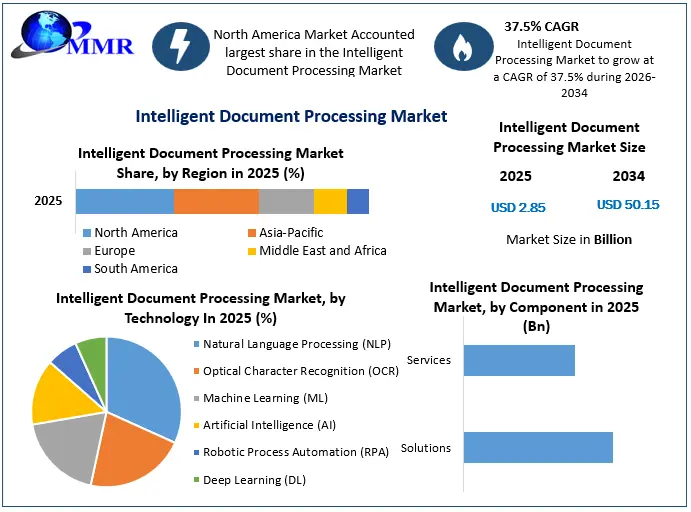
The global market valuation stands at USD 2.85 Billion in 2025 and will scale to USD 50.15 Billion by 2034.
Market momentum is sustained by a compounded annual growth rate of 37.5% over the nine-year forecast window.
The Large Enterprises segment maintains a commanding position due to the high volume of daily transactional records.
The Banking, Financial Services, and Insurance sector dominates application verticals to meet stringent regulatory mandates.
The Services segment exceeds software revenue due to heavy configuration, integration, and platform maintenance requirements.
North America commands the primary revenue share, while the Asia-Pacific region demonstrates the highest forward acceleration.
Why This Matters Now
Enterprise operations are stalling under an unprecedented data explosion where unstructured information expands by approximately 65% every month inside modern organizations. Legacy software cannot parse this influx of scanned PDFs, emails, invoices, and compliance documentation without manual intervention. Corporate executives face escalating labor costs and operational bottlenecks that weaken market responsiveness.
Modern infrastructure demands systems that convert raw text into structured corporate assets instantly. Corporate survival hinges on shifting human capital away from data entry into analytical positions. This market shift represents a fundamental re-architecture of how enterprise software ingests information.
Market Overview
The global Intelligent Document Processing Market reached a milestone valuation of USD 2.85 Billion in 2025. According to data published by Maximize Market Research, the industry will experience a multi-year expansion to hit USD 50.15 Billion by 2034. This path represents an annualized growth rate of 37.5%.
The massive expansion reflects a systemic shift away from static optical character recognition technologies toward advanced cognitive engines. Legacy OCR systems broke down when processing non-standard document formats, leading to expensive exception handling. Modern IDP platforms combine machine learning and natural language processing to extract insights from highly variable documents.
This transition allows companies to automate end-to-end processes by linking document intake with downstream operational applications. The integration of generative AI models allows these platforms to comprehend context, sentiment, and intent rather than just identifying specific text fields. Consequently, technology buyers are treating document automation as a mandatory foundation for their broader enterprise hyperautomation strategies.
Key Trends Driving Growth
Corporate information eco-systems are changing due to the combination of generative artificial intelligence and enterprise automation software. The introduction of large language models allows IDP software to process complex contracts and legal documents without custom programming. This technological leap minimizes implementation timelines, unlocking instant economic returns for technology buyers.
Cloud computing platforms have altered deployment economics by lowering the initial barriers to entry. Cloud-based SaaS architectures provide flexible subscription pricing that eliminates massive upfront hardware investments. These cloud environments allow automatic model updates, ensuring enterprises always deploy the latest machine learning enhancements without operational disruptions.
Data security protocols are evolving rapidly as regulatory bodies enforce stricter digital sovereignty rules. Modern document platforms include automatic data masking and advanced encryption to secure personally identifiable information during processing. These compliance features are necessary for corporate buyers operating across multiple legal jurisdictions.
Simultaneously, enterprise buyers are merging document processing with robotic process automation to build straight-through workflows. This structural alignment eliminates manual data entry between siloed enterprise software systems. This programmatic connectivity allows operations to run continuously without human supervision.
Segment Insights
Dominant Segment (Organization Size): Large Enterprises dominate total market expenditure due to their extensive network of global branches generating millions of complex documents daily.
Dominant Segment (Vertical): The Banking, Financial Services, and Insurance sector maintains the highest revenue share as institutions seek to automate mortgage processing, KYC compliance, and loan applications.
Dominant Segment (Component): The Services segment captures the majority of market share over software licenses because enterprises require extensive customization, integration, and training.
Fastest-Growing Segment (Vertical): The Healthcare and Life Sciences vertical displays the quickest adoption rate to handle unstructured electronic health records, clinical trials, and medical claims.
Fastest-Growing Segment (Deployment): Cloud-hosted implementations are growing faster than on-premises deployments due to superior scalability and simpler enterprise integration.
Regional Growth Story
North America holds the primary position in the global market, driven by high technology investment and the early adoption of automation architectures. United States enterprises are shifting resource allocation toward cognitive processing to combat rising domestic labor shortages. Strong regional compliance frameworks like HIPAA and CCPA force businesses to implement auditable, secure document processing pipelines.
The European market follows a similar path, heavily influenced by the strict enforcement of the General Data Protection Regulation. German and United Kingdom enterprises are choosing IDP software that features localized cloud storage to maintain strict data sovereignty. These organizations utilize intelligent processing to manage multi-language supply chain logistics across cross-border trade lanes.
The Asia-Pacific region is accelerating at the highest rate, with China and India leading infrastructure development. Rapid industrialization and digital transformation initiatives in these economies are forcing corporate operations to abandon paper-based systems entirely. Government-led digitization programs are driving massive enterprise software updates across local banking and manufacturing networks.
Competitive Landscape
The corporate landscape features intense competition between global cloud hyperscalers, legacy document management vendors, and pure-play automation software companies. Major cloud providers like Google LLC and Amazon Web Services leverage their massive infrastructure to deliver highly scalable document analysis application programming interfaces. This technical foundation allows these firms to offer competitive utility-based pricing structures that challenge standalone providers.
Platform giants like IBM Corporation and Adobe Inc. are embedding cognitive processing capabilities directly into their existing enterprise product lines. This integration allows their corporate clients to activate intelligent data capture features without introducing new software vendors into their IT stack. Consequently, these established players are retaining their enterprise accounts by focusing on system reliability and compliance.
Specialized automation providers, including UiPath Inc., Pegasystems Inc., ABBYY, and Kofax Inc., are positioning their platforms as comprehensive operational orchestration centers. These vendors are acquiring smaller machine learning startups to rapidly integrate generative artificial intelligence into their software suites. This rapid innovation model enables them to deliver superior out-of-the-box accuracy for specialized, unstructured industry documents.
The competitive balance is shifting toward vendors that provide open API architectures and seamless developer integration workflows. Software companies that lock data within proprietary platforms are losing ground to modern, flexible ecosystems. Enterprise technology leaders favor tools that combine easily with their existing business intelligence and customer relationship management systems.
Recent Developments
Enterprise automation software providers are releasing specialized industry LLMs trained on corporate financial records to boost data extraction precision to over 99%.
Cloud infrastructure providers are expanding edge data centers to run document classification models locally, reducing data transfer latency by half.
Major document software companies are integrating automated data lineage mapping to provide clear audit trails for regulatory compliance reviews.
Technology vendors are establishing strategic partnerships with global consulting firms to accelerate enterprise implementation schedules.
SaaS platforms are deploying real-time accuracy scoring dashboards that flag low-confidence extractions for immediate human review.
Strategic Implications
Corporate technology executives must re-evaluate their operational workflows as document automation shifts from a luxury to a baseline capability. Continuing to rely on manual data processing exposes an organization to operational inaccuracies and severe compliance risks. This digital transition demands that Chief Information Officers systematically eliminate isolated data silos by integrating cognitive capture tools into core business software pipelines.
Investment strategies must prioritize scalable cloud solutions that support modern hybrid workforce setups. Legacy on-premises architectures restrict operational agility and prevent quick access to advanced artificial intelligence updates. Selecting flexible cloud-native options ensures corporate systems can scale automatically during unexpected transaction surges.
Enterprise risk management teams must ensure these automated pipelines meet all regional data privacy rules. IT decision-makers must deploy document platforms that feature robust role-based access controls and automatic data classification mechanisms. Implementing these advanced security layers safeguards corporate data assets while protecting companies from regulatory non-compliance fines.
Future Outlook
The market will witness a deep convergence of intelligent document processing and autonomous enterprise execution networks over the next decade. Software systems will evolve from simple extraction tools into proactive operational assistants capable of executing business decisions based on document content. This shift will drastically lower operational cycles across global supply chains and financial markets.
The division between modern digital enterprises and struggling legacy companies will expand rapidly as automated processing speeds accelerate. Organizations that implement hyperautomation architectures will achieve significant cost advantages and vastly superior operational flexibility. Conversely, companies reliant on manual processing will struggle with slow processing turnarounds and unsustainable operational costs.
The true division will separate forward-looking technology leaders who deploy intelligent document networks from legacy executives who remain bound to manual verification pipelines.
Analyst Perspective
“We are witnessing a structural shift in how the modern enterprise processes unstructured operational information. The combination of generative artificial intelligence and cloud-based automation platforms is eliminating the friction that has historically slowed down corporate workflows. Organizations that rapidly integrate intelligent document processing into their core IT infrastructure will achieve unprecedented operational efficiency, while those that delay adoption will find themselves outpaced by faster, automated competitors.”
— Yash Ghosalkar, Lead Technology Analyst at Maximize Market Research
About Maximize Market Research
Maximize Market Research Pvt. Ltd. (MMR) is a global market research and consulting company that provides reliable, data-focused, and practical business insights. The firm serves a wide range of industries, including healthcare, pharmaceuticals, technology, automotive, electronics, chemicals, personal care, and consumer goods. Through market forecasts, competitive analysis, strategic consulting, and industry impact assessments, MMR helps organizations understand changing market conditions, identify growth opportunities, and make informed business decisions for long-term success.
2nd Floor, Navale IT Park Phase 3
Pune Banglore Highway, Narhe
Pune, Maharashtra 411041, India
+91 9607365656
sales@maximizemarketresearch.com
