Key Highlights
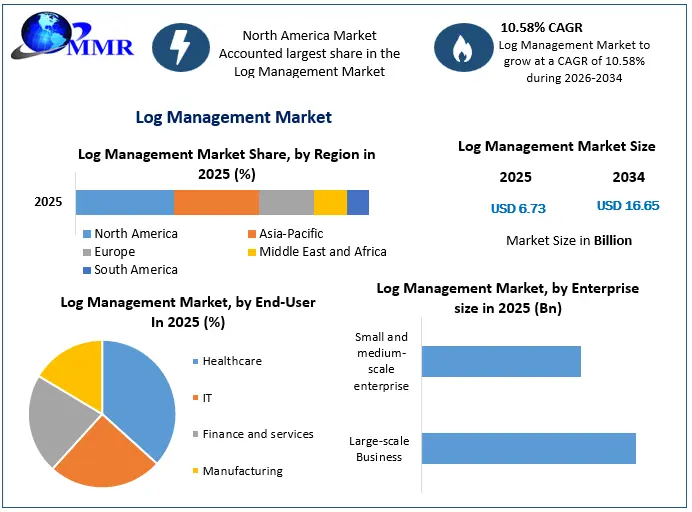
- Enterprise security teams are drowning in machine data while attackers use AI, ML and analytics to make intrusions harder to detect. The Log Management Market was valued at USD 6.73 Bn in 2025 and is expected to reach nearly USD 16.65 Bn by 2034, creating a growth opportunity for SIEM vendors, observability platforms, cloud logging providers and cybersecurity analytics companies.
- The Log Management Market is expected to grow at a 10.58% CAGR from 2026 to 2034, showing that log management is shifting from IT troubleshooting support to a strategic security, compliance and operations layer.
- Solutions are expected to lead the market because enterprises need platforms that identify application logs, security logs and system logs across warnings, errors, audits and information events.
- North America dominated with 36% share in 2025, giving vendors a strong base in advanced security infrastructure and technology adoption.
- Recent developments from Cognizant, IBM and Infosys show the market moving toward secure AI operations, AI-optimized hybrid cloud infrastructure and automated software delivery.
Why This Matters Now
Log management has become a control point for cyber resilience. Logs are created across networks, servers, containers, cloud infrastructure, applications, application infrastructure, message buses and load balancers, making them essential evidence for root-cause analysis, security monitoring and compliance.
The pressure is rising because cyberattacks are more frequent and more complex. MMR states that 98% of cyberattacks rely on social engineering, while attackers increasingly use AI, ML and analytics to complicate attacks and delay detection.
Market Overview
Log management is a set of processes used to manage the generation, analysis, transmission, storage, archiving and reporting of large volumes of log data created on systems or networks. These logs are also called audit records, audit trails and event logs.
The Log Management Market is segmented by component into services and solutions, by enterprise size into large-scale businesses and small and medium-scale enterprises, and by end user into healthcare, IT, finance and services, manufacturing and others. That structure places log management across cybersecurity, IT operations, observability, compliance and enterprise infrastructure management.
The public page contains a visible inconsistency: the top panel lists USD 6.73 Bn as forecast market size and shows a 10.8% CAGR, while the overview states USD 6.73 Bn in 2025, USD 16.65 Bn by 2034 and a 10.58% CAGR. This article uses the overview values because they match the supplied market-size statement.
Key Trends Driving Growth
Cybersecurity analytics is the first growth driver. Real-time log analysis integrated with predictive analytics helps organizations detect cyberattack activity, generate alerts and take mitigation steps before losses escalate.
The cost of delayed detection is central to the business case. MMR states that the average time to identify and contain a breach in 2022 was 280 days, cybercrime losses were around USD 2.9 million per minute, and the median cost of data breaches was USD 3.86 million.
Advanced technology integration is the second driver. Machine data is growing 50 times faster than traditional business data, and log management software helps collect, centralize and analyze data across enterprise technologies including firewalls, applications and other systems.
AI and machine learning are changing log intelligence. MMR states that applying machine learning to log analysis helps create algorithms that identify patterns, reduce search time and automatically analyze logs to find root causes before issues become widespread.
Compliance is increasing data-retention pressure. Network devices can generate about 10,000 log entries each day, medium-sized businesses generate about 4GB of log data per day, and organizations must meet requirements such as PCI-DSS, SOX and HIPAA.
Start Your Market Research Journey with a Free Sample Report
Segment Insights
- Dominant Segment Solutions: The solution segment is expected to lead the Log Management Market. Demand is supported by the need to manage application logs, security logs and system logs while improving SME productivity and offering management solutions at lower prices.
- Dominant Enterprise Size Large-Scale Businesses: Large-scale businesses are expected to drive demand because very large volumes of logs are created daily by IT systems, and this data supports SIEM and other security tools.
- End-User Growth Signal Finance and Services: The financial services sector has potential to become a major growth driver as compliance policies strengthen and BFSI use of log management software increases.
- Fastest-Growing Segment : The public MMR page does not identify a fastest-growing component, enterprise-size or end-user segment with a usable CAGR. No segment-level fastest-growth claim is inferred.
- Technology Signal SIEM and Security Analytics: Log data supports SIEM, threat detection, malware alerts, login-failure tracking, incident response and compliance reporting, making log management part of the cybersecurity operating stack.
Regional Growth Story
North America dominated with 36% share in 2025. The region benefits from technologically advanced markets such as the United States and strong adoption of security infrastructure and advanced technology.
The United States is the strongest disclosed country signal because North America’s lead is tied to developed technology infrastructure and adoption of log management by SMEs to expand customer bases and improve business efficiency. Country-level revenue is not disclosed.
Asia Pacific is expected to witness significant growth at an 8.9% CAGR through the forecast period. Growth is linked to the expanding mobile workforce, rising mobile-device adoption and use of log management in Australia, China and Japan to protect data from theft.
South Korea, Australia and Japan are identified among the top five countries in advanced technology adoption, giving Asia Pacific a stronger base for cybersecurity analytics and log management adoption. The public page does not disclose data center investments, 5G deployment metrics, edge computing adoption or telecom infrastructure expansion by country.
Competitive Landscape
Key players include AlienVault, Sematext Group, Veriato, LogRhythm, ZURIEL, Graylog, DataDog, Cisco Systems, IBM, Splunk, SolarWinds, Rapid7, Micro Focus, RSA, McAfee, Alert Logic, Intel and Blackstartus. The field combines SIEM, observability, cloud monitoring, endpoint security, infrastructure monitoring and enterprise security analytics vendors.
Competition is moving toward integrated security operations. Vendors that combine log collection, search, analytics, alerting, compliance reporting and incident-response workflows can compete for larger enterprise security budgets than point tools focused only on storage.
IBM’s partnership with Arm signals rising demand for AI-optimized and hybrid cloud platforms that can handle data-intensive log analysis workloads. Cognizant’s Secure AI Services signal that enterprises now need governance and monitoring for agentic AI systems, not only traditional IT logs.
Infosys integrating Harness’s AI Software Delivery Platform into Infosys Topaz Fabric signals that automated testing, cloud-cost reduction and software release speed are becoming part of the broader observability and operations value chain. The public page does not disclose named data center investments, 5G deployments or network expansion deals.
Recent Developments
- 05 May 2026 Cognizant: Cognizant launched Secure AI Services to govern, monitor and scale agentic AI systems across enterprise environments, strengthening threat detection and compliance management for AI operations.
- 15 April 2026 IBM and Arm: IBM partnered with Arm to develop enterprise computing platforms optimized for AI and hybrid cloud workloads, improving scalability and efficiency for high-performance log analysis.
- 01 April 2026 Infosys and Harness: Infosys integrated Harness’s AI Software Delivery Platform into Infosys Topaz Fabric, reducing cloud costs by up to 60% and accelerating software release cycles through automated testing.
- Open-Source Restraint: Free log management tools such as Logstash, Fluentd, GoAccess and LOGalyze remain a restraint because SMEs and startups can use free software and pay only for upgrades, customization and support.
Strategic Implications
For CIOs and CISOs, log management is now a real-time risk-control layer. The strongest business case connects threat detection, incident response, compliance evidence, root-cause analysis, application reliability and software-quality improvement.
For cloud providers and observability vendors, the market is tied to hybrid infrastructure growth. Logs now come from cloud infrastructure, containers, applications, servers and networks, so buyers need scalable systems that can normalize and analyze data across distributed environments.
For investors, the market offers exposure to SIEM, observability, AI log analytics, compliance automation, cloud logging, IT operations and cybersecurity resilience. The main risks are open-source alternatives, huge data volumes, retention burdens and incomplete public disclosure on segment-level growth rates.
Future Outlook
The Log Management Market is forecast to grow from USD 6.73 Bn in 2025 to nearly USD 16.65 Bn by 2034 at a 10.58% CAGR. Growth will come from solutions, large enterprises, finance and services, IT, healthcare, manufacturing, cyberattack detection, SIEM integration, predictive analytics, AI log intelligence, cloud infrastructure and compliance demands.
The next phase will test whether vendors can turn log data from passive records into real-time security and operations intelligence. Future digital leaders will control AI-enabled log intelligence across cloud, applications and networks; laggards will remain buried in unmanaged machine data while attackers move faster than their detection models.
Analyst Perspective
“Log management is becoming strategic cybersecurity and IT operations infrastructure as enterprises face growing machine data, complex attacks and stricter compliance demands,” said Yash Ghosalkar, Analyst at Maximize Market Research. “The strongest providers will combine SIEM integration, AI-driven analytics, cloud-scale logging, incident response, compliance reporting and real-time operational visibility.”
About Maximize Market Research
Maximize Market Research Pvt. Ltd. (MMR) is a global market research and consulting company that provides reliable, data-focused, and practical business insights. The firm serves a wide range of industries, including healthcare, pharmaceuticals, technology, automotive, electronics, chemicals, personal care, and consumer goods. Through market forecasts, competitive analysis, strategic consulting, and industry impact assessments, MMR helps organizations understand changing market conditions, identify growth opportunities, and make informed business decisions for long-term success.
Contact Us
2nd Floor, Navale IT Park Phase 3
Pune Banglore Highway, Narhe
Pune, Maharashtra 411041, India
+91 9607365656
sales@maximizemarketresearch.com
