AI-Driven Biologics Manufacturing Accelerates Global Biosimilar Market Growth
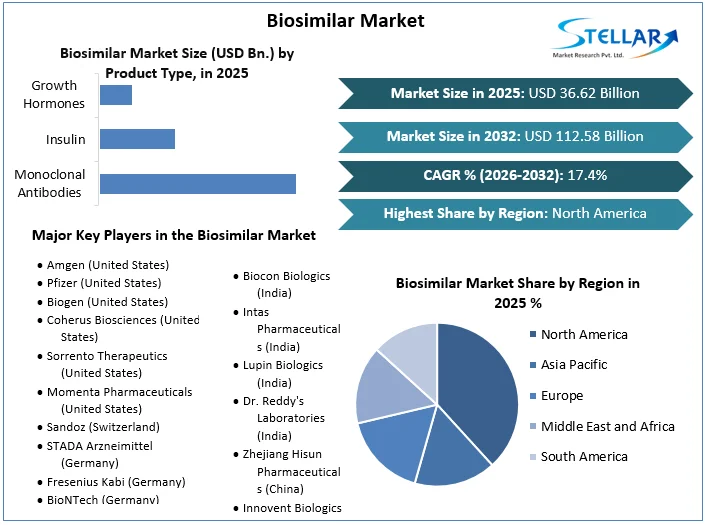
The Biosimilar Market, valued at USD 36.62 billion in 2025, is projected to reach USD 112.58 billion by 2032, expanding at a CAGR of 17.4% during 2026–2032, as patent expirations, regulatory support, and biologics affordability reshape the pharmaceutical landscape.
PUNE, India, July 10, 2026 – The Biosimilar Market is entering a transformative growth phase, according to the latest study by Stellar Market Research. As healthcare systems worldwide seek cost-effective alternatives to high-priced biologic therapies, biosimilars are emerging as a strategic solution for improving patient access while reducing healthcare expenditure. The report highlights that expanding patent expirations, favorable regulatory pathways, and increasing investments in advanced biologics manufacturing are accelerating commercial adoption across major pharmaceutical markets.
Download Free PDF Brochure: https://www.stellarmr.com/report/req_sample/biosimilar-market/2759
Market Opportunity Overview
The global pharmaceutical industry is witnessing one of its largest structural shifts as blockbuster biologics worth more than USD 100 billion in annual sales approach patent expiration. This transition is creating unprecedented opportunities for biosimilar manufacturers to commercialize affordable therapeutic alternatives across oncology, autoimmune diseases, diabetes, and immunology.
Healthcare providers, governments, and private insurers are increasingly encouraging biosimilar adoption to control escalating treatment costs without compromising therapeutic outcomes. At the same time, investments in AI-enabled manufacturing, digital quality management systems, and next-generation bioprocessing technologies are improving production efficiency and accelerating regulatory approvals. Emerging markets across Asia-Pacific, Latin America, and the Middle East are also strengthening local manufacturing capabilities, creating new growth opportunities for global pharmaceutical companies.
Key Findings from the Report
Global Biosimilar Market size reached USD 36.62 billion in 2025.
The market is forecast to grow at 17.4% CAGR during 2026–2032.
Market value is expected to reach approximately USD 112.58 billion by 2032.
North America currently dominates the global market owing to high biologics utilization and supportive commercialization strategies.
Emerging economies in Asia-Pacific, particularly India and South Korea, are becoming major biosimilar manufacturing and export hubs.
Patent expirations of blockbuster biologics are creating one of the largest commercial opportunities in the pharmaceutical industry.
Increasing government initiatives to improve affordable healthcare continue to strengthen long-term investment prospects.
Market Drivers and Restraints
Key Growth Drivers
Patent Expirations Unlock New Revenue Opportunities
The expiration of patents for leading biologic medicines is enabling pharmaceutical companies to introduce biosimilars across multiple therapeutic categories, significantly expanding market competition.
Growing Demand for Affordable Biologic Therapies
Biosimilars typically offer prices 15–30% lower than reference biologics, making advanced therapies more accessible for patients while reducing healthcare spending.
Supportive Regulatory Environment
Regulatory agencies across North America, Europe, and Asia continue refining biosimilar approval pathways, encouraging faster commercialization and broader physician confidence.
Major Market Restraints
Complex Manufacturing Processes
Unlike generic drugs, biosimilars require sophisticated biological manufacturing infrastructure, specialized expertise, and significant capital investment.
Regulatory and Commercial Challenges
Interchangeability requirements, physician adoption, reimbursement complexity, and intellectual property litigation continue to delay commercialization in several regions.
Technology, Regulation, and Sustainability Trends
Artificial intelligence, machine learning, and digital manufacturing platforms are increasingly being integrated into biologics production to optimize yield, improve quality assurance, and reduce batch variability.
Continuous bioprocessing technologies, automation, and advanced analytical testing are shortening development timelines while improving manufacturing efficiency.
Governments worldwide continue strengthening biosimilar reimbursement frameworks to improve patient affordability. Sustainability initiatives—including energy-efficient manufacturing, reduced process waste, and localized production facilities—are also gaining importance as pharmaceutical companies pursue ESG objectives alongside operational resilience.
Regional Insights
North America remains the largest regional market due to increasing FDA approvals, expanding physician acceptance, and strong healthcare reimbursement systems. The United States continues to experience rising biosimilar adoption across oncology and autoimmune disease treatment.
Europe maintains a mature biosimilar ecosystem supported by long-standing regulatory experience and widespread healthcare adoption, particularly in Germany, the United Kingdom, France, and the Nordic countries.
Asia-Pacific is emerging as the fastest-expanding production and commercialization hub. India and South Korea have established themselves as leading global manufacturing exporters, while China continues expanding domestic biologics production capacity through policy support and healthcare modernization initiatives. Latin America and the Middle East are also strengthening biosimilar adoption through public healthcare investments and local manufacturing partnerships.
Recent Industry Developments
Biocon Biologics (2026): Expanded its global biosimilar portfolio through additional regulatory approvals and commercialization initiatives, strengthening its oncology and immunology presence.
Celltrion (2025): Commercially launched STOBOCLO and OSENVELT in the U.S., expanding competition in bone disease biologics and improving treatment accessibility.
Amgen (2025): Introduced WEZLANA, the first U.S. ustekinumab biosimilar, intensifying competition within high-value immunology therapies.
Multiple Biosimilar Manufacturers (2025): Several ustekinumab biosimilars entered the U.S. market, significantly increasing patient treatment options and pricing competition.
U.S. FDA (2025): Continued expanding biosimilar approvals, supporting broader therapeutic coverage and accelerating healthcare cost savings through increased market competition.
Competitive Landscape
The Biosimilar Market remains highly competitive with global pharmaceutical leaders investing aggressively in manufacturing capacity, regulatory expertise, product development, and strategic partnerships.
Major participants include Amgen, Pfizer, Novartis (Sandoz), Biocon Biologics, Celltrion, Samsung Bioepis, Viatris, Dr. Reddy’s Laboratories, Teva Pharmaceutical Industries, and F. Hoffmann-La Roche. Companies continue expanding product portfolios through acquisitions, licensing agreements, manufacturing collaborations, and regional commercialization strategies to strengthen long-term market positioning.
Download Free PDF Brochure: https://www.stellarmr.com/report/req_sample/biosimilar-market/2759
Analyst Commentary
“The next decade will redefine competition in biologics as biosimilars become central to healthcare affordability strategies. Companies capable of combining advanced manufacturing technologies, regulatory excellence, and global commercialization capabilities will be best positioned to capture the significant opportunities created by upcoming biologic patent expirations,” said a Senior Research Analyst at Stellar Market Research.
Future Outlook
The Biosimilar Market is expected to experience sustained double-digit growth through 2032, supported by continuous biologic patent expirations, expanding healthcare coverage, increasing physician confidence, and technological innovation in biologics manufacturing.
AI-driven production optimization, digital quality management, localized manufacturing ecosystems, and stronger regulatory harmonization are expected to improve production efficiency while accelerating market entry. Growing investment across emerging economies is also anticipated to diversify global supply chains and improve long-term market resilience.
About Stellar Market Research
Stellar Market Research is a global market research and business consulting firm delivering comprehensive industry intelligence across healthcare, pharmaceuticals, chemicals, automotive, information technology, manufacturing, consumer goods, and industrial sectors. The company combines rigorous primary research, advanced analytics, and deep industry expertise to help organizations identify emerging opportunities, evaluate competitive landscapes, assess investment potential, and develop sustainable growth strategies. Its reports provide actionable insights on market size, forecasting, technological developments, regulatory dynamics, and strategic business intelligence, enabling corporate decision-makers, investors, policymakers, and industry stakeholders to make informed business decisions in rapidly evolving global markets.
Media Contact
Stellar Market Research
Website: https://www.stellarmr.com/
Email: sales@stellarmr.com
