Key Highlights
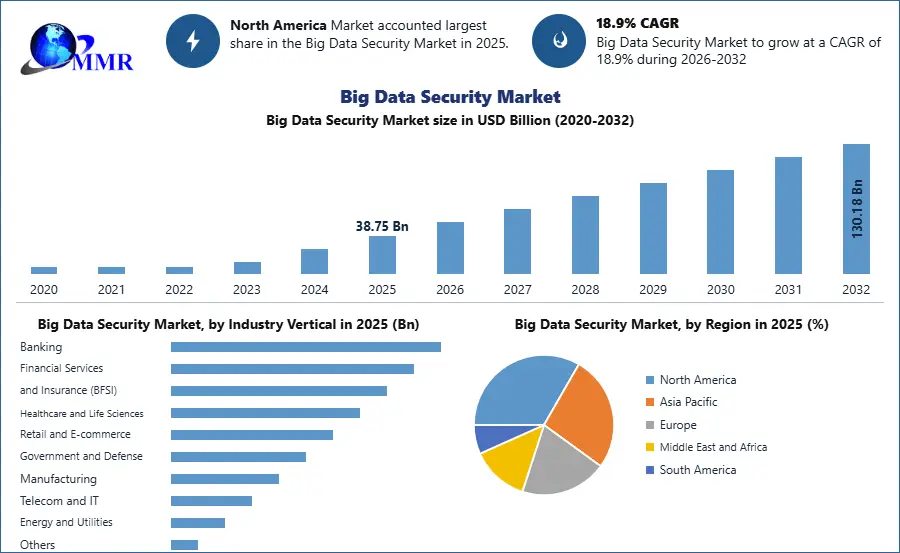
- Big data has become a cyber-risk frontier as enterprises store sensitive information across cloud platforms, hybrid infrastructure, applications, transactions, sensors and digital channels. The Big Data Security Market was valued at USD 38.75 Bn in 2025 and is expected to reach USD 130.18 Bn by 2032, creating a large opportunity for cybersecurity vendors, cloud providers, analytics platforms and managed security firms.
- The Big Data Security market is forecast to grow at an 18.9% CAGR from 2026 to 2032, showing that data protection is becoming a strategic requirement for analytics-led enterprises.
- Software dominated in 2025 because enterprises need encryption, access controls, monitoring and threat-detection tools to secure large data environments.
- Data Security Analytics held the largest security-type share in 2025, making AI, machine learning and advanced analytics central to threat detection and incident response.
- Cloud deployment held the largest share in 2025 because enterprises need scalable, agile and cost-effective protection for cloud-based big data systems.
Why This Matters Now
Enterprises are using big data analytics to make faster decisions, but every larger dataset increases exposure to unauthorized access, data breaches and sophisticated attacks. MMR states that big data security protects infrastructure, systems and sensitive data generated from social media, sensors, devices, transactions and other digital interactions.
For CIOs, CISOs and cloud leaders, the issue is not only breach prevention. Big data security now protects customer trust, brand reputation, regulatory compliance and the integrity of analytics models that guide business decisions.
Market Overview
The Big Data Security market includes technologies and practices used to protect large volumes of structured, semi-structured and unstructured data. The market covers data discovery and classification, authorization and access, encryption, tokenization and masking, auditing and monitoring, governance and compliance, security analytics, and backup and recovery.
The market is segmented by component into software and services, by deployment into on-premise and cloud, by organization size into large enterprises and SMEs, and by industry vertical into BFSI, healthcare and life sciences, retail and e-commerce, government and defense, manufacturing, telecom and IT, energy and utilities, and others.
The public page contains a header inconsistency: the top panel lists USD 38.75 Bn as forecast market size, while the overview and scope table state USD 38.75 Bn in 2025 and USD 130.18 Bn by 2032. This article uses the overview and scope-table values because they match the supplied market-size statement.
Key Trends Driving Growth
Cybersecurity threats are the first growth driver. MMR states that cyber-attacks, data breaches and sophisticated hacking techniques are rising, pushing organizations to adopt robust security solutions for real-time monitoring and threat response.
Cloud adoption is the second driver. As organizations shift big data storage and processing into cloud and hybrid IT environments, they need secure data transfer, encryption, access controls and monitoring to protect cloud-based data assets.
AI and machine learning are becoming the main technology shift. Big Data Security solutions are using advanced analytics, machine learning and artificial intelligence to detect patterns, anomalies and potential threats inside large datasets, enabling proactive threat detection and efficient incident response.
Regulatory pressure is also driving demand. GDPR, CCPA, HIPAA and PCI-DSS create strict requirements for personal and sensitive data, forcing enterprises to adopt stronger privacy, consent management and compliance controls.
The main restraints are complexity, skill shortages, integration challenges and cost. Big data environments involve diverse sources, distributed architectures and varied formats, requiring specialized security expertise and investment in technology, infrastructure and skilled personnel.
Request an Exclusive Sample for In-Depth Market Analysis
Segment Insights
- Dominant Segment Software: Software dominated in 2025 and is expected to hold the largest share because enterprises need tools and applications that secure big data environments through encryption, access controls and monitoring capabilities.
- Dominant Security Type Data Security Analytics: Data Security Analytics held the largest share in 2025 and is expected to dominate because it uses advanced analytics, machine learning and AI to detect anomalies, threats and attack patterns in large datasets.
- Dominant Deployment Cloud: Cloud held the largest share in 2025 and is expected to retain leadership because it offers scalability, agility, reduced upfront cost and accessibility from anywhere.
- Fastest-Growing Segment: The public MMR page does not identify a fastest-growing component, security type, deployment mode, organization-size or industry vertical with a usable CAGR. No segment-level fastest-growth claim is inferred.
- End-User Scope BFSI, Healthcare, Retail, Government, Manufacturing, Telecom and IT: These verticals are covered, but the public page does not rank them by revenue share or growth rate.
Regional Growth Story
North America dominated the Big Data Security Market in 2025 and is expected to hold the largest share through the forecast period. Regional demand is tied to rising data generation, greater breach risk, cloud computing, IoT adoption and enterprise reliance on big data analytics.
The United States is included in the North America scope, with Canada and Mexico. The public page does not disclose U.S.-specific revenue, data center investments, 5G deployment, telecom infrastructure expansion or edge computing adoption tied to this market.
Asia Pacific is also expected to dominate over the forecast period, creating a regional wording inconsistency with the North America leadership statement. China, Japan, India, Australia and South Korea are identified as significant contributors, supported by digital transformation, cyberattack awareness and national data-protection regulations.
Europe covers the UK, France, Germany, Italy, Spain, Sweden and Austria. The public page identifies GDPR as a key regulatory driver but does not disclose country-level revenue values or specific European deployment metrics.
Competitive Landscape
Key players include Tracxn Technologies, IBM, Oracle, Microsoft, Cloudera, AWS, HPE, Symantec, McAfee, Splunk, Dell EMC, Check Point Software Technologies, Cisco Systems, Palo Alto Networks, Fortinet, Imperva, Trend Micro, Informatica, Thales Group, Micro Focus, RSA Security, FireEye, Rapid7, Proofpoint, Varonis Systems, Bitdefender, Carbon Black, LogRhythm, Trustwave, F5 Networks and Digital Guardian.
Competition is moving toward integrated security, analytics and cloud governance. Microsoft, IBM, Oracle, AWS and Google signal hyperscale and enterprise-platform competition, while Splunk, Palo Alto Networks, Fortinet, Check Point and Rapid7 signal specialized security analytics and threat-response depth.
Kyndryl’s collaboration with AWS shows where the market is moving: faster threat intelligence, better visibility and reduced time to detect and resolve cyber events. That signals rising demand for cloud-native security operations, not only standalone data-protection tools.
The public page does not disclose data center investments, telecom network expansion, 5G deployments or edge computing projects by vendor. The visible competitive direction is AI-driven security analytics, cloud data protection, identity and access control, compliance automation and managed security services.
Recent Developments
- 07 January 2026 Microsoft: Microsoft released the Digital Defense Report 2025, detailing AI-driven security agents and advancements in Microsoft Sentinel and Security Copilot for anomaly detection across massive cloud datasets.
- 30 July 2025 IBM: IBM launched the 2025 Cost of a Data Breach Report with new metrics for AI-specific security governance and autonomous security operations.
- 15 April 2025 Oracle: Oracle issued a critical security alert and automated patch deployment for Oracle E-Business Suite big data environments to prevent remote code execution vulnerabilities.
- 27 January 2025 AWS: AWS implemented enhanced data perimeter controls and auditing after detecting an external unauthorized access attempt on object storage.
- 14 October 2025 Google: Google integrated Mandiant threat intelligence into BigQuery to provide real-time risk scoring for datasets and isolate high-risk records.
Strategic Implications
For CIOs and CISOs, big data security is now part of enterprise data architecture. The strongest business case connects encryption, access controls, data governance, monitoring, AI threat analytics and compliance into one operating model.
For cloud providers, the market creates a platform opportunity around data perimeter controls, identity management, monitoring and secure analytics. As enterprises adopt cloud and hybrid IT, security controls must follow data across platforms rather than remain attached to legacy infrastructure.
For investors, the market offers exposure to AI security analytics, cloud data protection, managed security services, regulatory compliance, insider threat detection and data governance. The main risks are implementation complexity, skilled-professional shortages, performance overhead and integration challenges with legacy systems.
Future Outlook
The Big Data Security Market is forecast to grow from USD 38.75 Bn in 2025 to USD 130.18 Bn by 2032 at an 18.9% CAGR. Growth will come from software, cloud deployment, data security analytics, AI and machine learning, managed security services, privacy regulation, insider threat detection, BFSI, healthcare, government, telecom and IT demand.
The next phase will test whether enterprises can protect data at the same speed they generate, move and analyze it. Future digital leaders will control AI-enabled, cloud-integrated big data security systems; laggards will remain exposed to fragmented controls while attackers turn data scale into attack scale.
Analyst Perspective
“Big data security is becoming strategic enterprise infrastructure as organizations rely on cloud analytics, AI, IoT and regulated data environments,” said Yash Ghosalkar, Analyst at Maximize Market Research. “The strongest providers will combine AI-driven threat analytics, encryption, access control, cloud security, data governance, compliance support and managed security expertise.”
About Maximize Market Research
Maximize Market Research Pvt. Ltd. (MMR) is a global market research and consulting company that provides reliable, data-focused, and practical business insights. The firm serves a wide range of industries, including healthcare, pharmaceuticals, technology, automotive, electronics, chemicals, personal care, and consumer goods. Through market forecasts, competitive analysis, strategic consulting, and industry impact assessments, MMR helps organizations understand changing market conditions, identify growth opportunities, and make informed business decisions for long-term success.
Contact Us
2nd Floor, Navale IT Park Phase 3
Pune Banglore Highway, Narhe
Pune, Maharashtra 411041, India
+91 9607365656
sales@maximizemarketresearch.com
