Key Highlights
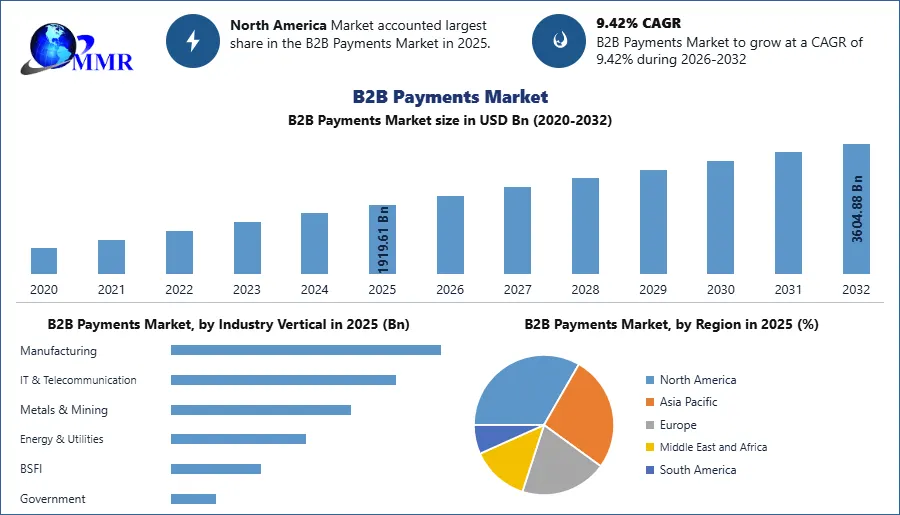
- The B2B Payments Market was valued at USD 1,919.61 billion in 2025 and is projected to reach USD 3,604.88 billion by 2032, expanding at a CAGR of 9.42% from 2026 to 2032.
- Domestic payments represented about 63% of the market in 2023, supported by high transaction volumes, established national banking infrastructure and demand from small and medium-sized businesses.
- Cross-border payments held about 37% of the market as global trade, e-commerce and multicurrency payment technologies increased international transaction demand.
- North America led the global market with a share exceeding 40% in 2023.
- Asia Pacific held a 35% share in 2023 and was identified as the fastest-growing regional market.
- AI, machine learning, cloud computing, APIs, blockchain rails and automated reconciliation are reshaping enterprise payment operations.
- Cybersecurity, payment fraud, data protection rules and regulatory complexity remain major barriers to digital adoption.
Why This Matters Now
Corporate payments are shifting from back-office administration to programmable financial infrastructure. AI agents, real-time settlement networks and embedded payment APIs are beginning to determine how quickly enterprises reconcile invoices, release working capital and trade across borders.
The B2B Payments Market expected rise from USD 1,919.61 billion in 2025 to USD 3,604.88 billion by 2032 signals a structural replacement of paper-based processes rather than a simple increase in transaction volumes. The 9.42% CAGR creates a large opportunity for banks, fintech companies, enterprise software vendors and cloud-based payment platforms that can combine speed with compliance and fraud protection.
Market Overview
B2B Payments Market cover financial transactions between businesses, including payments to suppliers, distributors, contractors, employees and service providers. These transactions differ from consumer payments because they often involve larger values, complex approval chains, invoices, trade-credit arrangements and regulatory checks.
Digitalization is replacing manual workflows with automated accounts payable, electronic invoicing and remote cashless payments. Businesses increasingly expect platforms to initiate transactions, reconcile records and present payment information through one interface. That demand is moving payment functionality into enterprise resource planning systems, procurement software and digital marketplaces.
Global trade adds another layer of urgency. Companies operating across supply chains require multicurrency conversion, transaction visibility and faster settlement between suppliers, wholesalers and retailers. Payment providers that simplify these processes can become embedded in a client’s wider financial and operational architecture.
Key Trends Driving Growth
Artificial intelligence and machine learning are moving B2B payment automation beyond fixed rules. The technologies can support invoice matching, reconciliation, fraud detection and payment-trend analysis. This allows finance teams to reduce manual errors and concentrate on exceptions rather than processing every transaction individually.
Visa’s GenAI-powered autonomous payables agent, launched in March 2026, was designed to automate complex back-office reconciliation. The report states that the tool is expected to reduce operational costs by 15% for large enterprises by eliminating manual invoice-matching errors. The strategic implication is clear: payment platforms are becoming autonomous workflow systems rather than transaction gateways.
Cloud computing supports this transition by allowing payment services to scale across business units and markets. Cloud-based platforms can connect payment initiation, invoice data, approval rules and reporting without requiring companies to operate separate systems for each process.
API ecosystems are also changing platform economics. Mastercard introduced an API-based orchestration platform in December 2025 to simplify virtual-card issuance for manufacturers and enable straight-through posting into enterprise resource planning systems. Such integrations strengthen payment providers’ positions inside corporate software stacks and make switching platforms more difficult.
Real-time processing is becoming a competitive requirement. FIS Global formed an alliance with Asia Pacific banks in February 2026 to deploy real-time rails for cross-border B2B trade, targeting shorter settlement cycles and better liquidity for small and medium-sized enterprises. Faster settlement gives businesses greater control over cash positions and reduces capital trapped between payment initiation and receipt.
Blockchain-based infrastructure is developing in parallel. JPMorgan Chase piloted tokenized deposits on a regulated blockchain rail for continuous treasury settlement in October 2025. The initiative shows how regulated digital assets could remove weekend and holiday delays from international corporate payments without relying on unregulated payment instruments.
Cybersecurity remains the counterweight to this automation. Malware, phishing, ransomware, invoice manipulation and executive impersonation can compromise transactions and expose confidential business information. GDPR, PCI DSS and other compliance requirements increase the need for layered fraud detection, secure authentication and auditable payment controls.
Explore Market Dynamics with a Free Research Sample
Segment Insights
- Dominant Segment Domestic Payments: Domestic transactions held about 63% of the market in 2023. Lower processing costs, familiar banking infrastructure and simpler regulatory requirements make them attractive to companies paying local suppliers and service providers.
- Fastest-Growing Segment: The public report page does not identify a transaction, enterprise-size, payment-method or industry segment as the fastest-growing. Unsupported segment rankings have therefore been omitted.
- Cross-Border Payments: The segment held about 37% of the market in 2023. International trade, e-commerce, multicurrency capabilities and demand for secure global transfers support continued adoption.
- Enterprise Opportunity: Small and medium-sized companies represent an important adoption base because they prioritize cost efficiency, payment visibility and automated processing.
- Payment Methods: The report segments the market into bank transfers and cards. Virtual-card orchestration and real-time bank rails are expanding the strategic role of both methods.
- Industry Verticals: Manufacturing, IT and telecommunications, metals and mining, energy and utilities, banking and financial services, and government are included within the market scope.
Regional Growth Story
North America held more than 40% of the global market in 2023 and is expected to retain its leadership. Established clearing systems, electronic payment adoption and companies including Visa, Mastercard, PayPal, Stripe and Square give the region a mature innovation base. Clear payment standards also increase enterprise confidence in digital transactions.
Asia Pacific held a 35% share and was the fastest-growing region in 2023. China, India and Indonesia generate large transaction volumes, while internet access, mobile commerce and fintech activity create demand for more efficient business payments. Government initiatives, including Digital India and the Immediate Payment Service, also support real-time payment adoption.
India illustrates the scale of payment infrastructure development. The report states that 414 banks were live on the Unified Payments Interface as of April 2023, while the BHIM UPI application accounted for more than 67% of its identified category in 2023. This infrastructure gives payment providers a foundation for building corporate services around mobile access and immediate settlement.
Europe held about 20% of the market in 2023. Demand for faster transactions and greater transparency supports adoption, although continued dependence on traditional payment infrastructure in some countries can slow modernization. The United Kingdom and Germany remain within the report’s European coverage, while China, India, Japan and South Korea are included in Asia Pacific.
Competitive Landscape
The market brings together global banks, card networks, fintech specialists and enterprise software vendors. American Express, Bank of America, Citigroup, JPMorgan Chase, Mastercard, PayPal, Payoneer, Stripe, Visa and Wise compete alongside Bill.com, Coupa, SAP Ariba, Oracle NetSuite, FIS, Fiserv and Intuit QuickBooks.
Competition is moving away from standalone payment acceptance. Providers increasingly want to control invoice data, credit decisions, reconciliation, treasury visibility and supplier workflows. This favors platforms that combine payment rails with SaaS functionality and direct integrations into procurement and accounting systems.
Stripe reported in January 2026 that its embedded-finance stack processed USD 1 trillion during fiscal 2025. The report links this milestone to rapid growth in B2B marketplaces, signalling that payment volume is migrating toward software platforms where transactions are built directly into commercial workflows.
Partnerships further show that network reach alone is insufficient. Visa’s collaboration with Swift connects major payment networks, while Fiserv and Stripe’s partnership combines product development with broader enterprise distribution. Citigroup’s work with Hokodo integrates B2B buy-now-pay-later capabilities into digital commerce platforms, turning trade credit into an embedded software feature.
Recent Developments
- Stripe announced in January 2026 that its embedded-finance stack processed USD 1 trillion during fiscal 2025.
- FIS Global partnered with Asia Pacific banks in February 2026 to deploy real-time cross-border payment rails.
- Visa launched a GenAI-powered autonomous payables agent in March 2026 to automate enterprise reconciliation.
- JPMorgan Chase piloted regulated tokenized deposits for continuous treasury settlement in October 2025.
- Mastercard introduced an API-based virtual-card orchestration platform for manufacturers in December 2025.
- Citigroup expanded its Hokodo collaboration in February 2025 to integrate B2B buy-now-pay-later services into global platforms.
Strategic Implications
CIOs and chief financial officers must treat payment modernization as an enterprise architecture decision. A platform that cannot connect with procurement, accounting, treasury and supplier systems will preserve manual work even when the transaction itself becomes digital.
Technology buyers should assess fraud controls, regulatory coverage, API quality and reconciliation capabilities alongside processing fees. The lowest-cost rail may create higher operational costs when it lacks visibility or requires manual exception handling.
Banks face pressure to expose services through APIs and participate in embedded-finance ecosystems. Fintech providers, meanwhile, must prove that their cloud-based models can satisfy enterprise security, resilience and compliance requirements.
Future Outlook
B2B payments will increasingly operate as automated software workflows rather than isolated bank instructions. Generative AI agents will manage reconciliation, real-time rails will compress settlement periods, and programmable platforms will connect payments with invoices, credit and enterprise data.
The next competitive boundary will be ownership of the financial workflow: digital leaders will orchestrate money and data through one secure platform, while laggards will continue reconciling fragmented systems after transactions have already occurred.
Analyst Perspective
“B2B payments are becoming an intelligent enterprise software category rather than a narrow transaction service. AI reconciliation, real-time settlement, APIs and embedded finance can improve working-capital control, but providers must combine automation with cybersecurity and regulatory compliance to secure long-term enterprise adoption,” said Yash Ghosalkar, Analyst at Maximize Market Research.
About Maximize Market Research
Maximize Market Research Pvt. Ltd. (MMR) is a global market research and consulting company that provides reliable, data-focused, and practical business insights. The firm serves a wide range of industries, including healthcare, pharmaceuticals, technology, automotive, electronics, chemicals, personal care, and consumer goods. Through market forecasts, competitive analysis, strategic consulting, and industry impact assessments, MMR helps organizations understand changing market conditions, identify growth opportunities, and make informed business decisions for long-term success.
Contact Us
2nd Floor, Navale IT Park Phase 3
Pune Banglore Highway, Narhe
Pune, Maharashtra 411041, India
+91 9607365656
sales@maximizemarketresearch.com
