Military Tactical Vest Market Outlook: Rising Defense Investments Fuel Next-Generation Soldier Protection
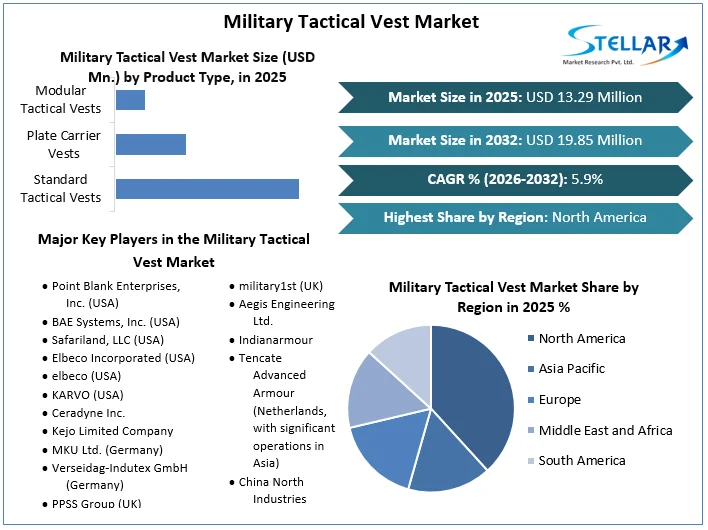
The global Military Tactical Vest Market is witnessing consistent growth as armed forces worldwide continue to modernize soldier protection systems. Rising geopolitical tensions, increasing defense budgets, and continuous advancements in ballistic materials are encouraging governments to invest in lightweight, modular, and highly protective tactical vests. According to Stellar Market Research, the market was valued at USD 13.29 million in 2025 and is projected to reach USD 19.85 million by 2032, growing at a CAGR of 5.9% during the forecast period.
What Is a Military Tactical Vest?
A military tactical vest is specialized protective equipment designed to safeguard soldiers while providing storage for mission-critical gear such as ammunition, communication devices, hydration systems, medical kits, and navigation tools. Modern tactical vests are highly customizable, enabling personnel to configure equipment according to mission requirements while maintaining mobility and comfort.
Today’s tactical vests combine ballistic protection with modular load-bearing capabilities, making them indispensable for military operations, law enforcement, and special forces.
𝐃𝐨𝐰𝐧𝐥𝐨𝐚𝐝 𝐅𝐫𝐞𝐞 𝐏𝐃𝐅 𝐁𝐫𝐨𝐜𝐡𝐮𝐫𝐞: https://www.stellarmr.com/report/req_sample/Military-Tactical-Vest-Market/1922
Key Factors Driving Market Growth
Rising Global Defense Spending
Many countries are increasing military budgets to strengthen national security amid evolving geopolitical challenges. Procurement of advanced personal protective equipment has become a priority as governments focus on improving soldier survivability and operational efficiency.
Growing defense modernization programs across North America, Europe, and Asia-Pacific continue to create strong demand for next-generation tactical vests.
Advancements in Ballistic Materials
Material innovation is transforming tactical vest performance. Manufacturers are utilizing advanced materials such as:
Kevlar
Ultra-High-Molecular-Weight Polyethylene (UHMWPE)
Composite ceramics
High-strength nylon and polyester
These materials offer improved ballistic protection while significantly reducing weight, allowing soldiers greater mobility during combat missions.
Demand for Modular Equipment
Modern military missions require adaptable equipment. Tactical vests now feature MOLLE-compatible systems, detachable pouches, quick-release mechanisms, and integrated hydration systems that enable users to customize gear based on operational requirements.
This flexibility has become a major purchasing criterion for defense organizations worldwide.
Emerging Technology Trends
The military tactical vest industry is evolving beyond conventional body armor. Manufacturers are incorporating smart technologies that improve battlefield awareness and operational performance.
Some emerging innovations include:
Integrated communication systems
Wearable sensors
Body cameras
Smart textiles
Lightweight ballistic plates
Improved ergonomic designs
Enhanced ventilation systems
These technologies are expected to play an increasingly important role in future soldier modernization programs.
Market Segmentation
By Material Type
The market includes several high-performance materials:
Kevlar
UHMWPE
Composite Ceramics
Nylon & Polyester
Others
Kevlar and UHMWPE remain among the most preferred materials because of their superior strength-to-weight ratio and excellent ballistic resistance.
By Product Type
Major product categories include:
Standard Tactical Vests
Plate Carrier Vests
Modular Tactical Vests
Other Tactical Systems
Plate carriers and modular tactical vests continue gaining popularity because they provide greater operational flexibility and customizable protection levels.
By Protection Level
Military tactical vests are commonly classified into:
Soft Armor
Hard Armor
Soft armor offers mobility and protection against handgun threats, while hard armor provides enhanced protection against rifle ammunition and armor-piercing rounds.
𝐃𝐨𝐰𝐧𝐥𝐨𝐚𝐝 𝐅𝐫𝐞𝐞 𝐏𝐃𝐅 𝐁𝐫𝐨𝐜𝐡𝐮𝐫𝐞: https://www.stellarmr.com/report/req_sample/Military-Tactical-Vest-Market/1922
Regional Market Analysis
North America Leads the Market
North America continues to dominate the military tactical vest market due to high defense expenditure, continuous investment in soldier modernization, and the presence of major manufacturers.
The United States remains one of the world’s largest purchasers of advanced tactical protection systems.
Asia-Pacific Shows Strong Growth
Asia-Pacific is expected to witness significant growth throughout the forecast period. Countries including India, China, Japan, and South Korea are increasing investments in military modernization and indigenous defense manufacturing.
Growing border security concerns and expanding defense budgets continue to create new opportunities for tactical vest manufacturers.
Europe Maintains Steady Demand
European countries are also strengthening defense capabilities by upgrading protective equipment for military personnel and special forces in response to evolving regional security challenges.
Competitive Landscape
The military tactical vest market remains competitive, with manufacturers focusing on innovation, material science, product customization, and government defense contracts.
Leading companies continue investing in research and development to improve:
Lightweight ballistic protection
Ergonomic designs
Modular load-bearing systems
Smart wearable technologies
Soldier comfort and mobility
Strategic collaborations with defense agencies are expected to remain an important growth strategy across the industry.
Market Challenges
Despite favorable growth prospects, manufacturers face several challenges.
High production costs associated with advanced ballistic materials can increase procurement expenses. Additionally, strict military certification standards, lengthy government procurement processes, and supply chain disruptions may affect production timelines.
Balancing maximum protection with lightweight construction also remains a critical engineering challenge.
Future Opportunities
Future opportunities are expected to emerge from:
Smart wearable military equipment
AI-enabled battlefield systems
Integrated communication technologies
Advanced ballistic composites
Sustainable manufacturing processes
Increasing defense procurement in emerging economies
As armed forces increasingly adopt connected soldier systems, tactical vests will evolve into multifunctional platforms supporting communication, monitoring, navigation, and protection.
Conclusion
The Military Tactical Vest Market is poised for stable long-term growth as global defense organizations prioritize advanced personal protection for military personnel. Continuous improvements in ballistic materials, modular designs, and wearable technologies are reshaping the industry and enhancing soldier effectiveness on modern battlefields.
With rising defense investments, increasing demand for lightweight protective equipment, and ongoing technological innovation, the market offers promising opportunities for manufacturers, suppliers, and defense technology providers throughout the forecast period.
