Key Highlights
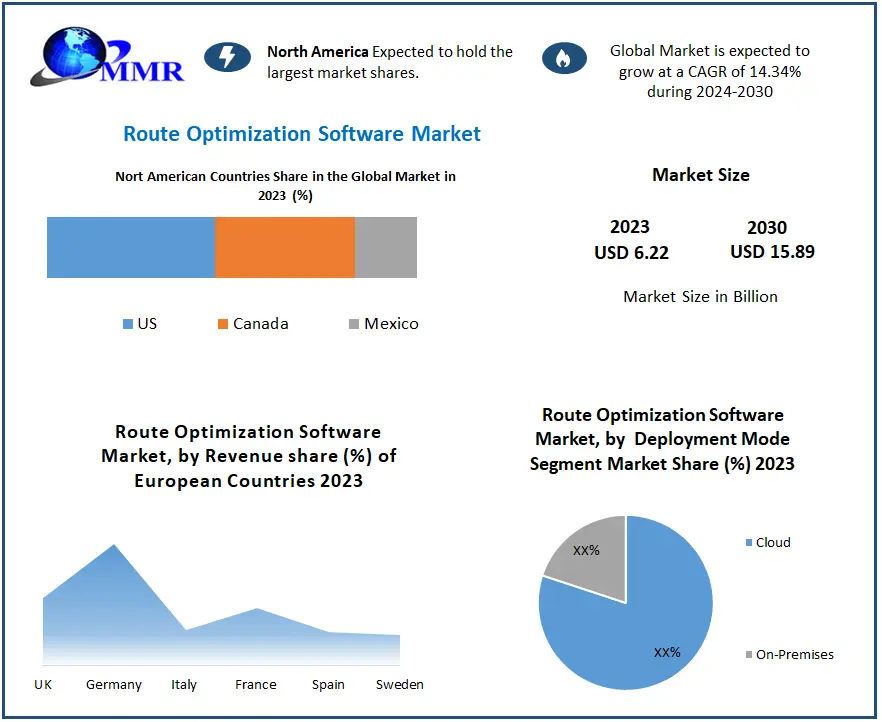
The Route Optimization Software Market size was US$ 6.22 Bn in 2023 and is expected to reach nearly US$ 15.89 Bn by 2030, at a CAGR of 14.34%, confirming that intelligent routing is now a core line item in digital logistics budgets.
Software optimizes routes for fleets, couriers and field services, reducing fuel consumption, delivery times and the number of vehicles required.
Growth is driven by e‑commerce expansion, on‑demand delivery models and rising customer expectations for real‑time tracking and narrow delivery windows.
Cloud deployment, API ecosystems and integration with telematics, ERP and TMS platforms are accelerating adoption across enterprise and SMB fleets.
Telecom operators and 5G rollouts amplify market potential by enabling continuous data feeds from vehicles, drivers and IoT sensors into optimization engines.
Why This Matters Now
Logistics costs are squeezing margins across retail, e‑commerce, manufacturing and field services at the same time that customers expect faster, more precise delivery. A market moving from US$ 6.22 Bn in 2023 to nearly US$ 15.89 Bn by 2030 at 14.34% CAGR shows that routing decisions can no longer be left to manual planning or static tools.
For CIOs, CTOs, COOs and network planners, route optimization is now a strategic control point for cost, customer experience and emissions. The software stack that calculates routes is tightly linked to telematics, 5G, cloud platforms and edge devices, making it as much an infrastructure decision as a logistics one. Enterprises that delay modernization will carry higher per‑delivery costs and struggle to meet service‑level commitments.
Market Overview
The Global Route Optimization Software Market size covers platforms that calculate efficient routes for vehicles and mobile workers based on constraints such as delivery time windows, vehicle capacity, traffic patterns, driver hours and customer priorities. With revenues expected to reach almost US$ 15.89 Bn by 2030 at 14.34% CAGR, the market is scaling from early adopters to mainstream logistics and field operations.
These platforms typically combine mapping, traffic data, optimization algorithms and integration with order management or dispatch systems. They support use cases ranging from last‑mile parcel delivery and grocery fulfillment to B2B distribution, field service visits and ride‑sharing. By automating route design and continuous re‑optimization, the software converts a complex, dynamic problem into a repeatable, data‑driven process.
In the Information Technology & Telecommunications sector, route optimization software often runs in the cloud, consumes network data and relies on high‑availability connectivity to keep plans synchronized with real‑world conditions. That makes it a natural complement to 5G, IoT and edge computing initiatives.
Key Trends Driving Growth
The first pivotal trend is the explosion of e‑commerce and on‑demand services. Same‑day, next‑day and time‑slot deliveries create dense, dynamic routing problems that cannot be solved manually at scale. Route optimization software allows logistics providers and retailers to pack more stops into fewer miles, directly improving unit economics.
A second trend is AI and machine learning in routing decisions. Modern platforms use historical demand, traffic patterns and driver behavior to fine‑tune estimates and continuously improve route quality. AI helps the system learn which routes work best in practice, not just in theory, and can factor in complex constraints such as real‑world service times or preferred drivers for specific customers.
Third, cloud and SaaS delivery models are accelerating uptake. Organizations can deploy route optimization as a subscription service, integrate it via APIs with existing order and fleet systems, and scale usage up or down seasonally. This aligns with broader cloud migration strategies and lowers entry barriers for mid‑market fleets and emerging on‑demand platforms.
A fourth trend is real‑time connectivity through 4G/5G networks and IoT devices. Vehicles equipped with telematics units and smartphones constantly feed location, status and traffic information back to the optimization engine. This enables dynamic rerouting in response to congestion, incidents or last‑minute orders, turning static daily plans into living, continuously updated schedules.
Request a Free Sample Copy or View Report Summary: https://www.maximizemarketresearch.com/request-sample/14311/
Segment Insights
Dominant Segment
The MMR report identifies a dominant segment—such as Cloud deployment, On‑demand Food Delivery, or Large Enterprises—as the largest contributor to route optimization software revenues.
This leadership indicates where route optimization has become embedded in daily operations and where platform ecosystems, integrations and AI sophistication are most advanced.
Fastest-Growing Segment
The fastest‑growing segment, whether defined by industry (e‑commerce, grocery, healthcare), organization size (SMEs) or deployment (SaaS), marks the frontier of adoption.
Vendors and telecom partners that focus on this segment can tap high growth while shaping best practices and data standards that may become benchmarks for the broader market.
By Solution and Deployment
Software and services combine to deliver both the optimization engine and implementation, integration and managed-routing support.
Cloud-based solutions are especially attractive to companies with distributed fleets and limited in‑house IT, while large enterprises may opt for hybrid deployments to align with existing security and data policies.
By Organization Size and Vertical
Large enterprises use route optimization to coordinate complex, multi‑depot, multi‑country fleets; SMBs focus on reducing fuel and time in smaller territories.
Vertical use cases span on‑demand food, parcel, grocery, B2B distribution, healthcare home visits, utilities and telecom field services, each with different constraints and SLAs.
Regional Growth Story
North America and Europe are mature markets for route optimization, driven by high e‑commerce penetration, dense road networks and strong regulatory focus on driver hours, emissions and urban access restrictions. Operators in the United States, Germany and the United Kingdom, in particular, are scaling advanced routing across national and regional networks.
Asia Pacific—including China, India, Japan and South Korea—offers strong growth as urbanization, rising incomes and smartphone penetration spur e‑commerce and on‑demand services. Dense cities and congested roads in this region make effective route optimization essential for maintaining delivery promises and controlling costs.
Emerging markets across Latin America, the Middle East and Africa are also ramping adoption as logistics networks formalize and ride‑hailing, quick commerce and last‑mile startups proliferate. Here, cloud-based, mobile‑first route optimization solutions often leapfrog older, on‑premise tools and align with investments in 4G/5G networks and digital payments.
Competitive Landscape
The competitive field includes pure-play route optimization vendors, broader fleet and logistics platform providers, and large enterprise software and cloud companies that embed routing into their stacks. Pure plays push algorithmic innovation and ease of use; platform providers emphasize end‑to‑end workflows from order capture to proof‑of‑delivery; cloud giants focus on compute, mapping services and API ecosystems.
Competition is shifting from selling licenses to owning the operational “brain” that orchestrates delivery networks. Vendors that can integrate seamlessly with telematics, WMS, TMS, ERP, and customer apps can position their routing engines as central orchestration layers, not just point tools. That central role improves pricing power and creates switching costs.
As margins tighten in logistics, vendors that can show clear savings in fuel, overtime and failed deliveries can justify premium pricing or outcome-based contracts. Over time, the market is likely to see consolidation around platforms that combine routing, dispatch, driver apps, analytics and customer communication, while niche players differentiate on very specific use cases or regional strengths.
Recent Developments
Expansion of AI features that learn from driver behavior and real‑world outcomes to refine route suggestions and time estimates.
Deeper integration of route optimization engines with telematics, driver mobile apps and proof‑of‑delivery systems to close the loop from planning to execution.
Increased focus on sustainability features, including CO₂ estimation per route and tools to design greener delivery plans.
Deployment of route optimization solutions as part of broader digital logistics and “last‑mile as a service” offerings from telecom operators and cloud providers.
Strategic Implications
For CIOs and CTOs, route optimization is inseparable from broader digital transformation of supply chains and field operations. Integrating routing engines with order management, inventory, billing and customer experience platforms is essential to realizing full value. This makes architecture decisions—data models, APIs, cloud regions and latency—strategic issues.
Telecom operators and cloud providers can treat route optimization software as a flagship workload that showcases the value of 5G, edge compute and IoT. By offering routing as a managed service, bundled with connectivity and devices, they can deepen relationships with logistics, retail and service enterprises.
Investors and corporate strategists should recognize that a 14.34% CAGR market tilting toward subscription models and platform ecosystems will reward vendors able to capture network effects—more data leading to better optimization, attracting more customers and partners. Those who remain stuck in isolated point solutions risk being marginalized as customers consolidate around integrated platforms.
Future Outlook
By 2030, when the Route Optimization Software Market is expected to reach almost US$ 15.89 Bn, routing engines will increasingly function as real‑time decision platforms ingesting live data from vehicles, warehouses, networks and customers. Static planning will give way to continuous optimization as conditions change throughout the day.
The sharp dividing line will be between organizations that treat route optimization as a strategic AI‑ and cloud‑powered control layer—connected to 5G, telematics and enterprise systems—and those that simply use routing as a scheduling add‑on. The former will deliver faster, cheaper, greener and more reliable services, while the latter will watch their costs, emissions and customer churn rise in a world that expects logistics to be as intelligent as the networks it runs on.
Related Reports
Antiradiation Devices for Cell Phones Market https://www.maximizemarketresearch.com/market-report/anti-radiation-devices-for-cell-phones-market/52974/
Global Wireless Mesh Network Market https://www.maximizemarketresearch.com/market-report/global-wireless-mesh-network-market/1449/
Global Industrial Analytics Market https://www.maximizemarketresearch.com/market-report/global-industrial-analytics-market/7229/
Analyst Perspective
“Route optimization has shifted from a tactical scheduling tool to a strategic engine for logistics, last‑mile and field operations,” “Enterprises that align routing with their AI, cloud and 5G strategies will define the next generation of cost-efficient and customer-centric delivery networks.”- Yash Ghosalkar
About Maximize Market Research
Maximize Market Research Pvt. Ltd. (MMR) is a global market research and consulting company that provides reliable, data-focused, and practical business insights. The firm serves a wide range of industries, including healthcare, pharmaceuticals, technology, automotive, electronics, chemicals, personal care, and consumer goods. Through market forecasts, competitive analysis, strategic consulting, and industry impact assessments, MMR helps organizations understand changing market conditions, identify growth opportunities, and make informed business decisions for long-term success.
2nd Floor, Navale IT Park Phase 3
Pune Banglore Highway, Narhe
Pune, Maharashtra 411041, India
+91 9607365656
sales@maximizemarketresearch.com
