SEO Title
Managed Detection and Response Market Surges as AI, XDR and Cloud Security Redefine Cyber Defense by 2034
Meta Description
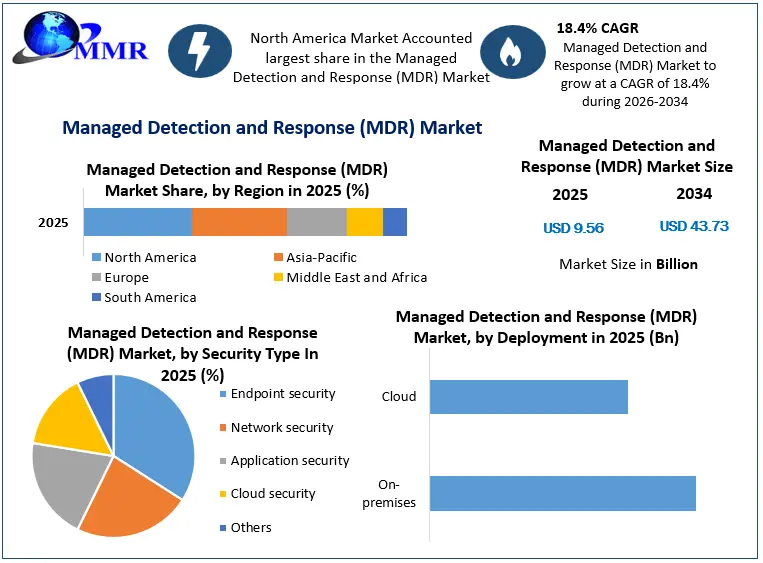
Global Managed Detection and Response (MDR) Market is projected to reach USD 43.73 Bn by 2034 at 18.4% CAGR, as AI, XDR and cloud security services become core to resilient digital infrastructure.
Meta Summary
The Global Managed Detection and Response (MDR) Market is expected to hit USD 43.73 Bn by 2034, growing at 18.4% CAGR, as enterprises, telecom operators and cloud providers turn to 24×7, AI-enhanced security operations to protect hybrid cloud, 5G and critical digital infrastructure from advanced cyber threats.
SEO Keywords
Managed Detection and Response Market; MDR market; global MDR services; AI-driven MDR; MDR for cloud security; MDR and XDR platforms; 24×7 managed SOC; telecom MDR services; MDR for hybrid cloud; outsourced threat detection and response
Key Highlights
Managed Detection and Response (MDR) Market revenue is expected to reach USD 43.73 Bn by 2034, growing at 18.4% CAGR, showing that organizations are shifting cybersecurity spend from tools to outcome-based managed services at scale.
MDR combines technology, threat intelligence and 24×7 security experts to detect, investigate and respond to attacks across endpoints, networks, cloud and identities.
Demand is strongest in enterprises with complex hybrid environments and limited in-house SOC capacity, including telecom operators and cloud-native businesses.
MDR adoption aligns with digital transformation, 5G expansion and cloud migration, where attack surfaces grow faster than internal security teams.
The market is consolidating around providers that integrate MDR with XDR platforms, zero-trust architectures and automated response playbooks.
Why This Matters Now
Digital infrastructure is scaling faster than security teams. Hybrid cloud, SaaS, 5G networks and remote work have created sprawling attack surfaces that legacy, tool-centric security models cannot cover. An MDR market expected to reach USD 43.73 Bn by 2034 at 18.4% CAGR signals that executives increasingly prefer 24×7 managed defense over building everything in-house.
For CIOs, CISOs, CTOs and telecom leaders, MDR is no longer an optional overlay. It sits on the critical path of cloud adoption, network modernization and AI deployment. The choice of MDR partner now determines how quickly an organization can detect intrusions, contain ransomware, satisfy regulators and maintain uptime across global digital operations.
Market Overview
The Global Managed Detection and Response Market size around service providers that operate continuous, managed security operations—fusing tooling, telemetry, threat hunting and incident response on behalf of customers. With market value projected to reach USD 43.73 Bn by 2034, MDR has matured into a core pillar of modern cybersecurity strategy rather than a niche add-on.
MDR services typically ingest logs and signals from endpoints, servers, cloud workloads, identity systems, networks and applications into centralized analytics platforms. Security analysts supported by automation and AI investigate anomalies, triage alerts, and execute or guide containment and remediation actions. Customers gain access to an always-on SOC without having to recruit, train and retain scarce security talent.
In the Information Technology & Telecommunications sector, MDR usage is especially pronounced. Telecom operators, MSPs, cloud providers and digital service platforms rely on MDR to protect customer data, critical networks, and high-availability services that cannot tolerate prolonged disruption or stealthy compromise.
Key Trends Driving Growth
One core trend is the shift from tool overload to managed outcomes. Organizations have accumulated multiple point products—EDR, NDR, SIEM, CASB—yet still miss threats due to integration gaps and analyst fatigue. MDR bundles technology with skilled analysts, runbooks and SLAs, converting complex tool stacks into a service centered on detection and response quality.
AI and automation represent a second major trend. MDR providers use machine learning to correlate events, prioritize alerts and surface high-risk anomalies faster than human-only teams. Automation then executes repetitive containment steps—isolating endpoints, blocking IPs, disabling accounts—freeing analysts to focus on complex investigations and threat hunting.
A third trend is MDR for cloud and SaaS. As workloads move to public and hybrid clouds, MDR providers extend coverage to cloud control planes, containers, serverless functions and SaaS applications. This aligns with cloud migration waves and ensures that security visibility keeps pace with infrastructure change.
Fourth, MDR is converging with XDR and zero trust. MDR services increasingly run on top of XDR platforms that unify telemetry across endpoints, identities, email, cloud and network. Combined with zero-trust principles—continuous verification, least privilege—this integration helps customers move from perimeter defense to proactive, inside-the-network threat hunting.
Request a Free Sample Copy or View Report Summary:https://www.maximizemarketresearch.com/request-sample/105682/
Segment Insights
Dominant Segment – [[Dominant Segment from full MMR report]]
The MMR report identifies a dominant segment—such as large enterprises, a specific industry vertical, or a core MDR service model—as the largest contributor to MDR revenue.
This dominant segment illustrates where MDR has already become embedded as a standard security operating model and where platform ecosystems and partner channels are most mature.
Fastest-Growing Segment – [[Fastest-Growing Segment from full MMR report]]
The fastest-growing segment, whether SMEs, specific regulated industries or a cloud-focused MDR offering, marks the frontier of MDR adoption.
Providers that tailor pricing, packaging and integrations to this segment can capture outsized growth and shape expectations for MDR features and SLAs.
By Organization Size and Industry
Large enterprises typically use MDR to augment internal SOCs, gaining advanced threat hunting, 24×7 coverage and access to global threat intelligence.
Mid-market firms often treat MDR as their primary security operations function, outsourcing the bulk of detection and response instead of trying to staff full in-house teams.
By Deployment and Coverage Scope
MDR services operate across on-premise, hybrid and multi-cloud infrastructures, using lightweight agents, API integrations and log collection from diverse systems.
Many offerings now emphasize specific coverage tiers—endpoint-centric MDR, full-stack MDR, cloud MDR—allowing customers to phase adoption based on budget and risk.
Regional Growth Story
Demand for MDR is global, but adoption patterns vary by region. In the United States and the United Kingdom, mature cyber insurance markets, stringent breach disclosure rules and heavy cloud adoption make MDR an attractive route to faster detection and regulatory alignment. Enterprises and critical infrastructure operators increasingly include MDR in board-level cyber resilience plans.
In Germany and other European Union states, MDR growth is shaped by strict data protection and sovereignty requirements. Providers must demonstrate compliant data handling, regional data center options and alignment with regulations while still delivering global threat visibility. This drives demand for MDR architectures that balance central analytics with regional controls.
China, India, Japan and South Korea are expanding MDR usage as they scale digital economies, 5G networks and cloud data centers. Rapid digitization and growing regulatory focus on critical information infrastructure push telecom, BFSI, manufacturing and public-sector organizations toward managed security partnerships. In these markets, MDR often rides alongside broader managed network and cloud services.
Competitive Landscape
The MDR market features global cybersecurity vendors, MSSPs, cloud and telecom providers and pure-play MDR specialists. Large security vendors leverage their endpoint, network and cloud products as telemetry and control layers for MDR offerings, signaling a move from product-centric to service-centric revenue models. This strengthens their platform ecosystems and encourages customers to standardize tool stacks around a single vendor.
Telecom operators and cloud hyperscalers increasingly bundle MDR into connectivity and infrastructure deals, positioning themselves as end-to-end digital infrastructure and security partners. This strategy utilizes their network visibility and cloud-native controls to offer differentiated threat detection at scale and deepens customer lock-in.
Pure-play MDR providers compete on agility, depth of expertise, and technology-agnostic integration. Their ability to sit on top of heterogeneous environments appeals to organizations that already own multiple security tools. Over time, the market is likely to see consolidation, with winners defined by their AI capabilities, XDR integration, global SOC footprint and ability to deliver measurable risk reduction, not just alert management.
Recent Developments
Broader integration of MDR with XDR platforms to unify telemetry from endpoints, identities, cloud workloads and networks for more complete threat views.
Increased use of AI and automation within MDR workflows to reduce mean time to detect (MTTD) and mean time to respond (MTTR).
Expansion of MDR coverage to cloud-native environments, including containers, Kubernetes and serverless architectures.
Growing alignment of MDR services with regulatory and compliance frameworks, including sector-specific guidance for telecom, financial services and critical infrastructure.
Strategic Implications
For CIOs and CISOs, MDR is now a strategic buy that shapes security operating models for the next decade. Choosing an MDR partner involves decisions about data residency, integration with existing tools, reliance on proprietary platforms versus open ecosystems, and the balance between in-house and outsourced capabilities. Those decisions affect how quickly organizations can respond to evolving threats.
Telecom operators and cloud providers can turn MDR into a key differentiator by embedding security into their core offerings. As connectivity and compute become commoditized, security outcomes—breach avoidance, compliance, uptime—offer new ways to create value and justify premium pricing. Partnering or building MDR is therefore a strategic move in platform economics.
Investors should view an 18.4% CAGR to 2034 as evidence that managed security will remain one of the fastest-growing segments in enterprise IT services. MDR providers that demonstrate scalable economics, strong automation, and clear integration with cloud and XDR platforms are best positioned to capture durable, high-margin recurring revenue streams.
Future Outlook
By 2034, MDR will be deeply embedded in the security fabric of most digital enterprises and service providers, operating as an AI-assisted, globally distributed network of virtual SOCs. As attacks increasingly leverage automation and AI, MDR services will use their own AI, threat intel and telemetry scale to counter adversaries in near real time.
The decisive divide will be between organizations that treat MDR as a strategic, data- and AI-driven extension of their architecture—and tightly align it with cloud, 5G and edge roadmaps—and those that view MDR as a checkbox managed service. The former will turn continuous detection and response into a lasting competitive advantage in resilience and trust; the latter will remain one breach away from seeing their digital ambitions derailed.
Related Reports
Global Business Intelligence Market https://www.maximizemarketresearch.com/market-report/global-business-intelligence-market/61991/
Global Realtime Flood Monitoring and Warning System Market https://www.maximizemarketresearch.com/market-report/global-real-time-flood-monitoring-and-warning-system-market/41068/
Global Professional Service Automation Software Market https://www.maximizemarketresearch.com/market-report/global-professional-service-automation-software-market/16097/
Analyst Perspective
“Managed Detection and Response has become the operational core of modern cybersecurity,” “Enterprises that pair MDR with cloud, XDR and zero‑trust strategies will be in a far stronger position to defend their digital businesses as threat actors and attack surfaces keep scaling.”-Yash Ghosalkar
About Maximize Market Research
Maximize Market Research Pvt. Ltd. (MMR) is a global market research and consulting company that provides reliable, data-focused, and practical business insights. The firm serves a wide range of industries, including healthcare, pharmaceuticals, technology, automotive, electronics, chemicals, personal care, and consumer goods. Through market forecasts, competitive analysis, strategic consulting, and industry impact assessments, MMR helps organizations understand changing market conditions, identify growth opportunities, and make informed business decisions for long-term success.
2nd Floor, Navale IT Park Phase 3
Pune Banglore Highway, Narhe
Pune, Maharashtra 411041, India
+91 9607365656
sales@maximizemarketresearch.com
