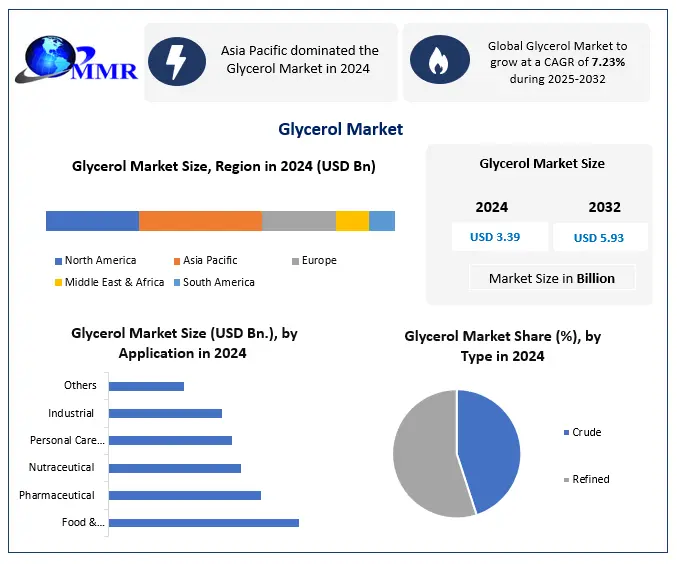
Key Highlights
Predictable Supply Volume Scaling: The global glycerol market volume is expanding steadily, heavily supported by government mandates pushing for higher biodiesel blending ratios around the world.
Biodiesel Source Dominance: Accounting for the lion’s share of global crude output, the biodiesel production pathway outpaces traditional fatty acid and soap splitting methods as the primary origin of glycerol.
Refined Grade Value Surge: Driven by strict purity mandates in the pharmaceutical, food, and cosmetic sectors, high-purity refined glycerol (99.5% and above) commands a premium market share.
Personal Care Application Leader: The cosmetics and personal care industry represents a massive and highly reliable revenue segment, continuously consuming refined glycerol as a core moisturizing agent.
Asia-Pacific Oleochemical Hub: The Asia-Pacific region remains the primary geographic center for both raw glycerol generation and advanced downstream processing, supported by vast palm oil cultivation and processing infrastructure.
Why This Matters Now
Modern oleochemical refining networks and industrial chemical producers face major processing and price volatility bottlenecks when managing raw crude glycerol streams. Relying on unpredictable wild-market crude supplies presents serious operating risks because unrefined glycerol contains variable water content, residual catalysts, and high matter organic non-glycerol (MONG) percentages. This structural inconsistency exposes downstream manufacturers to sudden equipment fouling, chemical batch failures, and expensive secondary purification cycles that eat into operating margins.
Deploying advanced multi-stage vacuum distillation and ion-exchange refining processes directly answers these purity and stability challenges. Converting crude material into 99.7% USP-grade refined glycerol allows chemical makers to eliminate batch variances, bypass strict regulatory hurdles, and seamlessly supply high-stakes pharmaceutical and food manufacturing loops. This reliable quality control protects production equipment from chemical scaling, ensures steady supply agreements, and helps refining operations capture premium margins from health-conscious consumer brands.
Market Overview
The glycerol market operates as a vital, multi-tiered chemical sector sitting at the intersection of renewable energy policies, large-scale oleochemical processing, and fast-moving consumer goods manufacturing. Because handling and storing refined trihydroxy alcohols demands strict compliance with international pharmacopeia standards, hygienic storage environments, and moisture-controlled transport lines, this industry acts as a crucial link between biofuel refineries and end-user brands.
The market’s clear path toward long-term expansion reflects a global manufacturing transition toward bio-renewable intermediates that replace petroleum-derived glycols. The broader market landscape monitors changing capacity dynamics across key product types (crude glycerol, refined glycerol), production sources (biodiesel, fatty acids, fatty alcohols, synthetic), primary applications (personal care, pharmaceuticals, food and beverage, alkyd resins, polyether polyols), and major distribution frameworks.
Key Trends Driving Growth
The most influential trend driving market expansion is the growing commercial integration of glycerol-to-epichlorohydrin (GTE) and bio-propylene glycol chemical processing lines. Modern chemical producers are actively swapping out traditional petroleum feedstocks for bio-based refined glycerol to synthesize eco-friendly resins and plastics, heavily reducing their carbon footprints. This technological pivot provides an alternative, high-volume industrial outlet for surplus glycerol stocks, stabilizing wholesale pricing during periods of high biofuel production.
Another primary driver is the accelerating consumer preference for clean-label, plant-derived ingredients inside the cosmetics and personal care domains. Young urban demographics are systematically seeking out skincare items containing natural, non-synthetic humectants, prompting global beauty brands to maximize their usage of vegetable-sourced glycerol over petroleum glycols. This steady consumer trend supports a regular, highly resilient stream of wholesale orders across major cosmetic compounding facilities.
Additionally, top-tier food and beverage companies are making substantial usage of food-grade glycerol as a safe solvent, humectant, and sweetener alternative in low-calorie snack formulations. These advanced texturizing applications allow manufacturers to hit strict nutritional and moisture-retention targets in baked goods and dairy alternatives, enabling them to capture steady margin returns from health-conscious shoppers.
Get Free Sample Report
Segment Insights
Refined Glycerol (Leading Product Type): Captures the largest slice of revenue within the processing matrix, driven by an industrial mandate for standardized, odor-free, and high-purity inputs across sensitive consumer goods industries.
Biodiesel Byproduct (Core Production Source): Holds absolute dominance over global volume output, where structural growth is directly tied to international mandates forcing higher integration of renewable fuels into commercial transportation networks.
Personal Care & Cosmetics (High-Volume Application): Represents a highly lucrative and fast-expanding end-use segment, requiring massive, year-round volumes of USP-grade glycerol to formulate everything from premium anti-aging creams to daily oral care products.
Regional Growth Story
The Asia-Pacific region stands as a dominant power in the global glycerol market, accounting for the largest share of both production value and consumption volume. This geographic position is secured by dense clusters of world-scale oleochemical processing plants in major agricultural countries like Malaysia, Indonesia, India, and China, which exploit vast local palm and coconut oil supplies. This immense processing concentration allows regional suppliers to fuel massive export corridors heading toward highly industrialized Western nations.
Simultaneously, Europe is maintaining robust market growth, driven by extensive biodiesel production infrastructure and tight green-energy mandates enforced by the European Union’s Renewable Energy Directive (RED). The high volume of domestic biofuel refining ensures an abundant and predictable supply of local crude glycerol feedstock. Furthermore, a steady focus on eco-friendly, bio-based industrial chemistry across Germany and France keeps regional demand for advanced glycerol derivatives exceptionally strong.
Market Restraints & Challenges
Overdependence on Biofuel Policy Shocks: Sudden shifts in government biodiesel subsidies or blending mandates can cause severe supply swings, creating intense crude glycerol price volatility that complicates corporate procurement.
High Logistics Costs for Bulk Liquid Transport: The high density and hygroscopic nature of pure glycerol demand specialized insulated transport vessels and moisture-tight storage setups, raising overhead costs for global distributors.
Competitive Landscape
The global market is highly competitive and closely tied to raw material positions, featuring a powerful mix of international oilseed processors, multinational chemical conglomerates, and specialized regional refining co-ops. Key market leaders are continuously investing in advanced distillation assets and widening their regional refining footprints to protect their customer relationships against low-tier, unrefined material suppliers.
To secure their market positions, top oleochemical names are establishing long-term, direct pipeline integrations with adjacent biodiesel plants, ensuring a continuous loop of raw feedstock. Companies compete directly on purity certification benchmarks (such as USP, EP, and Halal/Kosher compliance), the efficiency of their global supply chains, and the breadth of their value-added derivative portfolios, allowing them to capture multi-year supply contracts with premier global consumer brands.
Key Market Players
Wilmar International Ltd (Singapore)
Kuala Lumpur Kepong Berhad (KLK) (Malaysia)
Musim Mas Group (Singapore)
IOI Corporation Berhad (Malaysia)
Emery Oleochemicals (Malaysia)
P&G Chemicals (United States)
Cargill, Incorporated (United States)
BASF SE (Germany)
Oleon NV (Belgium)
Croda International Plc (United Kingdom)
Strategic Implications
For production planners and procurement directors at major consumer goods enterprises worldwide, relying on uncertified, non-traceable glycerol brokers represents a serious operational risk. As modern retail consumers demand absolute transparency and natural ingredient validation, unmonitored raw material shipments run the risk of batch variation and sudden product recalls. Securing long-term supply arrangements with vertically integrated, RSPO-certified (Roundtable on Sustainable Palm Oil) oleochemical providers is an essential step to lower supply chain friction and ensure absolute formulation stability.
For traditional biofuel refinery operators and independent processing plant managers, viewing crude glycerol as a mere waste byproduct limits future corporate expansion. As international chemical markets place a premium on bio-based building blocks, operators who invest in localized up-filtration and preliminary refining systems can immediately transform a low-value byproduct stream into a high-margin asset. Proactive investments in modern distillation technology are necessary to win lucrative supply contracts with leading global chemical conglomerates.
Future Outlook
The direction of the global glycerol market will be shaped by the growth of synthetic biotechnology to convert crude fractions into high-value specialty chemicals, the adoption of circular bio-refinery setups to achieve zero-waste processing, and the deployment of smart tracking platforms to verify carbon-intensity scores for export. As global consumer networks shift toward verified plant-based product lines and strict corporate sustainability frameworks, long-term market leadership will belong to refining brands that master low-energy, highly efficient distillation routines. Future industry leaders will be the companies that combine secure, multi-source feedstock access with advanced value-added derivative engineering.
Analyst Perspective
“The structural shift toward bio-renewable chemical manufacturing is completely changing how global manufacturing firms view the glycerol supply stream,” states Ankita Kagawade, a packaging and logistics specialist at Maximize Market Research. “Refining companies that optimize their processing technology to deliver ultra-high-purity grades will lock in highly resilient market share as world demand for green, bio-based alternatives continues to climb.”
About Maximize Market Research
Maximize Market Research Pvt. Ltd. (MMR) is a global market research and consulting company that provides reliable, data-focused, and practical business insights. The firm serves a wide range of industries, including healthcare, pharmaceuticals, technology, automotive, electronics, chemicals, personal care, and consumer goods. Through market forecasts, competitive analysis, strategic consulting, and industry impact assessments, MMR helps organizations understand changing market conditions, identify growth opportunities, and make informed business decisions for long-term success.
2nd Floor, Navale IT Park Phase 3
Pune Banglore Highway, Narhe
Pune, Maharashtra 411041, India
+91 9607365656
sales@maximizemarketresearch.com
