Key Highlights
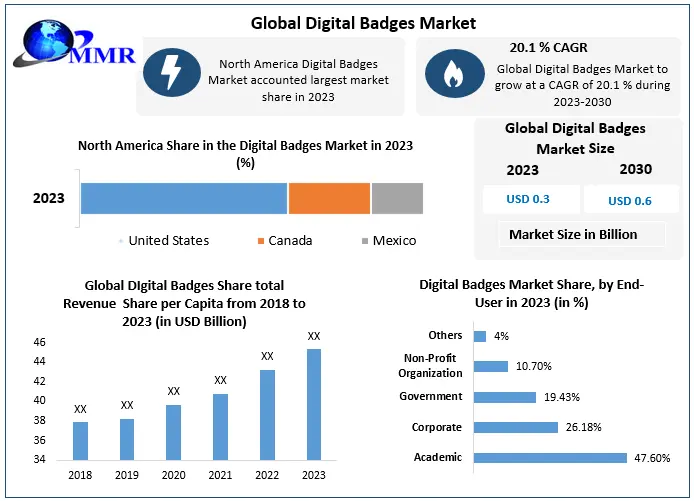
Global Digital Badges Market size is USD 0.6 Bn in 2023 and is forecast to grow at a CAGR of 16.2% through 2030, indicating that skill signalling infrastructure is expanding faster than many traditional HR and training categories.
The market covers platforms and services that issue, store and verify digital badges representing skills, certifications and achievements across education and enterprise environments.
Demand is driven by cloud, AI, cybersecurity and telecom modernization projects that require transparent, machine-readable proof of skills at scale.
SaaS-based badge platforms increasingly integrate with LMS, HCM, developer platforms and professional networks, turning credentials into live data assets.
Vendors that align badges with skills taxonomies and enterprise learning architectures are building strategic positions in future talent and workforce ecosystems.
Why This Matters Now
Every major digital initiative—AI deployment, 5G rollout, cloud migration, data center automation—hits the same bottleneck: shortage of proven skills. A market that is already USD 0.6 Bn in 2023 and compounding at 16.2% into 2030 signals that organizations are investing heavily in the metadata layer of talent—the verifiable record of who can do what, not just who they are on paper.
For CIOs, CTOs, CHROs and telecom leaders, digital badges are no longer a nice‑to‑have gamification tool. They are becoming core signals used by AI-driven recruitment, internal mobility engines, partner ecosystems and developer communities. The way you issue and read badges will shape how quickly you can staff cloud, AI and network transformation programs.
Market Overview
The Global Digital Badges Market size is defined as the industry focused on creation, distribution and use of digital badges as virtual representations of skills, accomplishments or learning outcomes. These badges are attached to metadata and typically link back to issuing bodies, criteria and evidence, enabling automated verification.
The market’s 2023 value of USD 0.6 Bn, with 16.2% CAGR projected through 2030, reflects growing adoption across universities, professional training providers, tech vendors and enterprises. This momentum is closely linked to the rise of online learning, vendor certifications, micro‑credentials and skills-based workforce planning.
In the Information Technology & Telecommunications context, badges are increasingly associated with cloud certifications, network engineering skills, cybersecurity competencies and platform-specific expertise from major vendors. That makes the badges ecosystem part of the operating system for digital talent supply and partner enablement.
Key Trends Driving Growth
The first major trend is skills-based hiring and internal mobility. As job requirements shift faster than traditional degrees, employers need granular, up-to-date indicators of proficiency in cloud platforms, programming languages, security frameworks and 5G technologies. Digital badges provide standardized, portable signals that can be ingested by HR tech, ATS and talent marketplaces.
A second trend is deep integration with cloud and SaaS learning environments. Badge platforms plug into LMS, LXP, online course providers and hands-on labs, automatically issuing credentials on completion of learning paths, labs and high-stakes assessments. For IT and telecom enterprises, this turns training programs into measurable, auditable capabilities mapped to specific technologies and products.
Third, platform ecosystems are forming around vendor and industry certifications. Cloud providers, network equipment vendors and software platforms increasingly issue their own digital badges for role-based certifications. This extends their brand into talent markets, strengthens ecosystem loyalty and gives them data on skill distribution across partners and customers.
Fourth, digital transformation and remote work have normalized online assessment and credentialing. As learning and exams move online, badges become the natural format for representing achievements—easier to store, share and verify than PDFs or static certificates, and compatible with AI-based matching systems.
Request a Free Sample Copy or View Report Summary: https://www.maximizemarketresearch.com/request-sample/12943/
Segment Insights
Dominant Segment – [[Dominant Segment from MMR report]]
The MMR report identifies a dominant segment—such as Education, IT & Telecom, or Enterprise Training—as the largest revenue contributor in the Digital Badges Market.
This dominance shows where badges have moved from pilots to institutionalized use, and where standards, integrations and recurring spend are most mature.
Fastest-Growing Segment – [[Fastest-Growing Segment from MMR report]]
The fastest-growing segment, whether defined by end user (corporate), badge type (micro‑credentials), or deployment (cloud-based platforms), marks where future adoption and experimentation are concentrated.
Vendors that align content, analytics and API strategies with this segment will capture disproportionate share of incremental market growth to 2030.
By Application and End User
Key applications include professional certifications, workforce upskilling, academic achievements and community recognition.
IT and telecom enterprises use badges to track completion of internal academies, partner enablement programs and critical compliance training related to cloud, security and network operations.
By Deployment and Delivery Model
Cloud and SaaS delivery dominate new deployments, giving organizations global reach, integration with existing identity systems and scalable verification.
API-first platforms allow badges to flow across HR systems, learning tools, developer portals and professional networks, turning credentials into interoperable data assets rather than isolated tokens.
Regional Growth Story
While the MMR detail sits in the full report, adoption patterns broadly track digital infrastructure and skills demand. The United States and United Kingdom are key markets, driven by strong ed‑tech sectors, intensive technology hiring and a high density of vendor certification programs. Universities and enterprises in these regions were early adopters of badges for MOOCs, bootcamps and corporate academies.
India, China and other Asia Pacific markets are rapidly scaling digital badges as they ramp up large-scale skilling initiatives for IT services, telecom rollouts and digital government programs. High volumes of engineering and IT graduates, combined with government and industry-led reskilling, make badges an attractive way to standardize and verify outcomes across fragmented training providers.
Germany, Japan and South Korea leverage badges within advanced manufacturing, automotive and electronics ecosystems, linking them to Industry 4.0 skills and vendor-specific technologies. Across all priority markets, badges align with investments in broadband, cloud and 5G, as they provide the skills layer needed to operate new infrastructure.
Competitive Landscape
The competitive arena includes dedicated digital badge platforms, broader credentialing and learning providers, as well as major technology vendors issuing their own badges. Dedicated platforms compete on interoperability, analytics and ease of integration with enterprise systems and learning environments. Their strategy is to become the canonical “skills ledger” for organizations.
Learning and certification providers integrate badges as part of their content and assessment offerings, using them to enhance learner engagement and provide shareable proof of completion. In technology sectors, vendor-issued badges anchor partner programs and marketplaces, becoming de facto currencies in hiring and procurement decisions.
Strategically, the battle is moving toward ownership of skills taxonomies and data. Platforms that can normalize badges across sources, infer proficiency, and feed that data into AI-driven talent marketplaces and workforce planning tools will gain pricing power and ecosystem centrality. Those that remain siloed issuers risk being treated as commodity certificate generators.
Recent Developments
Wider integration of digital badges into enterprise LMS, LXP and HR systems to automate issuance and verification of internal and external credentials.
Growing use of badges in large-scale cloud, AI and cybersecurity training initiatives, especially in IT and telecom sectors.
Expansion of vendor and industry certification programs using badges to signal role-based proficiency on specific platforms and products.
Increased use of badges in partner ecosystems, tying partner tiers and benefits to verified credentials across sales, pre‑sales and technical roles.
Strategic Implications
For CIOs and CTOs, digital badges are becoming a critical abstraction layer between technology roadmaps and workforce capabilities. They offer a machine-readable bridge between strategic priorities—cloud adoption, AI deployments, network modernization—and the skill inventory within and around the organization. That enables more precise planning for build/buy/partner decisions.
Telecom operators, cloud providers and platform vendors can use badges to orchestrate their ecosystems. By requiring or incentivizing badges for partners and customers, they can influence how quickly new features are adopted, how well networks are deployed, and how reliably services are supported. Badges thus become levers for product adoption and customer success.
Investors and HR tech strategists should read a 16.2% CAGR as validation that verified skills data is an emerging infrastructure layer. Companies that control how skills are represented, verified and consumed by AI systems will sit at the center of future labor and learning markets, with recurring, high-margin platform revenues.
Future Outlook
By 2030, digital badges will be woven into the core fabric of talent, learning and ecosystem platforms rather than living on the periphery as marketing gimmicks. AI-driven hiring, internal mobility and project staffing engines will increasingly rely on badge metadata and the underlying skills taxonomies to make decisions at scale.
The decisive divide will be between organizations that treat digital badges as strategic data assets—integrated into cloud, AI and workforce architectures—and those that use them as isolated marketing tokens. The former will enjoy transparent, agile access to the skills needed for next-generation connectivity and digital transformation; the latter will remain blind to their real capabilities in an economy where verified skills, not job titles, separate digital leaders from laggards.
Related Reports
Gesture Recognition and Touchless Sensing Market https://www.maximizemarketresearch.com/market-report/global-gesture-recognition-and-touchless-sensing-market/25173/
Cloud Backup Market https://www.maximizemarketresearch.com/market-report/global-cloud-backup-market/8040/
Global Artificial Intelligence in Military Market https://www.maximizemarketresearch.com/market-report/artificial-intelligence-in-military-market/12512/
Analyst Perspective
“Digital badges are becoming the API layer for skills in a cloud and AI-driven economy,” “Organizations that build their talent and partner strategies around verifiable, interoperable credentials will move faster on every major transformation initiative—from cloud migrations to 5G and AI rollouts.”-Yash Ghosalkar
About Maximize Market Research
Maximize Market Research Pvt. Ltd. (MMR) is a global market research and consulting company that provides reliable, data-focused, and practical business insights. The firm serves a wide range of industries, including healthcare, pharmaceuticals, technology, automotive, electronics, chemicals, personal care, and consumer goods. Through market forecasts, competitive analysis, strategic consulting, and industry impact assessments, MMR helps organizations understand changing market conditions, identify growth opportunities, and make informed business decisions for long-term success.
2nd Floor, Navale IT Park Phase 3
Pune Banglore Highway, Narhe
Pune, Maharashtra 411041, India
+91 9607365656
sales@maximizemarketresearch.com
