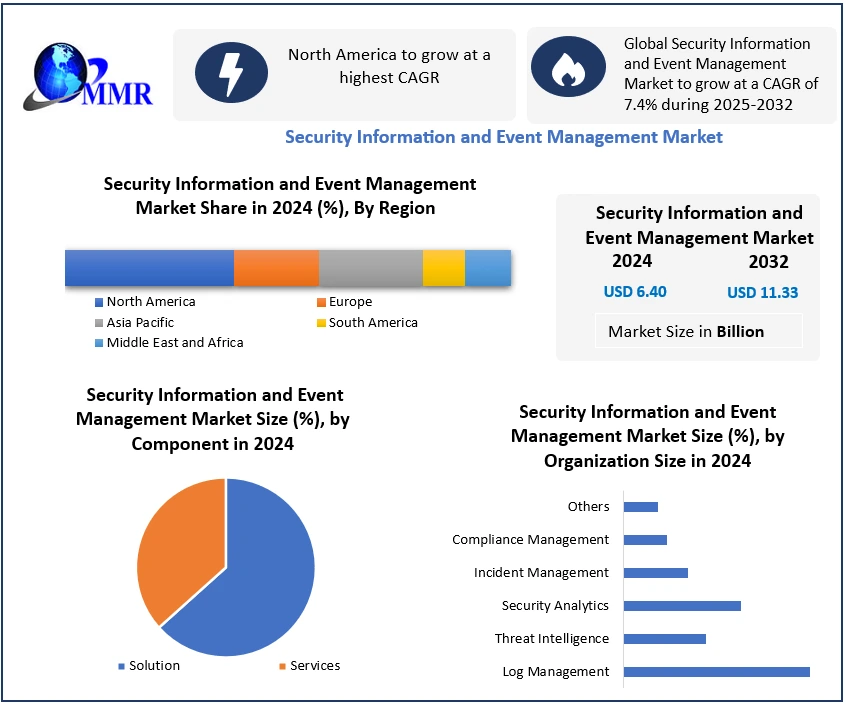
Key Highlights
Security Information and Event Management Market size is valued at USD 6.40 Bn in 2024 and is forecast to reach nearly USD 11.33 Bn by 2032 at a CAGR of 7.4%, signaling that centralized security analytics remain a non‑negotiable spend even as tools consolidate.
SIEM platforms aggregate logs and events across networks, endpoints, applications and cloud services, powering threat detection, incident response and compliance reporting.
The solution segment dominates the market and is expected to retain the largest share, reflecting continued demand for robust analytics and correlation engines over pure services.
Cloud-based deployment has already taken the lead and is projected to hold the largest market share, mirroring broader enterprise cloud adoption and remote work models.
IT and telecom emerge as critical adopters, where SIEM becomes the analytical core of 5G, edge and cloud-native security architectures.
Why This Matters Now
Cloud migration, API-first applications, 5G rollout and remote work have shattered traditional security perimeters. A SIEM market growing from USD 6.40 Bn in 2024 to nearly USD 11.33 Bn by 2032 at 7.4% CAGR shows that enterprises are doubling down on a single, authoritative lens over sprawling security telemetry.
For CIOs, CISOs, CTOs and telecom executives, SIEM is now the control plane of cyber resilience. It is the system that regulators ask about, auditors probe, and boards fund when they want assurance that hybrid infrastructure, customer data and critical services can withstand sustained cyber pressure. Without a modern SIEM, AI initiatives, cloud programs and 5G networks simply expand risk faster than security teams can respond.
Market Overview
The Security Information and Event Management Market around platforms that collect, normalize, correlate and analyze security events and logs from across an organization’s IT and OT estate. The projected growth to nearly USD 11.33 Bn by 2032 at a 7.4% CAGR indicates that SIEM remains the anchor for modern security operations centers (SOCs).
SIEM systems ingest telemetry from firewalls, IDS/IPS, endpoints, identity systems, applications, databases, cloud platforms and network devices. They apply rules, correlation logic and increasingly machine learning to detect anomalies, generate alerts and support root cause analysis. In heavily regulated industries, SIEMs also deliver the reporting trail required to prove compliance.
In the Information Technology & Telecommunications sector, SIEM is tied directly to service continuity and network integrity. Telecom operators and cloud providers rely on SIEM to spot lateral movement, detect abuse of customer-facing platforms, and correlate events across massive, distributed infrastructures.
Key Trends Driving Growth
The first structural trend is the shift to cloud-based SIEM. Maximize Market Research highlights the cloud-based deployment segment as having dominated the market in 2024 and expected to hold the largest share going forward, driven by cloud computing adoption and remote work. Cloud-native SIEM deployments scale with log volume, support global teams and simplify onboarding of new cloud workloads, making them attractive for fast-changing environments.
AI and advanced analytics form the second major trend. As telemetry volumes explode, SIEMs increasingly embed machine learning and behavior analytics to cut false positives and surface high‑risk patterns more quickly. Vendors link SIEM with UEBA and SOAR capabilities, turning the platform from a log collector into an intelligence and automation hub.
Third, regulatory pressure remains a durable growth driver. Frameworks across North America, Europe and Asia Pacific require detailed logging, monitoring and incident reporting. SIEMs are often explicitly cited in compliance strategies because they centralize evidence needed for audits and incident post‑mortems.
A fourth trend is integration with XDR, MDR and managed security services. SIEMs feed and consume data from extended detection and response platforms and are often the analytics backbone behind MDR offerings. This pushes SIEM vendors to open APIs, support multi‑tenant architectures and align with service providers’ operating models.
Request a Free Sample Copy or View Report Summary: https://www.maximizemarketresearch.com/request-sample/23793/
Segment Insights
Dominant Segment – Solutions
Based on component, the solution segment dominated the market in 2024 and is expected to hold the largest market share during the forecast period.
This dominance shows that enterprises still prioritize owning strong analytics engines and log management capabilities at the core, even as they augment with services and automation.
Fastest-Growing Segment – Cloud-Based Deployment
The cloud-based segment dominated the deployment mode in 2024 and is expected to maintain the largest share, driven by cloud adoption, remote work and demand for scalable, cost‑effective security.
This trend points to a future where SIEM is consumed as SaaS, tightly integrated with cloud-native telemetry, and easier to align with DevSecOps and agile application delivery.
By Component and Services
While solutions lead, services—implementation, tuning, content development and managed monitoring—remain critical to realizing SIEM value.
Organizations increasingly look for partners who can bring use cases, playbooks and industry-specific content rather than just technology.
By Vertical and Use Case
IT & telecom, BFSI, government and healthcare stand out as major users in external analyses, given their regulatory demands and high-value data.
For telecom operators and cloud providers, SIEM use cases extend to protecting signaling networks, APIs, customer portals and multi-tenant environments.
Regional Growth Story
External market data shows North America as the largest SIEM market today, driven by dense regulatory requirements, high breach visibility and advanced cloud adoption. The United States in particular sees strong SIEM demand fuelled by sector-specific rules in finance, healthcare and critical infrastructure.
Asia Pacific—including China, India, Japan and South Korea—is one of the fastest-growing regions. Rapid digitization, 5G deployments and expansion of data center capacity are pushing organizations to centralize and modernize their security monitoring with cloud-friendly SIEM solutions.
Europe, including Germany and the United Kingdom, combines strict privacy regulations with high IT maturity. Organizations there require SIEM deployments that respect data sovereignty while still offering cross-border visibility, prompting interest in regionally hosted or hybrid SIEM models.
Competitive Landscape
The SIEM landscape includes legacy SIEM specialists, broader security platform vendors, cloud hyperscalers and managed security providers. External sources highlight names such as IBM, Splunk, Microsoft, Fortinet, Rapid7 and others as important players, alongside newer SaaS‑first entrants.
Strategically, the market is shifting from SIEM as a standalone product to SIEM as one layer in a broader security analytics and operations platform. Vendors that tightly integrate SIEM with XDR, SOAR, identity security and cloud-native protection can position themselves as the primary operating system for the SOC. This platform position supports higher pricing power and longer contract durations.
At the same time, cloud providers embed SIEM-like capabilities into their security suites, using data gravity and native telemetry as differentiators. This puts pressure on traditional SIEM vendors to prove multi‑cloud value, open integration and superior analytics that go beyond what any single cloud can provide.
Recent Developments
Strong growth of cloud-based SIEM offerings delivering log ingestion, correlation and analytics as SaaS services to distributed teams.
Increased use of AI, UEBA and automation in SIEM platforms to manage alert volumes and accelerate triage and investigation.
Deeper integration between SIEM and XDR/MDR services, as managed providers lean on SIEM data for advanced threat detection and compliance evidence.
Expansion of SIEM deployments across mid-market organizations that previously relied on basic logging, driven by rising attack frequency and regulatory expectations.
Strategic Implications
For CIOs and CISOs, choosing a SIEM is no longer just about log storage and dashboards. It is about selecting the analytics and automation backbone for the next decade of cyber operations. Architecture decisions—where logs are stored, how data is normalized, how AI models are trained and how playbooks are executed—will shape incident response capabilities and compliance posture.
Telecom operators and cloud providers can leverage SIEM both internally and as part of managed offerings. By combining network visibility, cloud telemetry and SIEM analytics, they can offer differentiated security services to enterprise customers, tying security outcomes directly to connectivity and infrastructure contracts.
Investors and technology strategists should view a 7.4% CAGR on a multi‑billion dollar base as proof that SIEM remains resilient amid shifts to XDR and MDR. The vendors that win will be those that modernize SIEM into cloud-native, AI‑driven, API‑first platforms that fit naturally into DevSecOps, hybrid cloud and data residency requirements.
Future Outlook
By 2032, with the Security Information and Event Management Market projected to reach nearly USD 11.33 Bn, SIEM will, in many organizations, operate as the central nervous system for cyber defense—absorbing signals from across IT, OT, cloud and telecom networks and orchestrating automated and human responses.
The decisive divide will be between enterprises and service providers that re‑platform SIEM around cloud, AI and integrated response—and those that cling to legacy, on‑premise log collectors with limited analytics. The former will respond to threats at machine speed and treat security data as a strategic asset; the latter will drown in noise and lag behind attackers in an era where every millisecond and every log line matters.
Related Reports
Cloud Monitoring Market https://www.maximizemarketresearch.com/market-report/cloud-monitoring-market/641/
Speech Analytics Market https://www.maximizemarketresearch.com/market-report/speech-analytics-market/12971/
Global Legaltech Artificial Intelligence Ai Market https://www.maximizemarketresearch.com/market-report/global-legaltech-artificial-intelligence-ai-market/90661/
Analyst Perspective
“SIEM has shifted from being a compliance checkbox to the analytical core of modern SOCs,” “Organizations that modernize SIEM for cloud, AI and integrated response will turn security data into a competitive advantage rather than a burden.”-Yash Ghosalkar
About Maximize Market Research
Maximize Market Research Pvt. Ltd. (MMR) is a global market research and consulting company that provides reliable, data-focused, and practical business insights. The firm serves a wide range of industries, including healthcare, pharmaceuticals, technology, automotive, electronics, chemicals, personal care, and consumer goods. Through market forecasts, competitive analysis, strategic consulting, and industry impact assessments, MMR helps organizations understand changing market conditions, identify growth opportunities, and make informed business decisions for long-term success.
2nd Floor, Navale IT Park Phase 3
Pune Banglore Highway, Narhe
Pune, Maharashtra 411041, India
+91 9607365656
sales@maximizemarketresearch.com
