Key Highlights
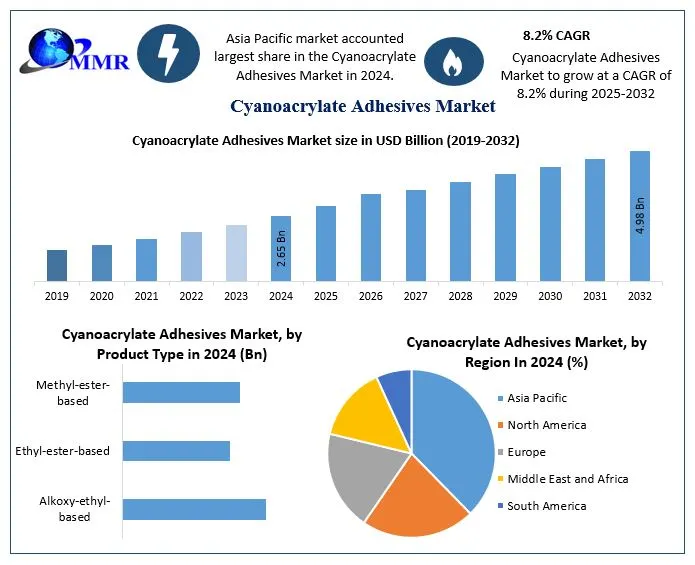
Market valuation expands from USD 2.65 billion in 2024 to reach USD 4.98 billion by 2032, registering an 8.2% compound annual growth rate.
The electronics manufacturing segment stands as the dominant application sector, catalyzed by high-volume smartphone and consumer device production cycles.
Asia Pacific maintains geographical dominance, leveraging robust manufacturing infrastructure, cost-efficient labor, and intensive footwear and electronics output.
Stringent environmental and sustainability regulations on chemical formulations act as primary headwinds for raw material processing and synthesis.
Automobile manufacturing, architectural bonding, and flexible packaging emerge as key industrial consumption vectors alongside traditional household use.
Why This Matters Now
Volatility in downstream electronic manufacturing pipelines and rapid automotive lightweighting cycles are forcing chemical producers to reassess instant-bond assembly inputs. Industrial buyers face immediate pressure to reconcile fast curing speeds with tighter environmental compliance, threatening legacy high-volatile formulations. Survival in this space depends on pivoting toward high-stability, localized raw material chains that satisfy stricter industrial criteria before alternative bonding agents displace synthetic monomers.
Market Overview
The global Cyanoacrylate adhesives market operates at the intersection of high-speed industrial manufacturing and everyday consumer maintenance. Formulated primarily as solvent-free, single-part acrylate systems, these compounds undergo instant polymerization upon contact with surface moisture, eliminating the need for external heat or curing agents. Valued at USD 2.65 billion in 2024, the structural demand for these materials is scaling continuously, positioned to hit USD 4.98 billion by 2032 under an 8.2% compound annual growth rate.
This sustained expansion signals a profound shift in how manufacturers handle modern assembly lines. Industrial sectors increasingly choose single-component cyanoacrylates because they streamline handling logistics, eliminate mixing errors, and offer high optical transparency. However, raw material suppliers must navigate a complex dynamic where polyurethane and silicone-based alternatives command more than 50% of the aggregate global sealants volume. To capture market share, cyanoacrylate manufacturers are forced to target technical niches where fast curing speeds directly decrease factory cycle times and raise net yield.
Key Trends Driving Growth
Accelerated engineering cycles in high-density consumer electronics and miniaturized components represent the primary catalyst for market expansion. Device manufacturers require precision dispensing mechanisms with zero vertical run-off to protect intricate circuit architectures while accelerating product throughput. Cyanoacrylate chemistry delivers controlled flow behaviors that lower material waste, directly lowering total assembly costs for high-volume OEMs.
Simultaneously, structural transformations within the automotive sector are reshaping industrial consumer behaviors. Vehicle manufacturers are increasing their use of composite plastics, rubber geometries, and lightweight synthetic substrates to improve vehicle fuel economy and support electric drivetrain weights. Cyanoacrylates establish reliable bonds across these dissimilar materials during automotive sub-assembly, outperforming mechanical fasteners that risk inducing stress fractures. Beyond heavy transportation, expanding consumer demand for dense electronic goods, premium household furnishings, and flexible packaging solutions broadens the base of predictable industrial procurement.
Segment Insights
Dominant Segment: The electronics industry stands as the largest application channel by value, capturing the leading share of total market revenue. This position is sustained by massive production runs of smartphones, tablets, and consumer micro-appliances where fast sealing saves crucial seconds per unit.
Fastest-Growing Segment: The medical sector, alongside architectural plastic bonding, exhibits the highest acceleration rate through 2032. This development stems from specialized adoptions of n-butyl and 2-octyl formulations for advanced surgical wound closure and structural household assembly.
Product Breakdown: Chemical portfolios remain split among Alkoxy-ethyl-based, Ethyl-ester-based, and Methyl-ester-based monomers, each serving distinct heat resistance and blooming criteria across commercial assembly floors.
Regional Growth Story
Asia Pacific controls the largest position in the global landscape and will continue to lead global consumption trends throughout the forecast window. The region benefits from highly integrated manufacturing ecosystems across China, India, and Japan, alongside emerging manufacturing hubs throughout Southeast Asia. Strong labor pools, localized chemical synthesis clusters, and extensive state-backed infrastructure investments draw foreign direct investment from global hardware brands. Heavy industrial investment in regional footwear production, premium leather manufacturing, and home furnishings further cements the dominant status of Asia Pacific.
Conversely, Western markets like the United States and Germany are moving toward high-margin specialty variants. Tight environmental regulations across the European Union place strict limits on volatile chemical components, driving local chemical producers to re-engineer core formulations. This regulatory environment splits global trade: developing Asian economies focus on manufacturing high volumes of cost-competitive standard ethyl cyanoacrylates, while Western production centers focus on specialized medical and low-odor industrial grades.
Competitive Landscape
The global cyanoacrylate arena remains consolidated among top chemical conglomerates operating alongside specialized regional formulation plants. Industry leaders include multi-billion-dollar entities like 3M, Henkel, Arkema, H.B. Fuller, Sika, and DowDuPont, which compete directly on formulation stability, distribution scale, and proprietary dispensing systems. Specialized companies such as Cyberbond, DELO Industrial Adhesives, Dymax, Jowat, and Pidilite target high-value regional manufacturing niches. This multi-tiered market structure creates a dynamic environment where large chemical organizations must continually expand their technical capabilities to counter low-cost commoditization.
Strategic positioning within this competitive space is shifting from basic capacity metrics to advanced application engineering. Top-tier manufacturers are forming joint ventures and optimizing supply chains to secure steady access to key acrylic acid derivatives. Smaller, regional firms face intensifying pressure to merge or exit the market as rising compliance costs and advanced technical requirements favor organizations with global distribution and R&D networks.
Recent Developments
Multinational formulation leaders are increasing capital expenditures for dedicated low-odor, low-blooming product lines to satisfy electronics manufacturers demanding high-aesthetic surface finishes.
Merger and acquisition activity is rising among mid-tier European and American adhesive specialists, as companies build out specialized portfolios to defend regional market share against low-cost imports.
Strategic partnerships between adhesive suppliers and automated dispensing equipment companies are increasing, giving industrial clients fully integrated, turnkey assembly operations.
Targeted capital investments are flowing into India and Southeast Asia to build local blending and packaging plants, placing production closer to major consumer electronics hubs.
Strategic Implications
For chemical industry executives and investment funds, these developments signal a clear end to the era of basic, undifferentiated commodity super glues. Future profitability depends on developing advanced specialty formulations that resist high thermal loads and maintain bond strength under environmental stress. Procurement managers must build resilient raw material networks for custom monomers to protect production lines from supply interruptions or price swings in the petro-chemical sector. Companies that fail to update their product portfolios risk losing market share to advanced polyurethane and hybrid silicone technologies that are rapidly improving their performance characteristics.
Furthermore, environmental sustainability mandates require immediate capital investment into bio-based or recyclable cyanoacrylate platforms. As electronic brands push for greater circularity and circular economy compliance, adhesive manufacturers must supply materials that support automated end-of-life device disassembly. This shifting market dynamic creates clear opportunities for suppliers who can balance rapid curing performance with cleaner, more sustainable product profiles.
Future Outlook
The market will split into two distinct sectors: highly automated, high-volume standard chemical production concentrated throughout developing Asia, and high-margin, specialized engineering formulation clusters centered in Western economies. Winners will be determined by their ability to integrate custom adhesive formulations directly into automated client production workflows, making it difficult for industrial buyers to switch suppliers.
Analyst Perspective
“The global cyanoacrylate adhesives market is undergoing an engineering-driven transformation where speed alone no longer guarantees market share. Winners must deliver hyper-stable, low-emission formulations that plug directly into automated robotic assembly lines while satisfying intensifying circular economy mandates.” — Ankita Kagawade, Industry Analyst, Maximize Market Research
About Maximize Market Research
Maximize Market Research Pvt. Ltd. (MMR) is a global market research and consulting company that provides reliable, data-focused, and practical business insights. The firm serves a wide range of industries, including healthcare, pharmaceuticals, technology, automotive, electronics, chemicals, personal care, and consumer goods. Through market forecasts, competitive analysis, strategic consulting, and industry impact assessments, MMR helps organizations understand changing market conditions, identify growth opportunities, and make informed business decisions for long-term success.
2nd Floor, Navale IT Park Phase 3
Pune Banglore Highway, Narhe
Pune, Maharashtra 411041, India
+91 9607365656
sales@maximizemarketresearch.com
