Black Lung Disease Market: Advancements in Diagnosis, Treatment, and Occupational Health Drive Market Growth
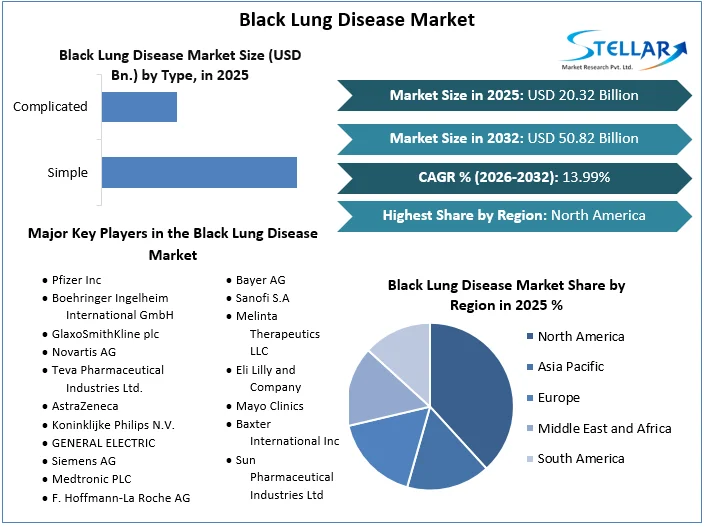
The Black Lung Disease Market size was valued at USD 20.32 Bn. in 2025 and the total Global Black Lung Disease revenue is expected to grow at a CAGR of 13.99% from 2026 to 2032, reaching nearly USD 50.82 Bn. by 2032.
The global healthcare industry continues to prioritize the prevention and treatment of occupational diseases, creating significant opportunities for specialized healthcare markets. Among these, the Black Lung Disease Market is gaining momentum due to increasing awareness of occupational respiratory disorders, rising investments in pulmonary healthcare, and advancements in diagnostic technologies. Black lung disease, medically known as Coal Workers’ Pneumoconiosis (CWP), remains a major occupational health concern, particularly in regions with extensive coal mining activities. As governments strengthen workplace safety regulations and healthcare providers improve disease management strategies, the market is expected to witness steady growth during the forecast period.
According to industry estimates, the Black Lung Disease Market is projected to expand consistently over the coming years, supported by improved screening programs, enhanced access to healthcare services, and continuous innovation in respiratory disease management. Growing collaborations between healthcare providers, research institutions, and pharmaceutical companies are further accelerating the development of advanced diagnostic tools and therapeutic solutions.
Download Free PDF Brochure: https://www.stellarmr.com/report/req_sample/Black-Lung-Disease-Market/2053
Understanding Black Lung Disease
Black lung disease is a chronic occupational lung condition caused by prolonged inhalation of coal dust particles. Over time, these particles accumulate in the lungs, leading to inflammation, fibrosis, breathing difficulties, and reduced lung function. Although preventive workplace measures have significantly improved in many countries, the disease continues to affect thousands of miners worldwide, particularly those working in underground coal mines.
The condition ranges from simple coal workers’ pneumoconiosis to progressive massive fibrosis (PMF), a severe and irreversible form of the disease. Early diagnosis is essential because timely medical intervention, respiratory therapy, and workplace modifications can help manage symptoms and improve patients’ quality of life.
Key Factors Driving Market Growth
Increasing Incidence of Occupational Lung Diseases
Despite improvements in workplace safety, occupational exposure to coal dust remains a concern in several mining regions. Rising awareness among governments, employers, and healthcare organizations has increased demand for regular health screenings, diagnostic imaging, and respiratory care services.
Stringent Workplace Safety Regulations
Governments across developed and developing economies continue to strengthen occupational health regulations aimed at reducing miners’ exposure to respirable coal dust. Mandatory health surveillance programs, improved dust monitoring systems, and stricter compliance requirements are driving investments in diagnostic equipment and preventive healthcare services.
Advances in Pulmonary Diagnostics
Technological innovations are significantly improving the diagnosis of black lung disease. High-resolution computed tomography (HRCT), digital chest radiography, pulmonary function testing, artificial intelligence-assisted imaging, and remote patient monitoring are enabling healthcare professionals to identify disease progression more accurately and at earlier stages.
Emerging Trends Transforming the Market
One of the most significant trends shaping the Black Lung Disease Market is the adoption of artificial intelligence in medical imaging. AI-powered diagnostic systems can analyze chest X-rays and CT scans with greater speed and consistency, helping radiologists detect early signs of lung fibrosis while reducing diagnostic variability.
Another important trend is the growing use of telemedicine and remote respiratory monitoring. Digital healthcare platforms allow physicians to monitor chronic respiratory patients, adjust treatment plans remotely, and improve access to specialist care for individuals living in remote mining communities.
Research into antifibrotic therapies, regenerative medicine, and novel pulmonary treatments is also gaining momentum. Although there is currently no cure for black lung disease, ongoing clinical research aims to slow disease progression, reduce inflammation, and improve long-term respiratory outcomes.
Market Segmentation
The Black Lung Disease Market can be segmented based on diagnosis, treatment, end user, and region.
By diagnosis, the market includes chest X-rays, high-resolution CT scans, pulmonary function tests, bronchoscopy, and laboratory testing. Advanced imaging technologies are witnessing increasing adoption due to their ability to identify disease severity more accurately.
Based on treatment, the market comprises oxygen therapy, bronchodilators, corticosteroids, pulmonary rehabilitation, supportive care, and lung transplantation for severe cases. Pulmonary rehabilitation programs are becoming increasingly important as healthcare providers focus on improving patients’ quality of life through exercise training, respiratory therapy, and education.
Hospitals, specialty respiratory clinics, occupational health centers, and diagnostic laboratories represent the major end users. Mining companies are also partnering with healthcare providers to expand employee health surveillance programs.
Regional Insights
North America remains one of the leading markets for black lung disease diagnosis and treatment due to established occupational safety regulations, advanced healthcare infrastructure, and comprehensive monitoring programs for coal miners. The United States continues to invest in miner health surveillance initiatives, respiratory disease research, and improved diagnostic capabilities.
Europe also maintains a significant market presence through stringent workplace safety standards and increasing adoption of advanced diagnostic technologies. Countries with historical mining activities continue to strengthen occupational health policies while investing in respiratory disease management.
The Asia-Pacific region is expected to witness the fastest growth throughout the forecast period. Rapid industrialization, expanding mining operations, improving healthcare infrastructure, and growing government awareness regarding occupational diseases are supporting market development across China, India, Australia, and other mining-intensive economies.
Emerging economies are increasingly investing in occupational healthcare programs, modern diagnostic facilities, and worker protection initiatives to reduce long-term disease burden.
Competitive Landscape
- Pfizer Inc
- Boehringer Ingelheim International GmbH
- GlaxoSmithKline plc
- Novartis AG
- Teva Pharmaceutical Industries Ltd.
- AstraZeneca
- Koninklijke Philips N.V.
- GENERAL ELECTRIC
- Siemens AG
- Medtronic PLC
Download Free PDF Brochure: https://www.stellarmr.com/report/req_sample/Black-Lung-Disease-Market/2053
Future Outlook
The future of the Black Lung Disease Market will be shaped by continued improvements in occupational health standards, advancements in diagnostic technologies, and increased investment in respiratory disease research. Governments are expected to strengthen workplace safety regulations further, encouraging mining operators to adopt advanced dust control technologies and comprehensive employee health monitoring programs.
Artificial intelligence, digital health platforms, wearable respiratory monitoring devices, and predictive analytics will continue transforming disease diagnosis and long-term patient management. These technologies are expected to improve early detection rates while supporting personalized treatment strategies for individuals living with chronic occupational lung diseases.
Growing awareness of worker health, expanding access to specialized pulmonary care, and ongoing innovation in respiratory medicine will create new opportunities for healthcare providers, medical device manufacturers, and pharmaceutical companies. As industries increasingly prioritize employee well-being and regulatory compliance, the Black Lung Disease Market is expected to experience sustainable growth, supporting improved patient outcomes and safer occupational environments worldwide.
Media Contact
Stellar Market Research
Website: Stellar Market Research – Global Research Reports & Consulting
Email: sales@stellarmr.com
