Key Highlights
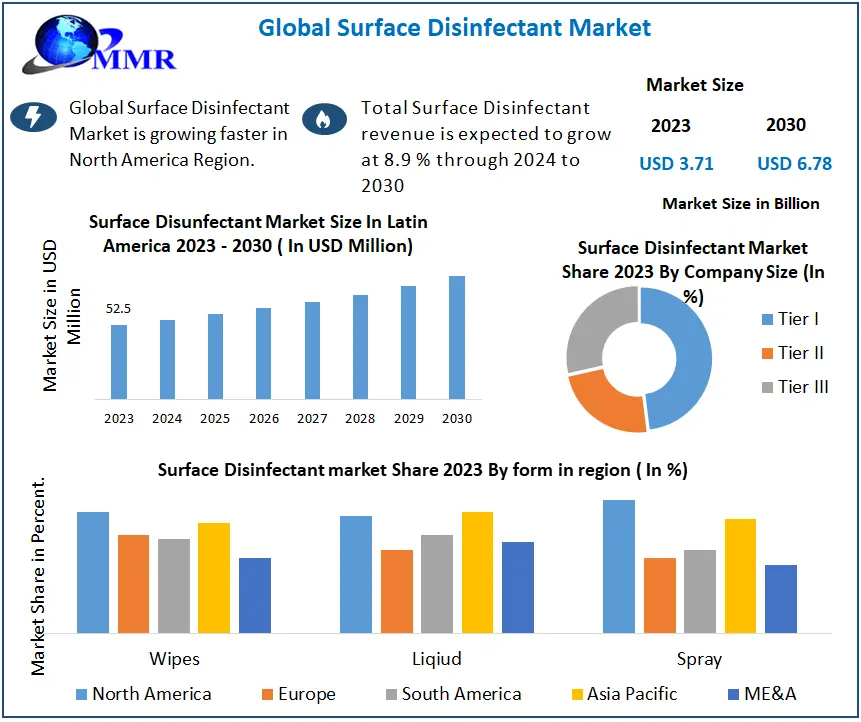
Market Growth Velocity: The global surface disinfectant market is expanding from USD 3.71 billion in 2023 to USD 6.78 billion by 2030, operating at a stable 8.9 percent CAGR.
Dominant Formulation Profile: The chemical composition segment retains the largest revenue share, driven by robust industrial downstream consumption of alcohol and chlorine compounds.
Fastest-Growing Frontier: Bio-based surface disinfectants are expanding rapidly due to consumer shifts toward natural, non-toxic alternatives and aggressive research and development spending.
Regulatory Pressures: Handling hazards associated with corrosive compounds like sodium hypochlorite are inflating compliance and logistics costs for manufacturers.
Technological Integrations: Next-generation hardware deployment, including electrostatic sprayers and UV-C devices, is fundamentally altering product consumption rates.
Why This Matters Now Volatile feedstock availability and tightening ecological legislation are forcing chemical manufacturers to urgently re-engineer legacy product lines. Industrial buyers face escalating procurement costs as compliance penalties and transportation hazards squeeze classic commodity chemical margins. Industrial facilities, laboratories, and healthcare networks cannot compromise on antimicrobial activity, yet traditional formulations present documented occupational risks. Consequently, investment capital is rapidly pivoting toward specialty chemical dynamics that combine high-level pathogen destruction with lower toxicity profiles. Decision-makers who fail to adjust their supply chain resilience strategies today risk severe supply disruptions and regulatory penalties as enforcement tightens globally.
Market Overview The Surface Disinfectant Market practical implementation of surface disinfection has evolved into a mandatory pillar of modern national and international infection control guidelines. The global market is expanding rapidly, underpinned by a valuation of USD 3.71 billion in 2023 and an expected climb to USD 6.78 billion by 2030. This upward trajectory reflects structural shifts in public health priorities, rising chronic disorders, and a growing volume of surgical procedures requiring sterile clinical environments.
However, the industry faces severe counterweights as users navigate the hazardous handling properties of heavy chemical agents. Regulatory bodies are examining the environmental and physiological impacts of legacy sanitizers, forcing a re-evaluation of production methods. The balance between high antimicrobial activity and human safety now dictates commercial viability, reshaping product development roadmaps.
Key Trends Driving Growth Heightened consumer awareness regarding pathogen transmission is driving systemic changes in downstream consumption habits across household and commercial spaces. Governments are introducing strict mandates for environmental preservation and enhanced sterilization, forcing industrial facilities to institutionalize rigorous cleaning regimens. These policy implementations directly boost volume demand for high-, intermediate-, and low-level disinfectants.
Simultaneously, technological advancements are altering the distribution and efficacy of these chemical compounds. The integration of advanced delivery technologies—such as electrostatic sprayers and autonomous UV-C disinfection devices—ensures more precise application. This technological shift optimizes fluid consumption, changes the required concentration levels of active ingredients, and opens new high-margin revenue streams for innovative chemical formulators.
Segment Insights
Dominant Segment: Chemical composition formulations hold the leading market position by revenue share, driven by strong demand for alcohol-based and chlorine bleach sanitizers.
Fastest-Growing Segment: Bio-based surface disinfectants represent the fastest-growing market vector, propelled by intense research and development focused on renewable, non-toxic raw materials.
Composition Dynamics: The hypochlorite segment, specifically sodium hypochlorite, commands substantial market share due to its broad-spectrum performance against vegetative bacteria, fungi, and viruses.
End-Use Focus: The food processing sector drives high-volume consumption of chlorine compounds, relying on recommended concentrations of 40 to 180 parts per million (ppm) to sanitize contact surfaces.
Regional Growth Story North America dominates the global landscape, supported by sophisticated healthcare infrastructure and strict enforcement of sanitation protocols by regional authorities. The United States acts as a primary consumption engine, where high surgical volumes and an aging demographic accelerate the procurement of intermediate- and high-level surface disinfectants. This mature market infrastructure ensures a steady demand baseline for global chemical suppliers.
Meanwhile, major chemical manufacturing hubs across Europe and Asia-Pacific—notably Germany, China, and India—are realigning their production lines. European manufacturers are investing heavily in green chemistry to comply with rigid regional environmental frameworks. In Asia-Pacific, rapid industrialization, expanding laboratory networks, and growing healthcare investments are driving substantial volume growth, making the region a critical target for capacity additions.
Competitive Landscape The global arena is characterized by intense competitive activity as established commodity chemical producers defend their market shares against agile specialty chemical innovators. Top-tier market participants are increasing their research and development budgets to improve the performance of eco-friendly formulations without sacrificing antimicrobial efficacy. This engineering push is critical to offset the market friction caused by rising product costs.
Strategic positioning is heavily influenced by how effectively companies manage the logistics risks of traditional chemical feedstocks. Firms with integrated supply chains are outperforming rivals by absorbing raw material price spikes more effectively. The competitive focus is shifting from simple price competition to providing validated compliance documentation, superior safety profiles, and integrated application hardware.
Recent Developments
Formulation R&D: Manufacturers are increasing investments in renewable, bio-based inputs to engineered non-corrosive, non-toxic industrial surface cleaners.
System Integration: Chemical developers are partnering with hardware manufacturers to optimize liquid disinfectants for electrostatic spraying systems.
Safety Adaptation: Suppliers are redesigning packaging and stabilization methods to mitigate the occupational risks of transporting volatile peroxides and acetic acid.
Spectrum Expansion: R&D pipelines are prioritizing formulations that can achieve high-level spore eradication without relying on hazardous concentrations of sodium hypochlorite.
Strategic Implications The transition toward bio-based chemistry signals a permanent structural shift in global capacity utilization. Chemical producers can no longer rely exclusively on high-volume, low-margin commodity sanitizers like standard sodium hypochlorite, which carries steep liabilities due to its corrosive nature, toxicity, and high transport costs. To protect long-term pricing power, operations must shift toward specialty chemical dynamics, where advanced, eco-friendly formulations command premium prices.
Furthermore, supply chain resilience is now directly tied to compliance capabilities. As national guidelines place greater emphasis on user health and environmental safety, manufacturers utilizing hazardous inputs face escalating operational costs and potential market exclusion. Procurement leaders must diversify their sourcing networks to prioritize vendors that offer stable, bio-derived alternatives, shielding their operations from sudden regulatory disruptions or raw material shortages.
Future Outlook Looking ahead, the global market will reward agile manufacturers that successfully align high-performance antimicrobial activity with strict ecological safety standards. Companies that anchor their production strategies in advanced bio-based chemical composition engineering and secure local feedstock supply lines will capture the highest margin growth. Conversely, operations that remain overly dependent on legacy, hazardous chemical processes will face compressing margins, escalating logistics barriers, and intensifying regulatory resistance.
Analyst Perspective “The global surface disinfectant market is undergoing a structural realignment as regulatory scrutiny on chemical handling safety forces a shift away from traditional, corrosive formulations,” said Ankita Kagawade, Research Analyst. “Chemical manufacturers that proactively pivot their portfolios toward high-efficacy, bio-based alternatives will secure distinct pricing power and capture expanding downstream demand across premium industrial and clinical segments.”
About Maximize Market Research
Maximize Market Research Pvt. Ltd. (MMR) is a global market research and consulting company that provides reliable, data-focused, and practical business insights. The firm serves a wide range of industries, including healthcare, pharmaceuticals, technology, automotive, electronics, chemicals, personal care, and consumer goods. Through market forecasts, competitive analysis, strategic consulting, and industry impact assessments, MMR helps organizations understand changing market conditions, identify growth opportunities, and make informed business decisions for long-term success.
2nd Floor, Navale IT Park Phase 3
Pune Banglore Highway, Narhe
Pune, Maharashtra 411041, India
+91 9607365656
sales@maximizemarketresearch.com
