Key Highlights
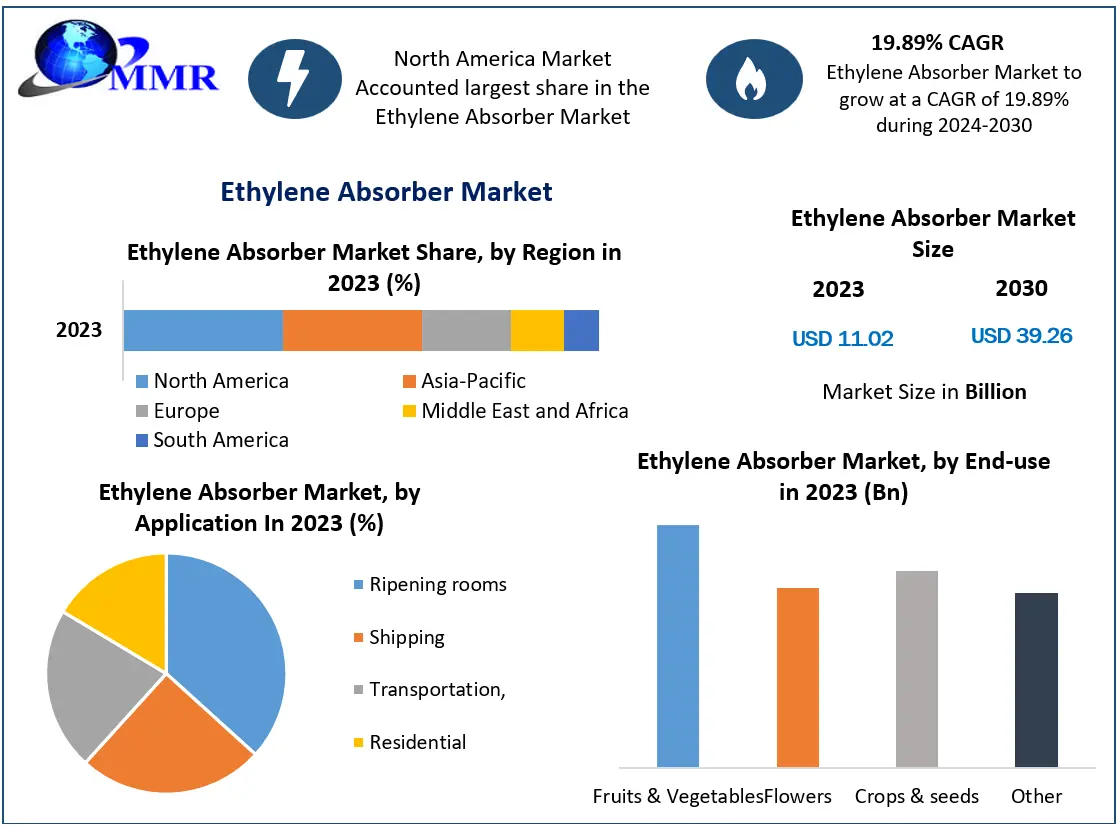
The global ethylene absorber market reached a valuation of USD 11.02 billion in 2023, with revenues forecasted to climb to USD 39.26 billion by 2030.
Market growth operates at a compounding annual growth rate (CAGR) of 19.89% over the seven-year forecast window.
Environmental control systems commanded the largest market share by type in 2023, functioning as cross-contamination barriers in cold chain infrastructure.
The transportation and shipping segment acts as both the dominant and fastest-growing application vector across the global logistics ecosystem.
Chemically, technologies relying on potassium permanganate oxidation and active carbon systems form the technical core of industrial absorption media.
Why This Matters Now
Industrial food waste and international shipping vulnerabilities have turned post-harvest shelf-life extension into an economic battleground for chemical manufacturers and logistics providers. Perishable assets degrade rapidly under the influence of autocatalytic plant hormones, making real-time atmospheric mitigation a regulatory and financial necessity. Companies that integrate active chemical scavengers directly into transit frameworks are capturing immediate margins by eliminating product spoilage before it reaches the retail layer.
Market Overview
The Ethylene Absorber Market as a potent volatile vegetable hormone that triggers ripening, softening, and tissue degradation in fresh produce, even at nominal parts-per-billion concentrations. To counter this, the global ethylene absorber market operates as a vital node within the broader agricultural chemicals and materials sector, providing active materials to intercept this gas. The market baseline of USD 11.02 billion in 2023 reflects a commercial landscape heavily reliant on specialized physical and chemical adsorption infrastructure.
Commercial expansion is heavily tethered to surging global demand for fresh fruits, vegetables, and floral products, which require pristine structural integrity over extended distribution timelines. As global post-harvest storage capacities expand to meet urban consumption centers, the integration of these chemical scavenging technologies has shifted from premium addition to standard operating procedure. However, market friction persists due to the higher capital costs of high-efficiency absorption media and the localized utilization of low-tier alternatives like activated charcoal.
Key Trends Driving Growth
The primary growth engine is the deep structural integration of ethylene absorbers into active packaging systems across global supply chains. Traditional passive packaging options merely insulate cargo from external dirt, whereas active packaging formats utilize integrated chemistry to manipulate internal atmosphere dynamics. Ethylene chemical elimination through potassium permanganate oxidation or carbon porous capture allows producers to extend transit timelines safely. This development directly offsets food waste and curtails the risk of food poisoning across long-distance distribution lines, creating measurable cost savings for food retailers.
Simultaneously, a sharp rise in downstream consumer adoption within the residential sector has altered historic demand models. Household utilization of anti-ethylene sheets, specialized absorbent pads, and kitchen-scale environmental sheets has expanded rapidly as consumers seek to prevent premature fruit wilting in domestic environments. This democratization of commercial-grade preservation tech has created a dual-track revenue stream for chemical manufacturers, feeding both industrial bulk transit and packaged consumer retail formats.
Segment Insights
Dominant Segment: Environmental Control Systems lead the product type category, offering multi-functional atmospheric remediation by scrubbing ethylene alongside broader volatile organic compounds (VOCs). These large-scale industrial machines incorporate built-in germicidal lamps to sanitize commercial refrigeration units and air channels simultaneously, providing comprehensive microbial and fungal defense.
Fastest-Growing Segment: The Transportation and Shipping sector represents both the dominant and fastest-growing application category through 2030. Because high-emitting crops are consistently grouped during cross-border transit, automated shipping enclosures require continuous chemical scrubbing to prevent catastrophic cross-contamination and cargo spoilage during long sea voyages.
Regional Growth Story
Regional distribution emphasizes major global trading and production hubs including the United States, Germany, China, India, Japan, and South Korea. In North America and Western Europe, rigid retail quality benchmarks and expansive cold chain networks maintain a stable, high-volume consumption pattern for premium chemical sachet and filter installations.
Concurrently, heavy domestic investments in cold storage facilities across China and India are unlocking immense volume potential. These manufacturing economies are scaling up their active packaging adoption to secure export viability for native horticultural outputs moving to international markets.
Competitive Landscape
The global market maintains a highly competitive structure populated by specialized materials firms and active packaging chemical developers. Sector concentration is shaped by intellectual property advantages related to carrier substrates and chemical impregnation stability, which dictate how long a material can absorb gas without degrading.
Key market participants include global operators such as Symphony Environmental Ltd., Bee Chems, Lipmen Co., Ltd., Secco International Group, DeltaTrak, Dingxing Industry Co., Ltd., Keep-it-Fresh, BioXTEND Inc., Bioconservacion, Praxas, Isolcell S.p.A., Hazel Technologies, Inc., AgroFresh, GreenKeeper Iberia, and Stream Peak International.
Recent Developments
Symphony Environmental Ltd. commercialized its Masterbatch Series 96540, an additive designed for integration into packaging materials to adsorb ethylene gas directly, mitigating mold, decay, and wilting.
Bee Chems scaled up its production of industrial ethylene scrubbers and sachets under the Freppe brand name, targeting international logistics networks to arrest agricultural over-ripening.
Specialized market entrants like Hazel Technologies and AgroFresh expanded their patent portfolios around target-specific chemical delivery systems to enhance structural deployment within active transport boxes.
Strategic Implications
The development trajectories of leaders like Symphony Environmental and Bee Chems highlight a major consolidation shift toward functional masterbatches and pre-packaged active technologies. By manufacturing masterbatches that blend scavenging properties directly into standard polymer lines, suppliers are gaining substantial pricing leverage over conventional converters.
This technical capability reconfigures upstream sourcing, forcing film packaging manufacturers to build dedicated partnerships with specialized chemical blending firms to protect their market positioning. Furthermore, these integrated product formulations elevate performance baselines, rendering legacy unfunctionalized packaging options obsolete in commercial cold-chain procurement contracts.
Future Outlook
The global ethylene absorber market will move toward deep chemical synthesis integration, where active gas-scavenging components are built directly into container structures rather than added as separate loose sachets. This design evolution will significantly optimize space utility inside international shipping containers and eliminate the risk of manual dosing errors during agricultural packing. Market leadership will belong to chemical material producers that successfully engineer high-capacity, regenerable substrates capable of maintaining long-term chemical structural integrity under highly humid, refrigerated supply chain conditions.
Analyst Perspective
“The rapid expansion of the global ethylene absorber market underscores a structural shift in agricultural asset preservation,” states Ankita Kagawade, Lead Analyst at Maximize Market Research. “By implementing active chemical scrubbing mechanisms like potassium permanganate oxidation within transport configurations, the industry is transitioning away from passive refrigeration toward precision kinetic atmosphere management.”
About Maximize Market Research
Maximize Market Research Pvt. Ltd. (MMR) is a global market research and consulting company that provides reliable, data-focused, and practical business insights. The firm serves a wide range of industries, including healthcare, pharmaceuticals, technology, automotive, electronics, chemicals, personal care, and consumer goods. Through market forecasts, competitive analysis, strategic consulting, and industry impact assessments, MMR helps organizations understand changing market conditions, identify growth opportunities, and make informed business decisions for long-term success.
2nd Floor, Navale IT Park Phase 3
Pune Banglore Highway, Narhe
Pune, Maharashtra 411041, India
+91 9607365656
sales@maximizemarketresearch.com
