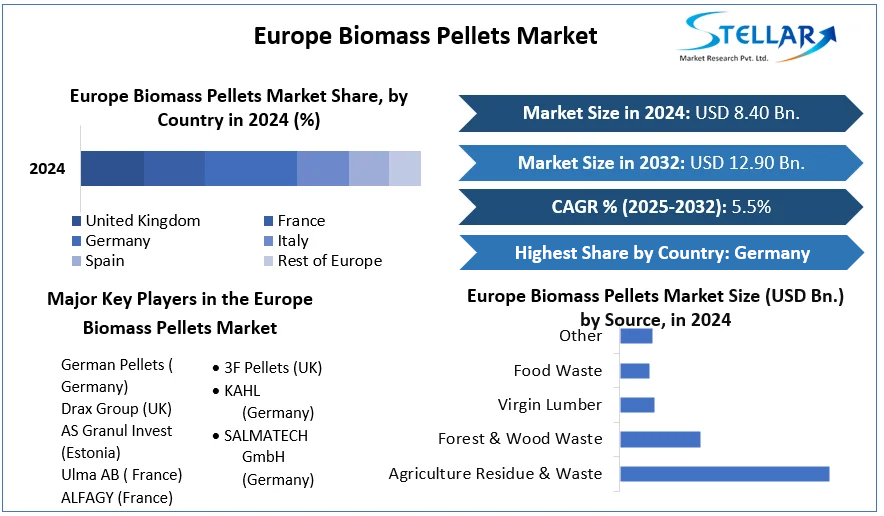
The Europe Biomass Pellets Market has become a cornerstone of the region’s renewable energy strategy, driven by ambitious climate goals, increasing demand for clean energy, and the gradual shift away from fossil fuels. Biomass pellets, produced from compressed organic materials such as wood residues, agricultural waste, and forestry by-products, provide a renewable and efficient fuel source for residential heating, commercial buildings, industrial boilers, and power generation facilities.
As Europe accelerates its transition toward a carbon-neutral economy, biomass pellets are playing a crucial role in reducing greenhouse gas emissions while supporting energy security and circular economy initiatives. Rising investments in bioenergy infrastructure and sustainable fuel production are further strengthening market growth.
Renewable Energy Policies Drive Market Growth
One of the primary drivers of the Europe Biomass Pellets Market is the implementation of stringent renewable energy policies and decarbonization strategies across the region. Governments are promoting biomass as part of a diversified renewable energy mix to reduce dependence on conventional fossil fuels.
Biomass pellets are widely used in:
Residential heating systems
Commercial heating applications
Industrial boilers
Combined Heat and Power (CHP) plants
Utility-scale power generation
District heating networks
Agricultural facilities
Institutional buildings
Their high energy density, ease of transportation, and lower emissions compared to coal make them an attractive renewable fuel option.
𝐃𝐨𝐰𝐧𝐥𝐨𝐚𝐝 𝐅𝐫𝐞𝐞 𝐏𝐃𝐅 𝐁𝐫𝐨𝐜𝐡𝐮𝐫𝐞: https://www.stellarmr.com/report/req_sample/Europe-Biomass-Pellets-Market/768
Rising Demand for Sustainable Heating Solutions
The growing need for energy-efficient and environmentally friendly heating systems is accelerating demand for biomass pellets across Europe. Residential and commercial consumers are increasingly adopting pellet-fired heating systems to reduce energy costs and carbon emissions.
Key advantages of biomass pellets include:
Renewable fuel source
Lower greenhouse gas emissions
High combustion efficiency
Consistent fuel quality
Easy storage and transportation
Reduced reliance on fossil fuels
Support for circular economy practices
Improved energy security
These benefits continue to strengthen the role of biomass pellets in Europe’s clean energy transition.
Technological Advancements Improve Pellet Production
Continuous innovation is enhancing the efficiency and sustainability of biomass pellet manufacturing.
Key technological developments include:
Advanced pelletizing equipment
Automated production systems
High-efficiency drying technologies
Digital process monitoring
Artificial Intelligence (AI)-based quality control
Internet of Things (IoT)-enabled production management
Energy-efficient manufacturing processes
Sustainable feedstock processing
These innovations improve pellet quality, optimize resource utilization, and reduce production costs.
𝐃𝐨𝐰𝐧𝐥𝐨𝐚𝐝 𝐅𝐫𝐞𝐞 𝐏𝐃𝐅 𝐁𝐫𝐨𝐜𝐡𝐮𝐫𝐞: https://www.stellarmr.com/report/req_sample/Europe-Biomass-Pellets-Market/768
Industrial Decarbonization Expands Market Opportunities
Heavy industries are increasingly using biomass pellets as an alternative to fossil fuels to achieve decarbonization targets. Sectors such as cement, pulp and paper, food processing, and manufacturing are integrating biomass-based energy systems into their operations.
Industrial adoption supports:
Lower carbon emissions
Improved environmental compliance
Reduced fossil fuel consumption
Greater energy diversification
Enhanced operational sustainability
Long-term cost optimization
Growing corporate sustainability commitments are expected to further boost industrial demand.
Circular Economy and Sustainable Forestry Support Market Expansion
Europe’s emphasis on responsible resource management is encouraging the use of forestry residues, sawdust, agricultural by-products, and other renewable biomass feedstocks for pellet production.
Manufacturers are investing in:
Certified sustainable forestry
Waste-to-energy initiatives
Biomass supply chain optimization
Renewable feedstock sourcing
Carbon footprint reduction
Recycling and resource efficiency
Sustainable logistics
Eco-friendly production practices
These initiatives strengthen both environmental performance and supply chain resilience.
Regional Market Insights
Germany
Germany remains one of the leading markets within the Europe Biomass Pellets Market, driven by strong renewable energy policies, widespread adoption of pellet heating systems, and continuous investment in clean energy infrastructure.
Sweden and Finland
Sweden and Finland benefit from abundant forest resources and well-established bioenergy industries, making them major producers and consumers of biomass pellets for district heating and industrial energy applications.
France and Italy
France and Italy are witnessing increasing demand due to government incentives for renewable heating, residential pellet stove installations, and efforts to reduce carbon emissions.
Central and Eastern Europe
Countries including Poland, Austria, and the Baltic nations are expanding biomass production and consumption through investments in renewable energy projects and sustainable forestry management.
Competitive Landscape
The Europe Biomass Pellets Market is highly competitive, with biomass producers, energy companies, forestry organizations, and technology providers investing in production capacity, sustainability, and supply chain optimization.
Major competitive strategies include:
Production capacity expansion
Sustainable feedstock sourcing
Advanced pellet manufacturing technologies
Strategic partnerships
Export market development
Supply chain integration
Research and development investments
Product quality enhancement
Companies continue focusing on improving production efficiency, environmental performance, and long-term supply reliability.
Emerging Opportunities
Several trends are expected to shape future market growth:
Advanced bioenergy technologies
Carbon-neutral heating systems
Smart biomass supply chains
AI-powered production optimization
Bioenergy with carbon capture (BECCS)
Renewable district heating
Sustainable industrial fuel solutions
Circular bioeconomy initiatives
These innovations are expected to strengthen biomass pellets’ role in Europe’s evolving renewable energy landscape.
Future Outlook
The future of the Europe Biomass Pellets Market remains highly promising as governments, utilities, industries, and consumers continue investing in renewable energy and sustainable heating solutions. Advances in pellet production technologies, responsible forestry management, and bioenergy infrastructure will support long-term market expansion.
Manufacturers that prioritize sustainability, operational efficiency, feedstock diversification, and product quality will be well positioned to capitalize on the growing demand for renewable biomass fuels.
Conclusion
The Europe Biomass Pellets Market is playing a pivotal role in supporting the region’s renewable energy transition by providing an efficient, sustainable, and low-carbon alternative to conventional fossil fuels. Increasing investments in bioenergy infrastructure, industrial decarbonization, and environmentally responsible resource management are driving market growth.
As Europe advances toward ambitious climate and energy goals, the Biomass Pellets Market is expected to witness sustained expansion, creating significant opportunities for biomass producers, energy companies, technology providers, forestry organizations, and investors.
