The Anaplasmosis Treatment Market is witnessing steady expansion as rising cases of tick-borne diseases, increasing awareness of livestock health, and advancements in veterinary diagnostics drive demand for effective treatment solutions. Anaplasmosis, a bacterial disease caused by Anaplasma species, affects both animals and humans, with livestock—particularly cattle—bearing the greatest economic burden. As governments, veterinary healthcare providers, and pharmaceutical companies intensify efforts to control the disease, the market is poised for sustained growth.
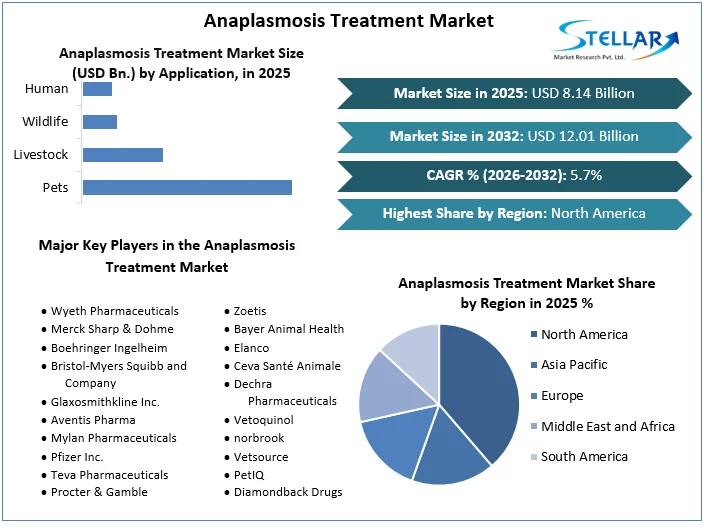
According to Stellar Market Research, the Anaplasmosis Treatment Market was valued at USD 8.14 Bn. in 2025 and is projected to reach nearly USD 12.01 billion by 2032, growing at a CAGR of 5.7% during the forecast period (2026–2032). Market growth is supported by improved disease surveillance, expanding veterinary infrastructure, increasing adoption of advanced diagnostic technologies, and greater investment in livestock healthcare.
Download Free PDF Brochure: https://www.stellarmr.com/report/req_sample/Anaplasmosis-Treatment-Market/2063
Understanding Anaplasmosis
Anaplasmosis is an infectious disease caused by bacteria belonging to the Anaplasma genus and is primarily transmitted through tick bites. In livestock, especially cattle, the disease causes fever, anemia, weight loss, reduced milk production, reproductive issues, and, in severe cases, death. Human granulocytic anaplasmosis (HGA), although less common, has also become an emerging public health concern in regions where tick populations are expanding.
Early diagnosis and timely antibiotic treatment remain essential for minimizing disease severity and preventing economic losses in the livestock industry. As awareness among veterinarians and livestock producers increases, demand for reliable diagnostic methods and effective therapeutics continues to grow.
Key Drivers Supporting Market Growth
Rising Prevalence of Tick-Borne Diseases
Climate change, changing ecosystems, and expanding tick habitats have contributed to an increase in tick-borne infections worldwide. Growing disease incidence among cattle and companion animals has strengthened demand for effective treatment protocols and preventive healthcare measures.
Increasing Investment in Livestock Healthcare
Livestock producers are investing more in animal health to improve productivity and reduce disease-related economic losses. Government-supported vaccination programs, veterinary healthcare initiatives, and disease surveillance systems are encouraging wider adoption of diagnostic testing and treatment solutions.
Advances in Diagnostic Technologies
Modern diagnostic methods such as enzyme-linked immunosorbent assay (ELISA), polymerase chain reaction (PCR), and indirect fluorescent antibody (IFA) testing are improving the speed and accuracy of disease detection. Portable diagnostic devices and digital veterinary platforms are making early diagnosis more accessible, particularly in rural farming communities.
Emerging Trends Reshaping the Market
The Anaplasmosis Treatment Market is benefiting from rapid technological innovation. Digital veterinary healthcare platforms are enabling remote consultations, disease monitoring, and electronic health records, helping veterinarians provide timely treatment recommendations.
Artificial intelligence is increasingly being integrated into livestock management systems to identify disease patterns, predict outbreaks, and support preventive healthcare strategies. Precision livestock farming technologies, including wearable animal sensors and smart monitoring systems, are also helping farmers detect illness at earlier stages.
Pharmaceutical companies continue investing in the development of improved antibiotic formulations, longer-acting therapies, and novel vaccine candidates aimed at reducing disease prevalence while addressing concerns surrounding antimicrobial resistance.
Collaborative research between academic institutions and veterinary pharmaceutical manufacturers is expected to accelerate innovation in both diagnostics and treatment over the coming years.
Market Segmentation
The Anaplasmosis Treatment Market is segmented by diagnosis, application, treatment, and geography.
By diagnosis, ELISA, PCR, and indirect fluorescent antibody (IFA) testing represent the primary diagnostic methods. PCR-based testing is gaining popularity due to its superior sensitivity and ability to detect infections during early stages.
Based on application, livestock represents the largest market segment because cattle remain the most affected species and contribute significantly to agricultural economies worldwide. Companion animals, wildlife, and human healthcare applications are also expanding as awareness of tick-borne diseases increases.
By treatment, antibiotics continue to dominate the market, while vaccine research and supportive therapies present attractive future growth opportunities.
Regional Market Insights
North America currently leads the Anaplasmosis Treatment Market owing to its high prevalence of tick-borne diseases, well-developed veterinary infrastructure, advanced diagnostic capabilities, and significant investment in animal healthcare. The United States and Canada continue to invest in disease surveillance programs and livestock health management.
Europe maintains a substantial market share through strong animal health regulations, robust veterinary services, and increasing awareness among livestock producers. Countries such as Germany, France, and the United Kingdom continue expanding research into tick-borne diseases and advanced diagnostic solutions.
The Asia-Pacific region is expected to witness the fastest growth during the forecast period. Expanding livestock populations, improving veterinary infrastructure, rising government investment in agriculture, and increasing awareness of animal health are driving market expansion across China, India, Australia, and Southeast Asia.
Competitive Landscape
The Anaplasmosis Treatment Market includes leading veterinary pharmaceutical manufacturers, animal health companies, diagnostic technology providers, and research organizations. Companies are focusing on expanding antibiotic portfolios, developing innovative diagnostic tools, investing in vaccine research, and strengthening distribution networks.
Leading participants include:
- Wyeth Pharmaceuticals
- Merck Sharp & Dohme
- Boehringer Ingelheim
- Bristol-Myers Squibb and Company
- Glaxosmithkline Inc.
- Aventis Pharma
- Mylan Pharmaceuticals
- Pfizer Inc.
- Teva Pharmaceuticals
- Procter & Gamble
Download Free PDF Brochure: https://www.stellarmr.com/report/req_sample/Anaplasmosis-Treatment-Market/2063
Future Outlook
The outlook for the Anaplasmosis Treatment Market remains positive as governments and livestock industries continue prioritizing animal health, food security, and disease prevention. Advances in molecular diagnostics, portable testing technologies, artificial intelligence, and precision livestock management are expected to improve early detection and treatment outcomes.
Increasing research into vaccines, next-generation antibiotics, and integrated disease surveillance systems will further strengthen the market over the forecast period. As livestock production expands globally and awareness of tick-borne diseases continues to rise, manufacturers that invest in innovative diagnostics, effective therapeutics, and digital veterinary solutions will be well positioned to capitalize on emerging opportunities.
With continuous improvements in veterinary healthcare infrastructure and growing collaboration across the animal health ecosystem, the Anaplasmosis Treatment Market is expected to play an increasingly important role in safeguarding livestock productivity, enhancing animal welfare, and supporting sustainable agricultural development worldwide.
Media Contact
Stellar Market Research
Website: http://stellarmr.com/
Email: sales@stellarmr.com
