Key Highlights
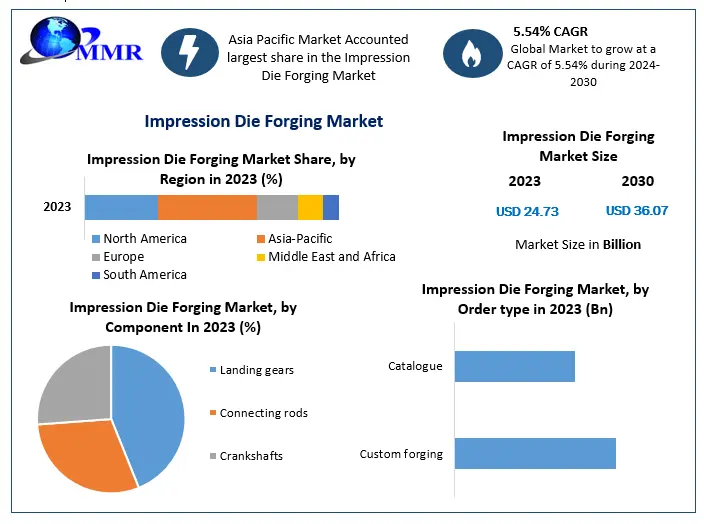
- The global Impression Die Forging Market was valued at USD 24.73 billion in 2023.
- The market is projected to reach USD 36.07 billion by 2030.
- The industry is expected to grow at a 5.54% CAGR during 2024–2030.
- Custom forging remains the leading order type for high-performance engineering applications.
- Steel alloys dominate material demand due to strength and cost efficiency.
- Aerospace and automotive industries continue to drive demand for precision forged components.
- Asia Pacific leads global production and consumption, supported by expanding manufacturing capacity.
- Automation is improving production efficiency and reducing secondary machining requirements.
Why This Matters Now
Manufacturers across aerospace, automotive, defense and energy industries are seeking stronger, lighter and more precise metal components. Impression die forging delivers high structural integrity while minimizing material waste and machining requirements. As advanced manufacturing and lightweight engineering become strategic priorities, forging companies capable of producing complex components at scale are gaining long-term competitive advantages.
Market Overview
The Impression Die Forging Market includes closed-die metal forming processes used to manufacture complex, high-strength components with tight dimensional accuracy. The process compresses heated metal within precision dies to create parts requiring minimal finishing and superior mechanical properties.
Demand is increasing as manufacturers replace fabricated and machined components with forged alternatives that offer higher durability, fatigue resistance and structural reliability. Aerospace, automotive, defense, shipbuilding and oil & gas industries remain the primary consumers of precision forged components.
Supply-side investment is increasingly focused on automated forging presses, advanced die technologies and production systems capable of processing high-performance materials including titanium and nickel alloys.
Industrial automation, infrastructure development, commercial aircraft production and electric mobility continue supporting long-term demand. However, fluctuating raw material costs, high capital investment requirements and skilled labor shortages remain important industry challenges.
Key Trends Driving Growth
Automation is transforming impression die forging operations. Modern forging equipment integrates robotics, digital controls and automated material handling to improve production consistency, reduce cycle times and lower manufacturing costs.
Demand for lightweight, high-strength materials continues to increase. Aerospace manufacturers are expanding the use of titanium and nickel-based alloys to improve aircraft efficiency while maintaining structural performance.
Advanced forging technologies are enabling production of larger and more complex components with minimal machining requirements. This reduces production costs while improving material utilization.
Industrial sustainability is becoming increasingly important. Precision forging minimizes material waste compared to conventional machining, supporting manufacturers’ environmental objectives and improving resource efficiency.
Global supply chains are also evolving. Automotive and aerospace OEMs are strengthening partnerships with regional forging suppliers to improve supply security, reduce logistics risks and support localized manufacturing strategies.
Explore detailed analysis, insights, and growth opportunities
Segment Insights
Dominant Segment – Custom Forging
Custom forging represents the largest order type because critical industries require application-specific components designed for demanding operating conditions.
Aircraft landing gear, defense equipment, offshore platforms and power generation systems depend on customized forged parts capable of meeting strict mechanical and safety standards. These applications require specialized engineering rather than standardized catalogue products.
From a business perspective, custom forging allows manufacturers to capture higher margins through engineering expertise, precision manufacturing and long-term customer relationships.
Fastest-Growing Segment – Aerospace End User
The aerospace sector is expected to remain the fastest-growing end-user segment due to increasing aircraft production and demand for lightweight structural components.
Advanced forged titanium and nickel alloy parts improve aircraft performance while reducing overall weight and maintenance requirements. Growing investments in commercial aviation, defense modernization and space programs continue expanding demand for precision forging technologies.
Manufacturers serving aerospace customers benefit from long production cycles, high-value contracts and stringent quality standards that create significant barriers to entry.
Additional Key Sub-Segments
Steel Alloys
Steel alloys remain the dominant material segment because they combine high strength, durability and cost efficiency across automotive, industrial machinery and infrastructure applications.
Titanium and Nickel Alloys
Titanium and nickel alloys are gaining importance as aerospace and energy sectors increasingly require components capable of operating under extreme temperatures and mechanical stress.
Component Applications
Connecting rods, crankshafts and landing gears continue generating consistent demand due to increasing vehicle production, heavy equipment manufacturing and commercial aircraft deliveries.
Regional Growth Story
Asia Pacific remains the largest regional market, supported by strong manufacturing ecosystems in China, India, Japan and South Korea. India continues strengthening its global position through expanding automotive production, government manufacturing initiatives and partnerships with international OEMs.
China benefits from large-scale industrial production and continuous investment in aerospace, railways and heavy engineering. Regional manufacturers are expanding production capacity to meet growing domestic and export demand.
Europe maintains a strong position in high-performance forging through advanced engineering capabilities and specialization in aerospace, automotive and industrial equipment manufacturing. Companies continue investing in precision forging technologies and advanced alloy processing.
North America benefits from sustained aerospace production, defense spending and energy sector investments. Demand remains concentrated in high-value applications requiring premium forged components and strict quality certifications.
Competitive advantages are increasingly shifting toward manufacturers capable of combining automation, advanced alloy expertise and large-scale precision production with reliable global supply chains.
Competitive Landscape
Competition in the Impression Die Forging Market is driven by manufacturing capability, metallurgical expertise and the ability to supply critical industries with high-performance forged components.
Bharat Forge Limited remains one of the industry’s strongest competitors through diversified manufacturing capabilities, global customer relationships and continuous investment in advanced forging technologies.
ATI strengthens its competitive position through expertise in specialty alloys serving aerospace and defense applications where material performance is critical.
Aubert & Duval, Böhler Schmiedetechnik GmbH & Co KG and Siderforgerossi Group S.p.A compete through premium alloy processing and precision engineering for high-value industrial markets.
Bifrangi SpA, Ellwood Group Inc., Mahindra Forgings Europe AG, Maschinenfabrik Alfing Kessler GmbH, SAMMI Metal Products Co. Ltd, Riganti Spa, Siepmann-Werke GmbH & Co. KG and ULMA Lazkao Forging continue strengthening market positions by expanding manufacturing capabilities and serving specialized industrial applications.
Market competition increasingly favors manufacturers capable of integrating automation, advanced materials expertise and global supply chain reliability while maintaining strict quality standards.
Recent Developments
The provided MMR report does not specify company-level recent developments, product launches, acquisitions or partnerships for the Impression Die Forging Market. Therefore, no additional developments have been included to maintain factual accuracy.
Future Outlook
Manufacturers investing in automated forging technologies, advanced alloy processing and aerospace-grade precision manufacturing will secure the strongest competitive position as demand for high-performance forged components continues to expand.
Analyst Perspective – Dharti Raut
The Impression Die Forging Market is evolving from conventional metal shaping toward highly automated precision manufacturing that supports next-generation aerospace, automotive and defense applications. Companies that invest in digital production systems, high-performance alloy capabilities and customized engineering solutions will be best positioned to capitalize on increasing demand for lightweight, durable and safety-critical forged components while strengthening resilience against global supply chain disruptions.Top of Form
About Maximize Market Research
Maximize Market Research Pvt. Ltd. (MMR) is a global market research and consulting company that provides reliable, data-focused, and practical business insights. The firm serves a wide range of industries, including healthcare, pharmaceuticals, technology, automotive, electronics, chemicals, personal care, and consumer goods. Through market forecasts, competitive analysis, strategic consulting, and industry impact assessments, MMR helps organizations understand changing market conditions, identify growth opportunities, and make informed business decisions for long-term success.
Contact Us :
2nd Floor, Navale IT Park Phase 3
Pune Banglore Highway, Narhe
Pune, Maharashtra 411041, India
+91 9607365656
sales@maximizemarketresearch.com
