Key Highlights
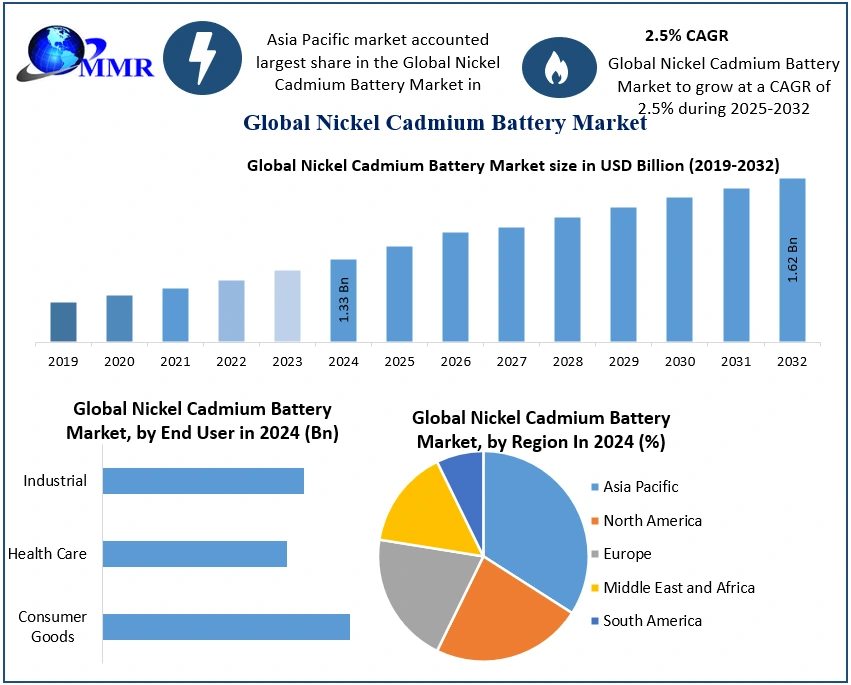
- Nickel Cadmium Battery Market was valued at USD 1.33 Billion in 2024 and is expected to reach nearly USD 1.62 Billion by 2032 at a 2.5% CAGR.
- Asia-Pacific remains the largest regional market and is projected to account for approximately 30–32% of global demand by 2032.
- Vented nickel cadmium batteries hold the largest share, while sealed batteries continue expanding across industrial applications.
- Aviation, railways, telecom, mining, emergency power, and defense remain the market’s strongest end-use sectors.
- Environmental regulations governing cadmium continue reshaping product development and recycling investments.
Why This Matters Now
Battery manufacturers face a market split between environmental regulation and mission-critical reliability. While lithium-ion dominates consumer applications, nickel cadmium technology continues to secure contracts in sectors where operational certainty outweighs energy density. That creates a distinct opportunity for suppliers focused on industrial infrastructure rather than consumer electronics.
Procurement leaders are increasingly evaluating lifecycle performance instead of purchase price alone. Longer operating life, temperature tolerance, and dependable backup performance allow nickel cadmium batteries to remain competitive in aviation, railways, telecom, and emergency systems despite higher upfront costs.
Market Overview
The Nickel Cadmium Battery Market was valued at USD 1.33 Billion in 2024 and is projected to reach nearly USD 1.62 Billion by 2032, expanding at a 2.5% CAGR. For manufacturers, this signals a stable industrial market rather than a volume-driven consumer opportunity. The emphasis has shifted toward specialized applications where reliability directly affects operational continuity.
Nickel cadmium batteries continue serving industries requiring dependable performance across extreme temperatures and demanding operating environments. Aerospace, defense, rail transportation, emergency lighting, telecom infrastructure, medical instrumentation, and industrial backup systems remain core demand centers. The technology’s ability to deliver consistent power over long service lives continues to justify investment despite increasing environmental scrutiny surrounding cadmium.
Key Trends Driving Growth
Industrial infrastructure investment continues supporting demand for nickel cadmium batteries. Rail operators require dependable emergency braking and coach lighting systems, while telecom providers continue investing in resilient backup power networks. These applications prioritize operational continuity over maximum energy density, preserving demand even as lithium-ion expands elsewhere.
Aviation remains another critical growth engine. Aircraft manufacturers and operators continue using nickel cadmium batteries for engine starting, emergency lighting, and backup power because of their high-rate discharge capability and dependable performance under extreme temperatures. This reinforces the technology’s position in regulated industries where safety certifications create significant entry barriers for alternative chemistries.
Supply-demand dynamics increasingly favor specialized rather than commodity battery manufacturing. Producers capable of serving aerospace, defense, mining, and industrial infrastructure markets maintain stronger competitive positioning because customers prioritize certified performance, lifecycle reliability, and maintenance efficiency over lowest-cost procurement.
Technology development is increasingly concentrated on extending service life, reducing maintenance requirements, and improving operational efficiency. Sealed battery designs continue expanding because they eliminate routine electrolyte maintenance while delivering long operational performance. At the same time, recycling and environmental compliance have become integral parts of manufacturing strategies as regulators tighten oversight on cadmium-containing products.
Segment Insights
- Dominant Segment: Vented nickel cadmium batteries account for approximately 50–55% of market share due to extensive deployment across aerospace, defense, industrial equipment, renewable energy systems, marine applications, and telecommunications. Their dependable performance under demanding operating conditions sustains leadership despite maintenance requirements.
- Fastest-Growing Segment: Sealed nickel cadmium batteries are expanding through adoption in aviation, rail transport, mass transit, and emergency power systems. Lower maintenance requirements, portability, and extended service life continue supporting broader deployment across industrial users.
Regional Growth Story
Asia-Pacific remains the industry’s production and demand center and is expected to account for roughly 30–32% of the global market by 2032. China, Japan, and South Korea continue driving manufacturing activity through strong industrial production, electronics manufacturing capabilities, and established battery supply chains. The region also benefits from continued investment across transportation, industrial infrastructure, and energy sectors.
North America represents the second-largest regional market with approximately 24–26% market share, supported by aviation expansion, industrial infrastructure, and transportation demand. Continued investment in aerospace and backup power systems sustains procurement activity, particularly where long operational reliability remains essential.
Europe maintains strategic importance through Germany, the United Kingdom, and France. Environmental regulations continue influencing product portfolios, encouraging manufacturers to strengthen recycling capabilities while focusing on industrial applications where nickel cadmium technology remains technically advantageous. India also presents long-term opportunities as industrialization, railway modernization, and telecom infrastructure investments expand demand for dependable backup power solutions.
Competitive Landscape
Competition increasingly centers on specialization rather than production scale. Manufacturers serving aerospace, railways, telecom, and industrial infrastructure benefit from certification requirements that create higher barriers to entry. This strengthens pricing resilience in mission-critical applications while limiting direct competition from lower-cost battery chemistries.
Companies expanding sealed battery portfolios signal a strategic move toward lower-maintenance industrial products with stronger lifecycle economics. Investments in manufacturing efficiency and environmental compliance also indicate that future competitiveness will depend as much on regulatory readiness and recycling capabilities as production capacity itself. Established suppliers across Asia-Pacific, Europe, and North America continue reinforcing regional supply chains to improve delivery reliability for industrial customers.
Recent Developments
- Sealed nickel cadmium batteries continue gaining wider industrial adoption due to reduced maintenance requirements and extended operational life.
- Aviation and defense applications continue supporting demand for high-performance nickel cadmium battery systems.
- Industrial backup power, telecom infrastructure, and railway modernization continue generating stable procurement opportunities.
- Environmental regulations surrounding cadmium are accelerating focus on recycling and responsible battery lifecycle management.
Strategic Implications
Battery producers should prioritize high-value industrial applications rather than competing directly in consumer electronics. Aerospace, defense, telecom, mining, and transportation provide stronger pricing discipline because procurement decisions emphasize reliability and lifecycle value instead of lowest acquisition cost. Environmental compliance will increasingly differentiate suppliers capable of integrating recycling and sustainable manufacturing into their business models.
Future Outlook
Nickel cadmium batteries will remain essential where reliability, safety, and long service life outweigh energy density advantages offered by competing chemistries. Suppliers that strengthen industrial specialization, regulatory compliance, and recycling capabilities will capture the most resilient opportunities as environmental standards continue tightening. The industry’s strongest winners will be manufacturers that combine certified industrial performance with circular economy capabilities rather than competing on commodity battery volumes alone.
Analyst Perspective
“The Nickel Cadmium Battery Market is evolving into a specialized industrial business where application reliability defines competitive advantage. Companies that align manufacturing, compliance, and lifecycle performance with aviation, rail, telecom, and critical infrastructure requirements will be best positioned for long-term value creation.” — Ankita Kagawade
About Maximize Market Research
Maximize Market Research Pvt. Ltd. (MMR) is a global market research and consulting company that provides reliable, data-focused, and practical business insights. The firm serves a wide range of industries, including healthcare, pharmaceuticals, technology, automotive, electronics, chemicals, personal care, and consumer goods. Through market forecasts, competitive analysis, strategic consulting, and industry impact assessments, MMR helps organizations understand changing market conditions, identify growth opportunities, and make informed business decisions for long-term success.
2nd Floor, Navale IT Park Phase 3
Pune Banglore Highway, Narhe
Pune, Maharashtra 411041, India
+91 9607365656
sales@maximizemarketresearch.com
