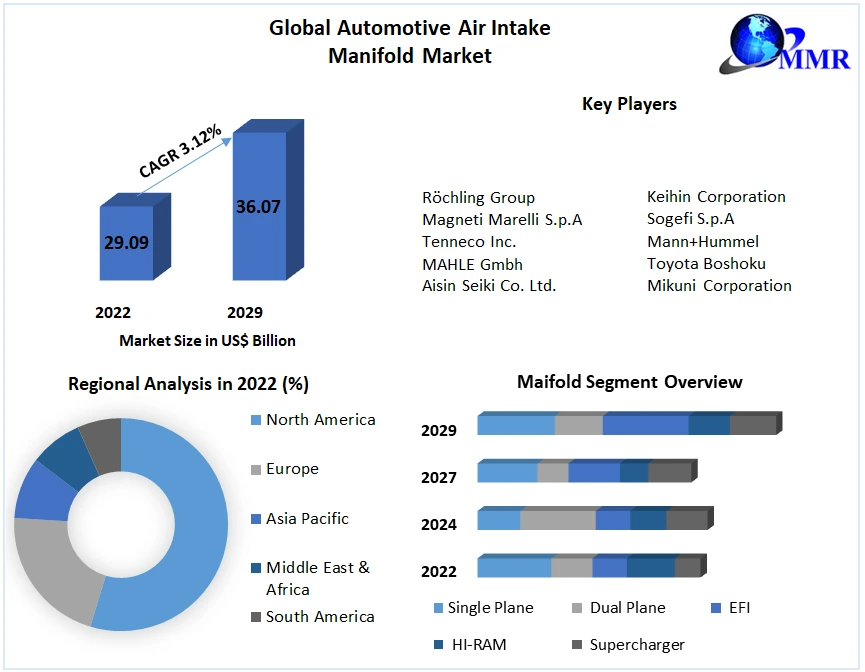
Key Highlights
- Market valued at USD 1.57 billion in 2025.
- Expected to reach USD 2.75 billion by 2034.
- Forecast CAGR of 6.42% during 2026–2034.
- North America dominates global market demand.
- Outlet defroster nozzles remain the leading product segment.
- Passenger cars account for the highest equipment demand.
- Smart sensor-integrated HVAC systems are driving product innovation.
- Electric vehicle thermal management is creating new growth opportunities.
- Lightweight composite materials are improving efficiency and regulatory compliance.
Why This Matters Now
Automotive Air Intake Manifold Market systems are evolving beyond passenger comfort to become critical safety technologies. Increasing adoption of electric vehicles, intelligent climate control systems, and stricter visibility regulations is transforming defroster nozzles into high-value engineered components. Suppliers capable of delivering energy-efficient and digitally integrated airflow solutions are strengthening their position within next-generation vehicle platforms.
Market Overview
Automotive defroster nozzles are specialized HVAC components that direct heated airflow toward windshields and side windows, removing frost, ice, and condensation to improve visibility during adverse weather conditions.
Growing global vehicle production, rising consumer expectations for safety, and increasing demand for premium cabin comfort continue supporting market expansion. Passenger vehicles, commercial fleets, and electric vehicles increasingly require high-performance airflow systems capable of maintaining visibility while minimizing energy consumption.
The transition toward electrified mobility has significantly increased the importance of thermal management. Electric vehicles require efficient windshield defrosting systems that preserve battery range without compromising occupant safety.
On the supply side, manufacturers are investing in computational fluid dynamics (CFD), lightweight composite materials, artificial intelligence, and sensor-enabled climate control technologies. These innovations reduce engineering complexity while improving airflow precision and operational efficiency.
However, integrating advanced defrosting technologies into entry-level vehicles remains challenging due to higher engineering costs, increased component complexity, and pricing pressure among budget vehicle manufacturers.
Key Trends Driving Growth
Intelligent HVAC Systems Drive Product Innovation
Automakers are integrating temperature, humidity, and occupancy sensors into HVAC systems to optimize airflow automatically. These technologies improve visibility while reducing unnecessary energy consumption, particularly in electric vehicles.
Lightweight Materials Support Efficiency Targets
Carbon fiber-reinforced polymers (CFRP) and glass fiber-reinforced polymers (GFRP) are increasingly replacing conventional materials. Reduced component weight contributes to improved fuel efficiency, lower emissions, and extended EV driving range.
Electric Vehicle Adoption Expands Market Potential
Battery-powered vehicles require highly efficient thermal management systems capable of maintaining cabin comfort without excessive energy consumption. This requirement is accelerating demand for next-generation defroster nozzle technologies.
Safety Regulations Encourage HVAC Upgrades
Government regulations across North America, Europe, and Japan continue tightening vehicle visibility standards. Automakers are investing in precision airflow systems that improve windshield defrosting performance under extreme weather conditions.
Digital Engineering Accelerates Development
Simulation tools, computational modeling, and predictive airflow analysis allow manufacturers to optimize nozzle placement before vehicle production, reducing development costs while improving product performance.
Explore detailed analysis, insights, and growth opportunities
Segment Insights
Dominant Segment: Outlet Defroster Nozzles
Outlet defroster nozzles held the largest market share in 2025 due to their direct role in windshield defrosting and driver visibility.
Unlike inlet nozzles, outlet systems determine airflow distribution across critical viewing areas, making them essential safety components. Growing demand for premium vehicles, SUVs, and electric cars continues increasing adoption of advanced outlet nozzle designs featuring automatic climate control and sensor integration.
Business impact: Suppliers specializing in precision airflow technologies benefit from stronger OEM demand as vehicle safety standards become increasingly stringent.
Fastest-Growing Segment: Passenger Cars
Passenger cars are expected to remain the fastest-growing vehicle category throughout the forecast period.
Increasing disposable income, expanding SUV ownership, and rising electric vehicle adoption continue driving investments in intelligent HVAC systems. Premium comfort features are becoming standard across mid-range vehicle platforms, supporting higher installation rates for advanced defroster technologies.
The global success of electric passenger vehicles further reinforces demand for energy-efficient thermal management capable of preserving driving range.
Business impact: OEM suppliers serving passenger vehicle manufacturers gain access to larger production volumes and long-term platform contracts.
Additional Key Sub-Segments
By Material
Plastic remains the dominant material due to manufacturing flexibility and cost efficiency. Composite materials are rapidly gaining market share as automakers pursue aggressive vehicle lightweighting strategies.
By Sales Channel
OEM sales dominate market revenue through factory-installed HVAC systems, while the aftermarket continues expanding due to seasonal maintenance requirements and replacement demand in colder climates.
Regional Growth Story
North America
North America leads the Automotive Defroster Nozzles Market due to harsh winter weather, high vehicle ownership, and rigorous safety regulations.
Automakers continue investing in intelligent HVAC technologies that deliver rapid windshield defrosting while improving energy efficiency. Strong aftermarket demand further supports sustained market growth.
Europe
European manufacturers are prioritizing sustainable thermal management technologies that support vehicle electrification and emission reduction objectives. Innovation is increasingly centered on lightweight materials and intelligent airflow management.
Asia Pacific
Asia Pacific continues strengthening its position as a global automotive manufacturing hub. Expanding production across China, Japan, South Korea, and India, combined with accelerating electric vehicle adoption, is driving long-term demand for advanced HVAC components.
Middle East & Africa and South America
Although seasonal demand is more limited, increasing vehicle production, premium vehicle adoption, and growing automotive manufacturing investments continue creating new opportunities for advanced climate control systems.
Competitive Landscape
The market remains highly competitive, with manufacturers differentiating themselves through engineering expertise, thermal management innovation, and strategic OEM partnerships.
DENSO Corporation, Valeo S.A., MAHLE GmbH, Bergstrom Inc., Red Dot Corporation, Thermo King Corporation, Proair LLC, SGM Company, Full Vision Inc., Interdynamics Research & Development, Delphi Technologies, Modine Manufacturing Company, Calsonic Kansei Corporation, Behr Hella Service GmbH, Hanon Systems, T.RAD Co., Ltd., Mitsubishi Heavy Industries, Visteon Corporation, Toyota Boshoku Corporation, Sumitomo Electric Industries Ltd., Johnson Electric Holdings Limited, Mahindra & Mahindra Ltd., Hella GmbH & Co. KGaA, BorgWarner Inc., Continental AG, Sodecar Automotive, Dorman Products Inc., and Kyungshin Corporation continue strengthening their competitive positions through innovation and product integration.
Competition is shifting toward complete thermal management solutions rather than standalone HVAC components. Companies with expertise in sensor integration, lightweight engineering, and electric vehicle technologies are gaining long-term strategic advantages.
Recent Developments
- February 2024: DENSO partnered with Betterfrost to develop a low-energy EV defrost and defog system capable of delivering up to 20 times greater energy efficiency.
- March 2025: Toyoda Gosei launched an ultra-thin air conditioning register system for the Toyota bZ3X electric SUV, reducing dashboard component thickness by 40%.
- September 2025: MAHLE introduced an integrated thermal management module featuring an advanced heat pump architecture that improves energy efficiency by approximately 15%.
- September 2025: Valeo commercialized a dual-layer HVAC climate control system capable of reducing windshield defrosting and heating time by 50% at temperatures as low as -15°C.
- March 2026: Toyoda Gosei integrated its hidden-fin air register mechanism into the Toyota bZ7 platform, combining improved cockpit aesthetics with optimized windshield airflow performance.
Future Outlook
Companies that lead in intelligent HVAC integration, lightweight thermal management technologies, and energy-efficient defrosting solutions will define the next generation of automotive safety and climate control systems.
Analyst Perspective – Tejaswini Kakade
The Automotive Defroster Nozzles Market is undergoing a structural transformation as vehicle electrification, connected technologies, and advanced safety standards redefine HVAC system design. Defroster nozzles are evolving from basic airflow components into intelligent thermal management solutions that directly influence vehicle efficiency, battery performance, and occupant safety. The rapid adoption of electric vehicles is accelerating demand for compact, sensor-driven, and energy-efficient defrosting systems that minimize power consumption while maintaining optimal visibility. Looking ahead, manufacturers investing in AI-enabled climate control, lightweight composite materials, and integrated thermal management platforms will be best positioned to secure long-term OEM partnerships and capitalize on the industry’s transition toward next-generation mobility.
About Maximize Market Research
Maximize Market Research Pvt. Ltd. (MMR) is a global market research and consulting company that provides reliable, data-focused, and practical business insights. The firm serves a wide range of industries, including healthcare, pharmaceuticals, technology, automotive, electronics, chemicals, personal care, and consumer goods. Through market forecasts, competitive analysis, strategic consulting, and industry impact assessments, MMR helps organizations understand changing market conditions, identify growth opportunities, and make informed business decisions for long-term success.
Contact Us :
2nd Floor, Navale IT Park Phase 3
Pune Banglore Highway, Narhe
Pune, Maharashtra 411041, India
+91 9607365656
sales@maximizemarketresearch.com
