Key Highlights
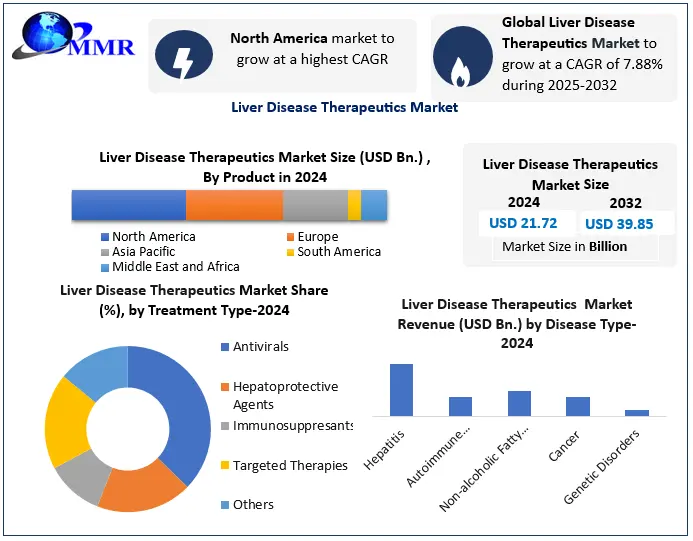
Market Valuation: USD 21.72 billion in 2024, projected to reach USD 39.85 billion by 2032.
Growth Trajectory: 7.88% CAGR over the 2025–2032 forecast period.
Dominant Segment: Antiviral therapies, accounting for approximately 43% of the global market share as of 2024.
Secondary Market Driver: Hepatoprotective agents hold a 20.7% market share, underscoring the demand for natural and synthetic tissue-protective solutions.
Regional Leader: North America continues to lead in revenue, driven by robust clinical research and high adoption of FDA-approved combination therapies.
Why This Matters Now
Chronic liver disease is evolving into a top-tier global health crisis, exacerbated by shifting dietary habits and an aging population. For healthcare providers, the “wait-and-see” approach is being replaced by proactive screening and early-stage intervention. The economic and clinical imperative is clear: identifying liver damage before it progresses to cirrhosis or carcinoma is the single most effective way to reduce the immense costs associated with end-stage liver disease and organ transplantation.
Market Overview
The Liver Diseases Therapeutics Market is currently defined by a transition toward combination therapies. As single-agent treatments often fall short in complex conditions like non-alcoholic steatohepatitis (NASH) and hepatitis C, pharmaceutical developers are prioritizing cocktails that address the multi-faceted nature of hepatic inflammation and fibrosis. This trend has attracted significant investment from both established global players and agile startups focused on biomarker-based diagnostics and targeted delivery systems.
Key Trends Driving Growth
Modern liver care is increasingly reliant on the synergy between advanced imaging techniques and pharmacological treatment. AI-enabled diagnostics—ranging from precision ultrasound to automated liver function test interpretation—are allowing clinicians to detect disease at nascent stages. This diagnostic precision is creating a “pull” effect, where earlier detection drives higher utilization of therapeutic pipelines, particularly antivirals and immunomodulators.
Government and NGO initiatives are further accelerating this trend. Campaigns such as the “Liver Health is Public Health” movement are fostering a global environment where screening is standardized, not elective. As these awareness programs improve, the demand for accessible, cost-effective therapeutic options grows, particularly in rapidly urbanizing regions where dietary shifts are significantly increasing the burden of metabolic liver disease.
Segment Insights
Dominant Segment: Antiviral therapies. Holding 43% of the market share, this segment remains the bedrock of liver care due to the persistent global burden of Hepatitis B and C infections.
Fastest-Growing Segment: Targeted therapies and combination regimens. These are gaining ground as clinicians move away from systemic treatments toward options that offer higher specificity and fewer side effects.
Hepatoprotective Agents: Representing 20.7% of the market, these agents are critical for supporting liver function and mitigating damage in patients with chronic lifestyle-linked ailments.
Regional Growth Story
North America’s dominance is anchored by an established clinical research ecosystem and high insurance coverage for specialized hepatic treatments. The region’s focus on the U.S. FDA’s approval of newer, complex combination drugs keeps it at the vanguard of innovation.
The Asia-Pacific region, however, represents the most significant opportunity for long-term expansion. With half of the world’s population and a sharp rise in hepatic disorders linked to lifestyle changes, countries like China and India are seeing unprecedented investments in domestic healthcare infrastructure. These markets are shifting toward cost-effective, high-access treatment models, presenting a major commercial theater for companies capable of balancing innovation with affordability.
Competitive Landscape
The competitive environment is characterized by intense M&A activity. Industry leaders are no longer building pipelines from scratch; they are acquiring them. Recent high-profile acquisitions, such as Bristol Myers Squibb’s move to secure NASH therapy pipelines and Johnson & Johnson’s expansion into Wilson’s disease treatments, signal a shift toward “specialization dominance.”
These corporate maneuvers are not merely about expanding catalogs; they are strategic bets on specific clinical pathways. For hospitals, this consolidation means that procurement is becoming more simplified but also more reliant on high-value, high-efficacy vendor partnerships. The companies that win are those that provide an ecosystem—integrating diagnostic screening tools, patient monitoring software, and the drugs themselves—to create a closed-loop care model.
Recent Developments
Pipeline Acquisitions: Major firms are aggressively targeting small-molecule and biologic pipelines specifically designed for fibrosis and non-alcoholic fatty liver disease (NAFLD).
Diagnostic Innovation: Integration of new biomarker-based tests is reducing the reliance on invasive biopsies, driving patient compliance and earlier therapeutic intervention.
Strategic Alliances: Cross-industry collaborations between biotech firms and clinical research institutions are accelerating the trial-to-market speed for novel hepatoprotective and anti-inflammatory compounds.
Strategic Implications
The key for healthcare systems is to shift from reactive care to integrated liver health management. This requires investing in the diagnostic infrastructure—such as advanced imaging and laboratory automation—that supports the prescription of modern therapeutics. For investors, the long-term winners will be the firms that master the delivery of combination therapies and demonstrate clear, measurable improvements in liver fibrosis metrics in real-world clinical settings.
Future Outlook
The next decade of liver disease therapeutics will be dictated by the shift toward nucleic acid-based treatments and AI-guided patient selection. While laggards continue to rely on traditional, broad-spectrum antivirals, market leaders are already building the platforms for personalized, gene-specific interventions that treat the root cause of metabolic liver damage rather than its symptoms. The true competitive advantage will belong to those who can successfully navigate the transition from chronic disease maintenance to disease reversal through deep integration of diagnostic and therapeutic technology.
Analyst Perspective
“The liver disease therapeutics sector is moving beyond simple symptom management,” says Komal Patil. “We are seeing a profound shift toward curative and restorative approaches. Companies that align their therapeutic portfolios with advanced diagnostic ecosystems will define the next standard of care, effectively transforming liver health from a late-stage burden into a manageable, early-interventional success story.”
About Maximize Market Research
Maximize Market Research Pvt. Ltd. (MMR) is a global market research and consulting company that provides reliable, data-focused, and practical business insights. The firm serves a wide range of industries, including healthcare, pharmaceuticals, technology, automotive, electronics, chemicals, personal care, and consumer goods. Through market forecasts, competitive analysis, strategic consulting, and industry impact assessments, MMR helps organizations understand changing market conditions, identify growth opportunities, and make informed business decisions for long-term success.
2nd Floor, Navale IT Park Phase 3
Pune Banglore Highway, Narhe
Pune, Maharashtra 411041, India
+91 9607365656
sales@maximizemarketresearch.com
