Key Highlights
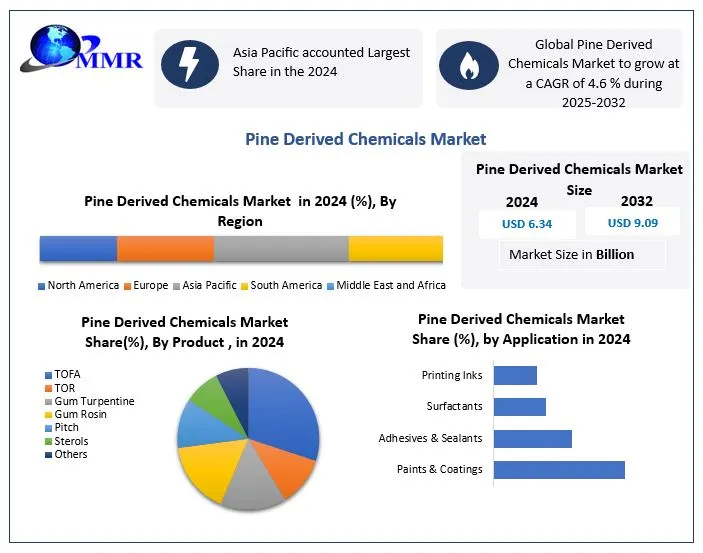
Market Valuation: USD 6.36 billion in 2025, projected to reach USD 9.44 billion by 2034.
Growth Trajectory: 4.5% CAGR over the 2025–2034 forecast period.
Dominant Process: Kraft pulping process, commanding approximately 62% of the market share.
Fastest-Growing Process: Tapping process, driven by rising demand for natural oleoresins.
Primary Application: Adhesives & Sealants, representing the largest end-use sector.
Why This Matters Now
The volatility of crude oil prices and the tightening of environmental regulations (such as Scope 3 carbon reduction mandates) have rendered traditional petrochemical-heavy supply chains increasingly vulnerable. Pine-derived chemicals offer a double advantage: they provide a renewable, circular alternative to fossil-based solvents and resins, and they often deliver superior technical performance in high-growth areas like sustainable adhesives and bio-based coatings. For industrial buyers, securing supply chains in the pine-chemical sector is now synonymous with securing long-term operational resilience against carbon-related regulatory costs.
Market Overview
The Pine-Derived Chemicals Market is currently undergoing a structural realignment. With a market size of USD 6.36 billion in 2025, the sector is increasingly integrated into the global pulp and paper value chain. By capturing the by-products of the Kraft process—specifically crude tall oil and turpentine—manufacturers are transforming what was once a waste-stream management challenge into a high-value chemical revenue stream. This evolution from “by-product management” to “value engineering” is the defining narrative of the market today.
Key Trends Driving Growth
Sustainability is no longer a marketing talking point; it is a balance-sheet necessity. Manufacturers are aggressively shifting toward bio-based chemicals to meet stringent emissions standards in the construction, automotive, and packaging sectors. The “green transition” in chemistry is accelerating the demand for tall oil fatty acids (TOFA) and rosin esters, which serve as essential building blocks for high-performance, non-toxic formulations.
Simultaneously, the industry is witnessing significant technological advancements in distillation and fractionation. These improvements are increasing the purity and consistency of pine-derived chemicals, allowing them to compete directly with their synthetic, petroleum-based counterparts in applications where quality standards are uncompromisingly high, such as pharmaceutical intermediaries and high-end fragrance bases.
Segment Insights
Dominant Process: Kraft Process. As the primary extraction method, the Kraft process generates large volumes of crude tall oil (CTO) and sulfate turpentine, ensuring a stable, large-scale feedstock base that is vital for industrial stability.
Fastest-Growing Process: Tapping Process. This method, which involves the extraction of oleoresin from living trees, is seeing rapid expansion as producers look to diversify their sourcing and meet specialized demand for gum rosin in high-end adhesive and printing ink markets.
Leading Application: Adhesives & Sealants. Representing the largest share of the market, this segment is driven by the consistent demand for high-temperature stable tackifiers and bio-based binding agents in the packaging and automotive assembly industries.
Regional Growth Story
Asia-Pacific currently holds the largest revenue share, a position cemented by the massive industrial footprint of China and India. The region’s focus on infrastructure development and expanding manufacturing bases requires vast quantities of adhesives, paints, and coatings, where pine-derived additives are increasingly standard. North America remains a center for innovation, with heavy investment in refining technologies that maximize the yield and utility of pine-based derivatives. Meanwhile, Europe is leading the regulatory charge, with aggressive carbon-neutrality goals forcing paint and coating companies to prioritize bio-based solvents, further incentivizing market development in the region.
Competitive Landscape
The market is characterized by a mix of forestry-linked conglomerates and specialty chemical players, including companies like Kraton Corporation, Ingevity, and Harima Chemicals Group. Strategic moves in this space—such as vertical integration between pulp mills and chemical refineries—signal a market shift where control over the raw material source is the ultimate competitive advantage. Companies are also prioritizing R&D partnerships to customize pine-based molecules for specific industrial uses, effectively creating a “moat” around their products by ensuring technical compatibility with customer manufacturing processes.
Recent Developments
Vertical Integration: Major players are securing long-term off-take agreements with paper and pulp manufacturers to guarantee feedstock volumes of crude tall oil.
Advanced Fractionation: New investments in distillation technology are increasing the output of high-purity sterols and tall oil pitch, allowing companies to enter high-margin pharmaceutical and lubricant markets.
Regional Sourcing Initiatives: Manufacturers are shortening supply chains by localizing extraction and refining operations to mitigate the logistical risks associated with global transport of biomass derivatives.
Strategic Implications
The strategic imperative for chemical buyers is clear: diversify away from exclusively petroleum-based portfolios. The pine-derived chemical market is one of the few areas where cost, performance, and sustainability converge. Procurement leaders must focus on long-term supplier relationships that go beyond spot-market pricing, as the availability of high-quality feedstocks like tall oil is finite and tied to the health of the broader pulp and paper industry.
Future Outlook
The pine-derived chemicals market is moving toward a future defined by high-value specialization rather than bulk commodity volume. The winners will be firms that master the chemistry of high-purity derivatives and successfully integrate these into the circular economy through proprietary, low-impact extraction technologies. Strategic resilience will depend on a company’s ability to navigate the complex relationship between forest management, pulp production cycles, and the growing demand for sustainable chemistry; those who control the feedstock will dictate the market’s pricing power for the next decade.
Analyst Perspective
“The pine-derived chemicals market is undergoing a transition from a secondary byproduct sector to a primary pillar of the bio-economy,” says Ankita Kagawade. “Companies that successfully bridge the gap between forestry-based extraction and advanced chemical engineering will capture the largest share of the value created by the global shift toward sustainable industrial feedstocks.”
About Maximize Market Research
Maximize Market Research Pvt. Ltd. (MMR) is a global market research and consulting company that provides reliable, data-focused, and practical business insights. The firm serves a wide range of industries, including healthcare, pharmaceuticals, technology, automotive, electronics, chemicals, personal care, and consumer goods. Through market forecasts, competitive analysis, strategic consulting, and industry impact assessments, MMR helps organizations understand changing market conditions, identify growth opportunities, and make informed business decisions for long-term success.
2nd Floor, Navale IT Park Phase 3
Pune Banglore Highway, Narhe
Pune, Maharashtra 411041, India
+91 9607365656
sales@maximizemarketresearch.com
