As industries increasingly prioritize speed, precision, and efficiency in packaging operations, cartoning machines have become an essential part of modern manufacturing and supply chain management. These automated systems streamline the process of forming, filling, and sealing cartons, enabling businesses to improve productivity while maintaining consistent packaging quality. With rising demand from the food and beverage, pharmaceutical, cosmetics, and consumer goods sectors, the Cartoning Machines Market is witnessing steady growth driven by automation, sustainability, and digital transformation.
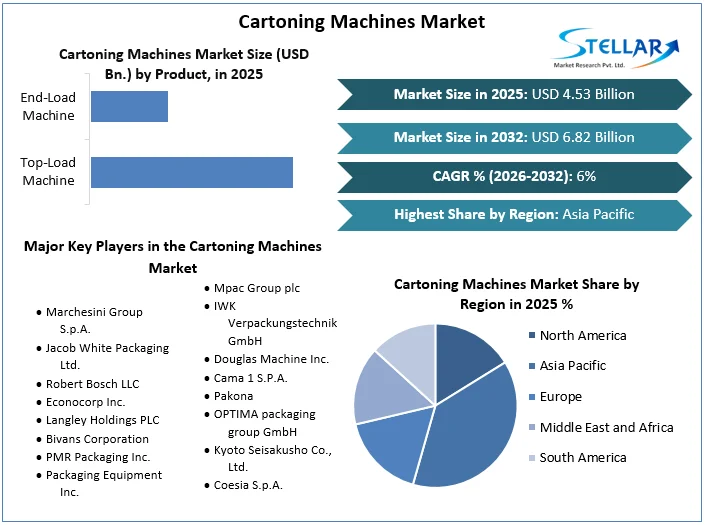
According to Stellar Market Research, the global Cartoning Machines Market was valued at US$ 4.53 Bn. in 2025 and is projected to reach US$ 14.18 billion by 2032, growing at a CAGR of 6% during the forecast period. Increasing investments in automated packaging lines, growing demand for sustainable packaging, and rapid expansion of e-commerce are expected to continue driving market growth over the next decade.
Download Free PDF Brochure: https://www.stellarmr.com/report/req_sample/Cartoning-Machines-Market/473
Understanding Cartoning Machines
Cartoning machines are automated packaging systems designed to erect cartons, insert products, and seal packages efficiently. These machines handle a wide variety of products ranging from pharmaceutical blister packs and cosmetic products to food items, beverages, household goods, and industrial components.
Modern cartoning equipment supports multiple packaging formats, enabling manufacturers to package products in tuck-in cartons, glued cartons, sleeve cartons, and customized retail packaging. Depending on production requirements, businesses can choose from horizontal, vertical, automatic, or semi-automatic cartoning machines.
The integration of robotics, intelligent sensors, servo-driven motion control, and programmable automation has significantly improved the flexibility, speed, and reliability of these systems.
Growing Demand for Packaging Automation
Automation remains the primary growth driver for the Cartoning Machines Market. Manufacturers are under constant pressure to increase production capacity while reducing operational costs and minimizing manual labor. Automated cartoning machines deliver consistent performance, reduce packaging errors, and improve production efficiency.
Industries such as pharmaceuticals and food processing require high-speed packaging operations that comply with stringent quality and safety standards. Automated cartoning systems ensure accurate product placement, secure carton sealing, and precise labeling while reducing the risk of contamination and product damage.
The increasing shortage of skilled labor in manufacturing facilities has also accelerated the adoption of automated packaging solutions capable of operating continuously with minimal human intervention.
Pharmaceutical Industry Driving Strong Demand
The pharmaceutical sector has emerged as one of the largest end users of cartoning machines. Growing production of prescription medicines, over-the-counter drugs, vaccines, and healthcare products has significantly increased demand for advanced packaging equipment.
Pharmaceutical manufacturers rely on cartoning machines to package blister packs, bottles, syringes, vials, and medical devices with high precision. Modern systems incorporate vision inspection technologies, barcode verification, serialization, and tamper-evident packaging features to comply with global pharmaceutical regulations.
As governments strengthen drug traceability requirements and patient safety regulations, pharmaceutical companies continue investing in intelligent cartoning systems that support regulatory compliance and production efficiency.
Sustainability Reshaping Packaging Operations
Sustainability has become a major priority across the global packaging industry. Consumers increasingly prefer environmentally friendly packaging solutions, encouraging manufacturers to adopt recyclable paperboard cartons and reduce plastic usage.
Cartoning machines support sustainability initiatives by optimizing carton dimensions, reducing packaging waste, minimizing material consumption, and improving energy efficiency. Advanced machine designs also reduce product rejection rates and improve production yields.
Manufacturers are increasingly designing equipment compatible with biodegradable, recyclable, and lightweight packaging materials, enabling companies to meet corporate sustainability goals while complying with evolving environmental regulations.
This transition toward sustainable packaging is expected to create long-term growth opportunities for cartoning machine manufacturers.
Smart Manufacturing and Digital Technologies
Industry 4.0 technologies are transforming the capabilities of modern cartoning machines. Intelligent packaging systems now integrate Industrial Internet of Things (IIoT), artificial intelligence, cloud connectivity, and predictive maintenance software.
Real-time machine monitoring allows operators to track production performance, detect equipment abnormalities, and optimize packaging efficiency. Predictive maintenance uses machine learning algorithms to identify potential component failures before they result in costly downtime.
Robotic product handling has further enhanced packaging accuracy while improving flexibility for manufacturers handling multiple product formats. Servo-driven systems provide faster changeovers, allowing production lines to adapt quickly to varying packaging requirements.
Digital twins and advanced analytics are also helping manufacturers simulate production processes, optimize machine performance, and improve overall equipment effectiveness.
Regional Market Insights
Europe currently dominates the Cartoning Machines Market due to its advanced packaging industry, strong pharmaceutical manufacturing base, and widespread adoption of automation technologies. Countries such as Germany, Italy, Switzerland, and France are home to leading packaging equipment manufacturers and continue investing in next-generation packaging solutions.
Asia Pacific is expected to witness the fastest market growth during the forecast period. Rapid industrialization, expanding pharmaceutical production, rising food processing activities, and increasing investments in automated manufacturing are driving demand across China, India, Japan, and Southeast Asia.
North America also represents a significant market supported by technological innovation, advanced manufacturing infrastructure, and strong demand from pharmaceutical and consumer goods companies. Increasing investments in smart factories and sustainable packaging solutions continue to accelerate equipment modernization across the region.
Latin America and the Middle East & Africa are gradually emerging as attractive markets due to expanding industrial production, improving packaging infrastructure, and growing consumer demand for packaged products.
Competitive Landscape
The Cartoning Machines Market remains highly competitive, with manufacturers focusing on technological innovation, automation, and customized packaging solutions. Companies are investing in robotics, AI-enabled inspection systems, digital connectivity, and sustainable machine designs to strengthen their market position.
Leading industry participants include Syntegon Technology, IMA Group, Marchesini Group, Mpac Group, Cama Group, Econocorp Inc., Jacob White Packaging, Omori Machinery, ROVEMA GmbH, and ADCO Manufacturing. These companies continue expanding their product portfolios through research and development, strategic partnerships, and global expansion initiatives.
The growing demand for flexible packaging equipment capable of handling multiple carton sizes and product formats is encouraging manufacturers to introduce modular and highly configurable cartoning solutions.
Download Free PDF Brochure: https://www.stellarmr.com/report/req_sample/Cartoning-Machines-Market/473
Future Outlook
The future of the Cartoning Machines Market looks promising as automation continues to reshape global manufacturing and packaging operations. Advances in robotics, artificial intelligence, machine vision, and predictive analytics will further improve packaging speed, flexibility, and operational efficiency.
Growing pharmaceutical production, expanding e-commerce, increasing demand for sustainable packaging, and the adoption of Industry 4.0 technologies will continue creating significant opportunities for equipment manufacturers. At the same time, stricter quality standards and regulatory requirements will encourage businesses to invest in intelligent packaging systems capable of delivering consistent performance.
Media Contact
Stellar Market Research
Website: http://stellarmr.com/
Email: sales@stellarmr.com
As manufacturers seek greater efficiency, reduced operational costs, and environmentally responsible packaging solutions, cartoning machines will remain a critical component of modern production lines. Their ability to support high-speed, accurate, and sustainable packaging processes will position them as an indispensable technology for the future of global manufacturing.
