Manufacturing industries worldwide are embracing intelligent quality inspection technologies to improve production efficiency, reduce operational costs, and maintain high product standards. As production lines become increasingly automated and customer expectations continue to rise, manufacturers are replacing traditional manual inspection methods with advanced defect detection systems powered by artificial intelligence (AI), machine vision, and industrial automation.
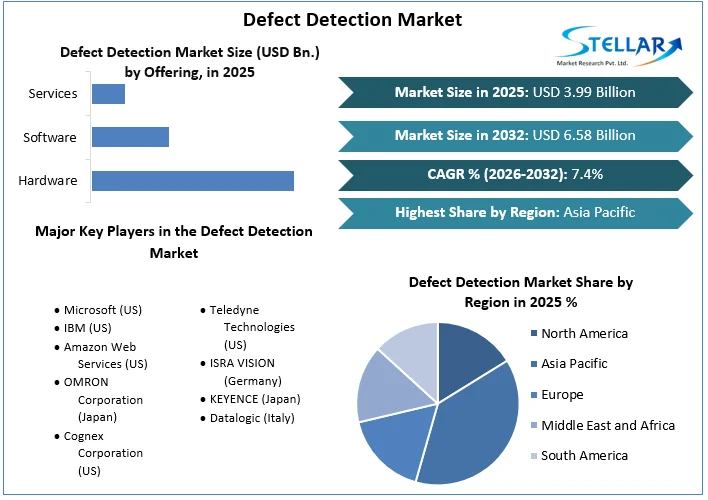
According to Stellar Market Research, the Defect Detection Market was valued at US$ 3.99 billion in 2025 and is projected to reach US$ 6.58 billion by 2032, growing at a CAGR of 7.4% during the forecast period. The market is gaining momentum as manufacturers across automotive, electronics, pharmaceuticals, food processing, and packaging industries invest in automated inspection systems to improve product quality, minimize waste, and enhance operational efficiency.
Why defect detection has become essential in modern manufacturing
Defect detection refers to the use of automated technologies that identify flaws, inconsistencies, or abnormalities during manufacturing processes. These systems use cameras, sensors, machine vision, AI algorithms, and data analytics to inspect products at high speed while maintaining exceptional accuracy.
Traditional quality inspection methods often rely on manual visual checks, which can be time-consuming, inconsistent, and prone to human error. Automated defect detection significantly improves inspection accuracy while enabling manufacturers to inspect every product without slowing production.
With industries adopting smart manufacturing and Industry 4.0 practices, defect detection has evolved into a strategic tool that not only improves product quality but also optimizes production performance and reduces operational costs.
Download Free PDF Brochure: https://www.stellarmr.com/report/req_sample/Defect-Detection-Market/452
Growing automation drives market expansion
One of the strongest growth drivers for the Defect Detection Market is the increasing adoption of factory automation. Manufacturers are integrating robotics, industrial IoT, and intelligent inspection systems to create highly efficient production environments capable of delivering consistent product quality.
Automated inspection systems continuously monitor manufacturing operations and immediately identify defects that could otherwise result in costly recalls or production delays. Early detection enables manufacturers to correct problems before defective products reach customers.
Industries operating high-speed production lines particularly benefit from automated defect detection because manual inspection cannot match the speed or consistency required in modern manufacturing environments. The increasing focus on lean manufacturing and operational excellence continues to accelerate investment in intelligent quality assurance technologies.
Artificial intelligence revolutionizes quality inspection
Artificial intelligence has become one of the most transformative technologies in defect detection. Modern AI-powered inspection platforms use deep learning algorithms to recognize complex defect patterns that traditional rule-based systems often fail to identify.
Machine learning models continuously improve inspection accuracy by learning from production data, allowing manufacturers to detect subtle surface imperfections, dimensional variations, missing components, and assembly defects with remarkable precision.
Unlike conventional systems that require predefined inspection rules, AI-based solutions can adapt to changing product designs and manufacturing conditions. This flexibility makes them especially valuable for industries producing complex products with multiple variants.
Edge computing further enhances AI inspection by processing image data directly on manufacturing equipment, reducing latency and enabling real-time decision-making without relying entirely on cloud infrastructure.
Manufacturing remains the leading application
Manufacturing represents the largest application segment within the Defect Detection Market due to the growing emphasis on product quality, production efficiency, and customer satisfaction. Automated inspection systems are widely deployed across assembly lines to identify defects quickly while minimizing production interruptions.
Automotive manufacturers utilize defect detection systems to inspect body panels, weld quality, engine components, and final vehicle assemblies. Electronics manufacturers depend on machine vision technologies to inspect printed circuit boards, semiconductors, connectors, and miniature components with exceptional accuracy.
Pharmaceutical companies employ defect detection solutions to inspect packaging integrity, tablet quality, labeling accuracy, and product traceability. Similarly, food and beverage manufacturers use automated inspection systems to detect contamination, packaging defects, and labeling inconsistencies while maintaining strict food safety standards.
Asia-Pacific emerges as a major growth engine
Asia-Pacific is expected to witness significant market growth due to rapid industrialization, expanding manufacturing capacity, and increasing investments in factory automation. Countries including China, India, Japan, and South Korea continue strengthening their manufacturing sectors through smart factory initiatives and digital transformation programs.
Government policies encouraging advanced manufacturing, including initiatives such as “Make in India,” are supporting investments in industrial automation and quality inspection technologies. Rising production of automobiles, electronics, consumer goods, and industrial equipment further contributes to regional market expansion.
North America and Europe also remain important markets due to widespread adoption of Industry 4.0 technologies, stringent quality regulations, and strong investments in AI-powered manufacturing solutions. Companies across these regions continue modernizing production facilities to improve competitiveness and meet evolving customer expectations.
Challenges influencing market growth
Despite promising growth prospects, several challenges continue affecting market adoption. The initial investment required for advanced defect detection systems can be significant, particularly for small and medium-sized manufacturers with limited automation budgets.
Another major challenge is the shortage of skilled professionals capable of implementing, operating, and maintaining sophisticated machine vision and AI inspection systems. Successful deployment often requires expertise in artificial intelligence, industrial automation, imaging technology, and data analytics.
Integration with existing production equipment can also present technical challenges, particularly in facilities operating older manufacturing infrastructure. However, ongoing technological advancements are making modern inspection platforms increasingly compatible with legacy production systems.
Innovation continues to create new opportunities
The future of the Defect Detection Market is closely tied to ongoing innovation in artificial intelligence, computer vision, robotics, and Industrial Internet of Things (IIoT) technologies. Manufacturers are increasingly adopting cloud-based inspection platforms that provide centralized monitoring across multiple production facilities while enabling predictive quality management.
Digital twins, advanced analytics, and real-time production monitoring are creating new opportunities for proactive quality control. Rather than simply identifying defective products, next-generation systems can predict potential quality issues before they occur, helping manufacturers optimize production processes and reduce waste.
Sustainability initiatives are also driving adoption. By minimizing defective products, reducing material waste, lowering energy consumption, and improving manufacturing efficiency, automated defect detection contributes to more environmentally responsible production practices.
Competitive Landscape
- Microsoft (US)
- IBM (US)
- Amazon Web Services (US)
- OMRON Corporation (Japan)
- Cognex Corporation (US)
- Teledyne Technologies (US)
- ISRA VISION (Germany)
- KEYENCE (Japan)
- Datalogic (Italy)
Download Free PDF Brochure: https://www.stellarmr.com/report/req_sample/Defect-Detection-Market/452
Future outlook
The Defect Detection Market is expected to experience sustained growth through 2032 as manufacturers continue investing in intelligent automation and digital quality management. The convergence of artificial intelligence, machine vision, edge computing, robotics, and Industrial Internet of Things technologies will further enhance inspection accuracy, production efficiency, and operational resilience.
As industries prioritize zero-defect manufacturing, regulatory compliance, and customer satisfaction, automated defect detection will become an indispensable component of modern production facilities. Companies that invest in AI-powered inspection technologies today will be better positioned to improve product quality, strengthen competitiveness, and support long-term sustainable manufacturing growth in an increasingly digital industrial landscape.
Media Contact
Stellar Market Research
Website: http://stellarmr.com/
Email: sales@stellarmr.com
