The growing need for national security, border surveillance, maritime monitoring, and airspace protection is accelerating investments in advanced surveillance radar systems worldwide. Governments are modernizing defense infrastructure to address evolving geopolitical challenges, while commercial sectors are increasingly adopting radar technologies for airport security, critical infrastructure protection, and maritime safety. The integration of artificial intelligence (AI), digital signal processing, and active electronically scanned array (AESA) technologies is transforming surveillance radars into intelligent systems capable of detecting and tracking multiple targets with greater accuracy and speed.
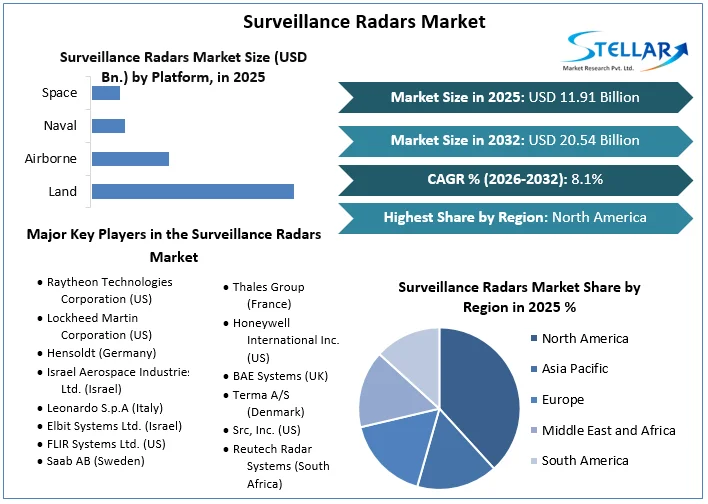
According to Stellar Market Research, the Surveillance Radars Market was valued at US$ 11.91 billion in 2025 and is projected to reach US$ 20.54 billion by 2032, expanding at a CAGR of 8.1% during the forecast period. The market is witnessing strong growth as defense modernization programs, increasing military expenditures, and advancements in radar technology continue to drive global demand.
Download Free PDF Brochure: https://www.stellarmr.com/report/req_sample/Surveillance-Radars-Market/456
Growing security concerns drive demand for advanced radar systems
Surveillance radars play a critical role in monitoring air, land, and maritime environments by detecting, tracking, and identifying potential threats over long distances. These systems are widely deployed across military installations, border security agencies, airports, naval fleets, and coastal surveillance networks.
Increasing geopolitical tensions, cross-border security challenges, illegal trafficking, and unauthorized drone activities have encouraged governments to strengthen surveillance capabilities. Modern radar systems enable continuous monitoring in all weather conditions, providing real-time situational awareness that supports rapid response and effective decision-making.
In addition to defense applications, surveillance radars are increasingly used in civil aviation, maritime navigation, disaster management, and critical infrastructure protection, expanding the market beyond traditional military use.
Defense modernization accelerates market growth
One of the primary growth drivers for the Surveillance Radars Market is the ongoing modernization of defense equipment worldwide. Governments are investing heavily in next-generation radar technologies to improve early warning capabilities, missile defense systems, battlefield surveillance, and integrated command-and-control operations.
Many countries are replacing aging radar infrastructure with digitally enabled systems capable of detecting stealth aircraft, unmanned aerial vehicles (UAVs), hypersonic threats, and low-observable targets. These upgrades enhance national defense readiness while improving interoperability across military platforms.
Growing procurement of advanced fighter aircraft, naval vessels, and integrated air defense systems further supports demand for high-performance surveillance radars equipped with sophisticated tracking and target classification capabilities.
Artificial intelligence transforms surveillance capabilities
Artificial intelligence is rapidly changing how surveillance radars operate. Traditional radar systems primarily detect and display objects, whereas AI-powered radars analyze large volumes of sensor data in real time to identify threats, classify targets, and reduce false alarms.
Machine learning algorithms continuously improve detection accuracy by recognizing complex movement patterns and distinguishing genuine threats from environmental noise. These intelligent capabilities significantly enhance operational efficiency while reducing the workload on defense personnel.
Advanced digital signal processing, sensor fusion, and edge computing technologies further improve radar performance by enabling faster data analysis and seamless integration with satellite systems, drones, and command centers.
The growing adoption of Active Electronically Scanned Array (AESA) radar technology is another major trend. AESA systems provide higher reliability, greater tracking precision, faster beam steering, and improved resistance to electronic warfare compared with conventional mechanically scanned radars.
Airborne and naval applications create new opportunities
While land-based surveillance systems continue to dominate deployments, airborne and naval radar platforms are experiencing strong growth due to increasing investments in maritime security and aerial surveillance.
Modern naval forces require advanced radar systems capable of tracking multiple airborne and surface threats simultaneously. Likewise, airborne surveillance aircraft and unmanned aerial vehicles rely on lightweight, high-performance radar technologies for intelligence gathering, reconnaissance missions, and border monitoring.
Commercial aviation also benefits from surveillance radar technologies that improve air traffic management, airport safety, and aircraft tracking, contributing to broader market expansion beyond defense applications.
North America leads while Asia-Pacific records rapid growth
North America remains the largest regional market due to substantial defense spending, continuous investments in advanced military technologies, and the presence of leading radar manufacturers. The United States continues to invest heavily in integrated air and missile defense systems, homeland security, and next-generation surveillance capabilities, reinforcing regional leadership.
Asia-Pacific is expected to witness the fastest growth throughout the forecast period. Countries such as China, India, Japan, South Korea, and Australia are increasing defense budgets to strengthen border protection, maritime surveillance, and regional security. Expanding indigenous defense manufacturing capabilities and government initiatives supporting military modernization further accelerate regional demand.
Europe also remains an important market, with NATO modernization initiatives, increased defense cooperation, and investments in integrated surveillance networks supporting long-term growth.
Challenges facing the market
Despite strong growth prospects, several factors continue to influence market expansion. Advanced surveillance radar systems require substantial investment in research, development, manufacturing, and maintenance, making procurement costly for many developing nations.
Cybersecurity has become another important consideration as modern radar systems become increasingly connected to digital defense networks. Protecting sensitive operational data from cyber threats requires continuous investment in secure communication infrastructure.
Export regulations, technology transfer restrictions, and long procurement cycles also create challenges for manufacturers seeking to expand internationally.
Download Free PDF Brochure: https://www.stellarmr.com/report/req_sample/Surveillance-Radars-Market/456
Competitive Landscape
- Raytheon Technologies Corporation (US)
- Lockheed Martin Corporation (US)
- Hensoldt (Germany)
- Israel Aerospace Industries Ltd. (Israel)
- Leonardo S.p.A (Italy)
- Elbit Systems Ltd. (Israel)
- FLIR Systems Ltd. (US)
- Saab AB (Sweden)
- Thales Group (France)
Future outlook
The future of the Surveillance Radars Market remains highly promising as governments continue prioritizing national security and technological superiority. Artificial intelligence, machine learning, digital signal processing, software-defined radar architectures, and multi-domain surveillance capabilities will define the next generation of radar systems.
Growing investments in autonomous defense platforms, space-based surveillance, unmanned systems, and integrated battlefield management will further increase demand for intelligent radar solutions capable of delivering real-time situational awareness across complex operational environments.
As defense organizations focus on interoperability, precision detection, and network-centric warfare, surveillance radar technologies will remain indispensable for safeguarding national security and protecting critical infrastructure. Manufacturers that invest in AI-enabled innovation, advanced sensor technologies, and scalable digital architectures will be well positioned to capitalize on the market’s sustained growth through 2032.
Media Contact
Stellar Market Research
Website: http://stellarmr.com/
Email: sales@stellarmr.com
