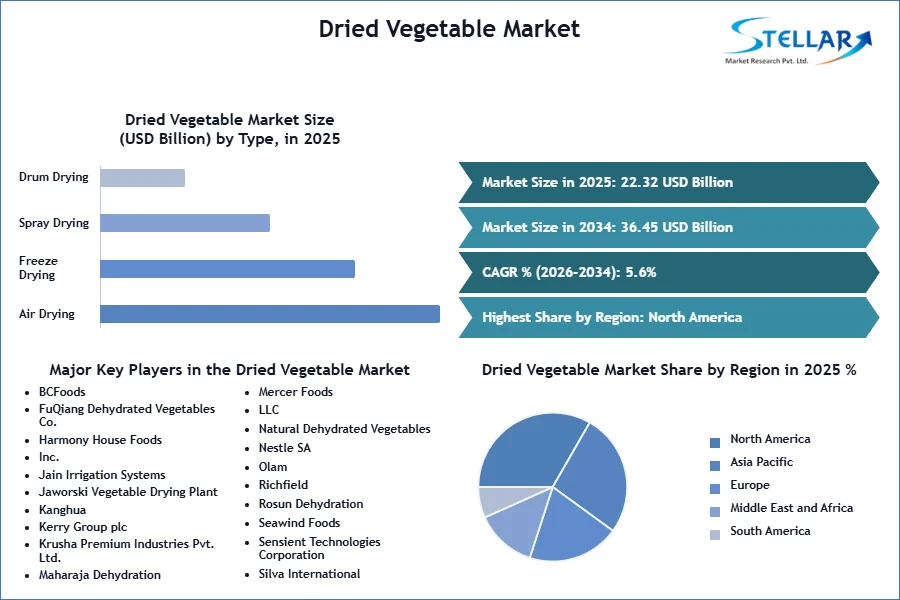
The Dried Vegetable Market has become an essential segment of the global food industry, supported by changing consumer lifestyles, rising urbanization, and the growing popularity of ready-to-cook and ready-to-eat meals. Dried vegetables are produced by removing moisture through techniques such as air drying, freeze drying, drum drying, spray drying, and vacuum drying. This process helps preserve flavor, color, texture, and nutritional value while significantly extending shelf life.
Food manufacturers, restaurants, catering companies, and households increasingly use dried vegetables because they are easy to store, transport, and incorporate into a wide range of food products. As consumers seek healthier and more convenient meal solutions, demand for premium-quality dried vegetables continues to rise.
Growing Demand for Convenience Foods Drives Market Growth
One of the primary drivers of the Dried Vegetable Market is the increasing consumption of convenience foods. Busy lifestyles and higher workforce participation have encouraged consumers to choose products that reduce meal preparation time without compromising quality.
Dried vegetables are widely used in:
Instant soups
Ready-to-eat meals
Instant noodles
Pasta dishes
Frozen foods
Snack products
Seasoning blends
Foodservice and catering
Their long shelf life and ease of use make them valuable ingredients for food manufacturers worldwide.
𝐃𝐨𝐰𝐧𝐥𝐨𝐚𝐝 𝐅𝐫𝐞𝐞 𝐏𝐃𝐅 𝐁𝐫𝐨𝐜𝐡𝐮𝐫𝐞: https://www.stellarmr.com/report/req_sample/Dried-Vegetable-Market/1365
Rising Focus on Healthy Eating Expands Consumer Demand
Health-conscious consumers are increasingly looking for food products made with natural ingredients and minimal preservatives. Modern drying technologies help retain essential nutrients while offering a practical alternative to fresh vegetables.
Key advantages include:
Extended shelf life
Reduced food waste
Easy storage and transportation
Convenient meal preparation
Lightweight packaging
Year-round product availability
Retention of essential nutrients
Minimal use of preservatives
These benefits are encouraging wider adoption across households and commercial kitchens.
Technological Advancements Improve Product Quality
Continuous innovation in food processing technologies is enhancing the quality, safety, and nutritional value of dried vegetables.
Major technological developments include:
Freeze-drying technology
Vacuum drying systems
Air drying processes
Infrared drying
Microwave-assisted drying
Automated quality inspection
Smart moisture monitoring
Energy-efficient drying equipment
These technologies improve product consistency while preserving natural taste, texture, and color.
Expanding Food Processing Industry Supports Market Growth
The global food processing industry continues to create significant opportunities for the Dried Vegetable Market. Manufacturers increasingly incorporate dried vegetables into packaged foods to improve convenience and maintain product quality.
Key application industries include:
Food manufacturing
Bakery products
Snack foods
Sauces and seasonings
Meat processing
Baby food
Pet food
Nutritional supplements
Growing demand for functional and value-added food products further supports market expansion.
𝐃𝐨𝐰𝐧𝐥𝐨𝐚𝐝 𝐅𝐫𝐞𝐞 𝐏𝐃𝐅 𝐁𝐫𝐨𝐜𝐡𝐮𝐫𝐞: https://www.stellarmr.com/report/req_sample/Dried-Vegetable-Market/1365
Sustainable Food Preservation Encourages Innovation
Sustainability is becoming a major focus across the food industry. Drying vegetables helps reduce post-harvest losses, minimize food waste, and improve supply chain efficiency.
Industry initiatives include:
Energy-efficient drying technologies
Sustainable packaging solutions
Reduced food waste
Renewable energy integration
Eco-friendly processing methods
Responsible sourcing practices
Circular economy initiatives
Supply chain optimization
These efforts support both environmental sustainability and long-term business growth.
Regional Market Insights
Asia Pacific
Asia Pacific dominates the Dried Vegetable Market, driven by large agricultural production, expanding food processing industries, increasing exports, and rising demand for convenience foods in countries such as China, India, Japan, and South Korea.
North America
North America continues to experience strong market growth due to increasing consumption of packaged foods, rising health awareness, and growing demand for clean-label ingredients and ready-to-cook meal solutions.
Europe
Europe remains a significant market, supported by demand for premium food ingredients, sustainable food processing, and growing consumption of organic and minimally processed food products.
Latin America, Middle East, and Africa
These regions are witnessing gradual growth due to expanding food manufacturing capacity, urbanization, and improving retail distribution networks.
Competitive Landscape
The Dried Vegetable Market is highly competitive, with food ingredient manufacturers, agricultural processors, and packaged food companies investing in innovation and production efficiency.
Major competitive strategies include:
Product portfolio expansion
Organic product development
Advanced drying technologies
Sustainable sourcing
Strategic partnerships
Export market expansion
Packaging innovation
Research and development investments
Manufacturers continue focusing on delivering high-quality, nutritious, and convenient food ingredients to meet evolving consumer expectations.
Emerging Opportunities
Several trends are expected to shape future market growth:
Organic dried vegetables
Freeze-dried premium products
Clean-label food ingredients
Functional food formulations
Plant-based meal solutions
Smart food processing technologies
Sustainable packaging innovations
AI-powered quality control systems
These developments are expected to strengthen market competitiveness while expanding product applications.
Future Outlook
The future of the Dried Vegetable Market remains highly promising as consumers increasingly seek nutritious, convenient, and sustainable food products. Continued investments in food processing technologies, supply chain modernization, and product innovation will support long-term market expansion.
Companies that prioritize quality, food safety, sustainable production, and innovative processing methods will be well positioned to capitalize on the growing global demand for dried vegetable products.
Conclusion
The Dried Vegetable Market is playing a vital role in supporting the global food industry by providing shelf-stable, nutritious, and versatile ingredients for a wide range of applications. Growing demand for convenience foods, healthier eating habits, and sustainable food preservation is creating significant opportunities for producers and food manufacturers.
As consumer preferences continue to shift toward high-quality, natural, and easy-to-prepare food products, the Dried Vegetable Market is expected to witness sustained long-term growth, benefiting agricultural producers, food processors, retailers, ingredient suppliers, and investors.
