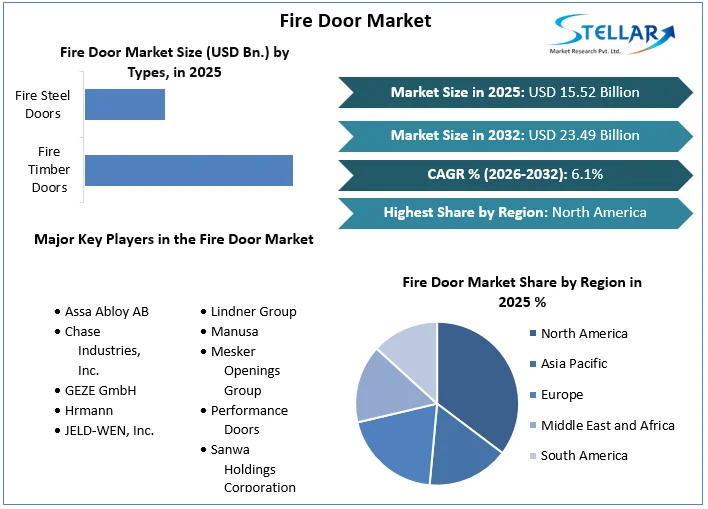
The Fire Door Market has become a vital component of modern building infrastructure, providing passive fire protection that helps contain the spread of fire and smoke during emergencies. Fire doors are specially designed and tested to withstand fire for a specified period, allowing occupants additional time to evacuate while helping emergency responders control fire incidents more effectively. They are widely installed across residential buildings, commercial complexes, industrial facilities, healthcare institutions, educational campuses, hospitality establishments, and public infrastructure.
With governments strengthening building codes and developers prioritizing occupant safety, demand for high-performance fire door systems continues to rise. Innovations in fire-resistant materials, smart monitoring technologies, and sustainable construction practices are further shaping the future of the market.
Stringent Fire Safety Regulations Drive Market Growth
One of the primary drivers of the Fire Door Market is the implementation of stricter fire safety regulations and building codes across developed and emerging economies. Regulatory authorities increasingly require certified fire-rated doors in new construction projects and building renovations.
Fire doors are commonly installed in:
Residential buildings
Commercial offices
Hospitals and healthcare facilities
Educational institutions
Hotels and hospitality properties
Manufacturing plants
Warehouses and logistics centers
Transportation infrastructure
Their ability to compartmentalize fire and smoke significantly enhances overall building safety.
𝐃𝐨𝐰𝐧𝐥𝐨𝐚𝐝 𝐅𝐫𝐞𝐞 𝐏𝐃𝐅 𝐁𝐫𝐨𝐜𝐡𝐮𝐫𝐞: https://www.stellarmr.com/report/req_sample/Fire-Door-Market/1372
Expanding Construction Industry Creates Strong Demand
Rapid urbanization and infrastructure development are increasing the need for advanced fire protection systems in both new and existing buildings.
Major growth drivers include:
High-rise residential construction
Commercial real estate development
Smart city projects
Industrial facility expansion
Healthcare infrastructure investments
Educational campus development
Airport and railway construction
Public infrastructure modernization
As construction activity expands worldwide, fire doors remain an essential element of building safety compliance.
Technological Advancements Improve Product Performance
Manufacturers are continuously developing advanced fire door solutions that combine safety, durability, aesthetics, and operational efficiency.
Key innovations include:
Steel fire doors
Timber fire doors
Glass fire-rated doors
Composite fire doors
Acoustic fire doors
Smoke-control door systems
Automated fire door closers
Smart fire monitoring systems
These products provide improved fire resistance while meeting architectural and design requirements.
𝐃𝐨𝐰𝐧𝐥𝐨𝐚𝐝 𝐅𝐫𝐞𝐞 𝐏𝐃𝐅 𝐁𝐫𝐨𝐜𝐡𝐮𝐫𝐞: https://www.stellarmr.com/report/req_sample/Fire-Door-Market/1372
Smart Building Integration Expands Market Opportunities
The growing adoption of smart buildings is creating new opportunities for intelligent fire protection systems. Modern fire doors can be integrated with building management systems to improve emergency response capabilities.
Emerging smart features include:
IoT-enabled monitoring
Automatic door release systems
Fire alarm integration
Remote status monitoring
Predictive maintenance alerts
Access control integration
AI-assisted building safety management
Digital inspection records
These technologies enhance building safety while simplifying maintenance and compliance.
Sustainability Influences Product Innovation
Environmental sustainability is becoming increasingly important in the construction sector. Fire door manufacturers are developing products that meet both safety and sustainability objectives.
Industry initiatives include:
Recyclable construction materials
Low-emission manufacturing processes
Sustainably sourced timber
Energy-efficient production methods
Eco-friendly coatings
Durable long-life product designs
Green building certification compatibility
Circular economy manufacturing practices
These developments support environmentally responsible construction while maintaining high safety standards.
Regional Market Insights
North America
North America holds a significant share of the Fire Door Market, supported by stringent building regulations, mature construction industries, growing commercial infrastructure, and widespread adoption of advanced fire protection technologies.
Europe
Europe remains a major market due to comprehensive fire safety standards, increasing renovation activities, and strong demand for certified fire-resistant building materials.
Asia Pacific
Asia Pacific is projected to register the fastest growth, driven by rapid urbanization, expanding infrastructure projects, rising investments in commercial real estate, and stricter enforcement of building safety regulations in countries such as China, India, Japan, and South Korea.
Middle East, Africa, and Latin America
These regions are witnessing increasing demand as governments invest in infrastructure development, hospitality projects, healthcare facilities, and public safety improvements.
Competitive Landscape
The Fire Door Market is highly competitive, with construction material manufacturers, fire protection solution providers, and building safety companies investing in innovation and product development.
Major competitive strategies include:
Development of advanced fire-resistant materials
Smart fire door technologies
Product certification and compliance
Manufacturing capacity expansion
Strategic partnerships
Sustainable product innovation
Geographic market expansion
Research and development investments
Manufacturers continue focusing on enhancing fire resistance, durability, aesthetics, and ease of installation.
Emerging Opportunities
Several trends are expected to shape future market growth:
AI-enabled building safety systems
IoT-connected fire protection solutions
Smart commercial buildings
Sustainable construction materials
Modular building technologies
Digital compliance management
High-performance composite fire doors
Automated inspection and maintenance systems
These innovations are expected to improve fire safety while supporting the evolution of intelligent building infrastructure.
Future Outlook
The future of the Fire Door Market remains highly promising as governments strengthen fire safety regulations, urban development accelerates, and smart building adoption increases. Advances in fire-resistant materials, digital monitoring technologies, and sustainable manufacturing will continue to support long-term market growth.
Companies that prioritize product quality, regulatory compliance, technological innovation, and environmentally responsible manufacturing will be well positioned to capitalize on expanding opportunities across residential, commercial, and industrial construction sectors.
Conclusion
The Fire Door Market plays a critical role in protecting lives and property by providing effective passive fire protection across modern buildings. Rising construction activities, stricter safety regulations, technological innovation, and growing awareness of fire prevention are creating substantial opportunities for manufacturers and construction stakeholders.
As global infrastructure development continues and building safety standards become increasingly rigorous, the Fire Door Market is expected to witness sustained long-term growth, benefiting construction companies, architects, fire protection specialists, facility managers, and investors.
